


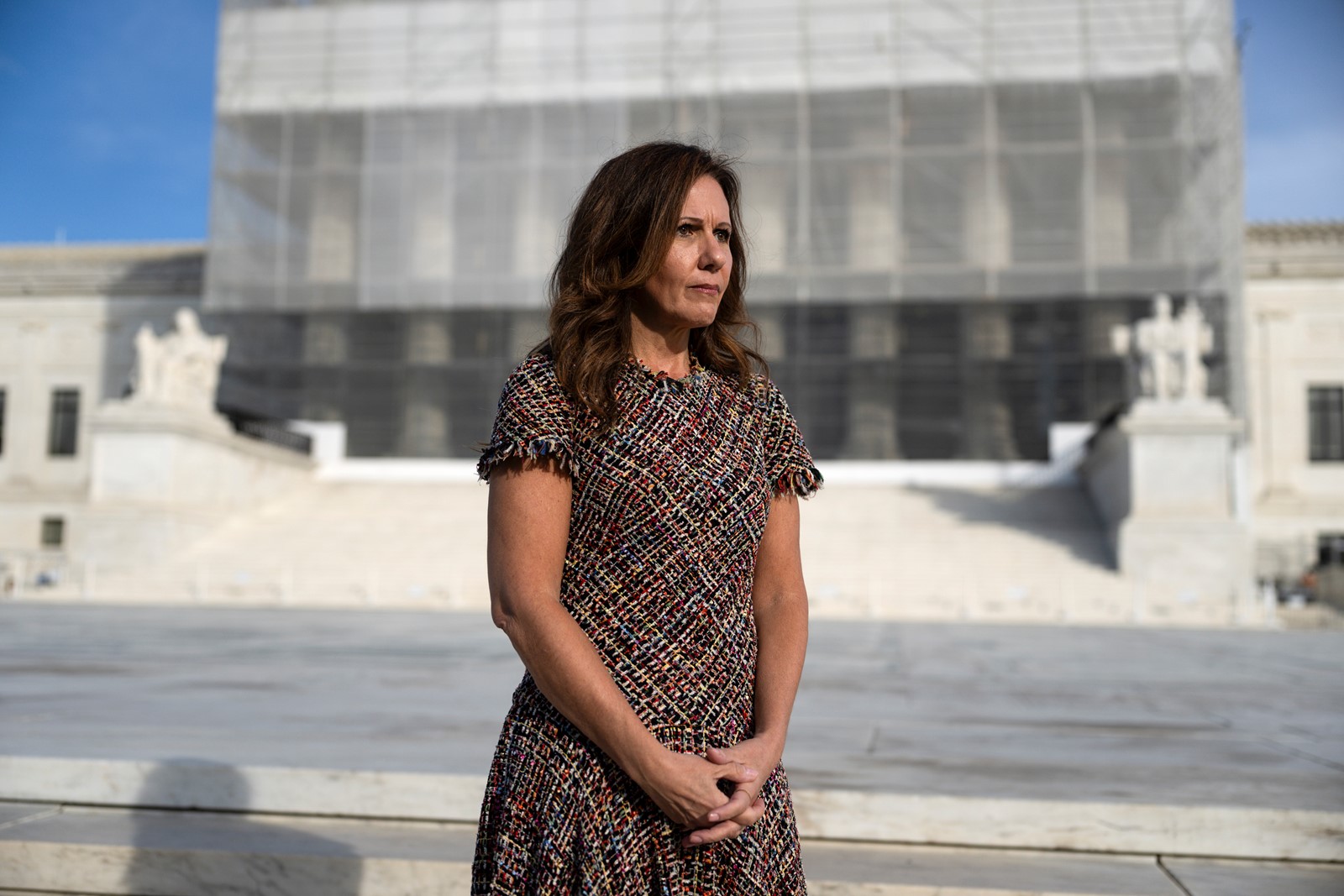


WASHINGTON>> A framed portrait of President Ronald Reagan hangs in a prominent spot next to Sara Albrecht’s computer, his face depicted in shades of purple. To Albrecht, a lifelong Republican, the blend of blue and red has come to symbolize the ideologically diverse coalition challenging the Trump administration’s signature economic policy at the Supreme Court today.
Albrecht voted three times for President Donald Trump, but the right-leaning legal organization she heads is now leading the challenge to his sweeping tariffs, representing the coalition of businesses that has sued over the legality of the policy. The role of her group, the Liberty Justice Center, underscores just how much the tariff issue has divided conservatives.
Until now, the group was best known for its success at the Supreme Court in 2018, when it brought a case that resulted in the justices’ ruling that public-sector workers could not be required to pay collective bargaining fees. The case was a major blow to labor unions that had raised millions from the fees.
The public-interest law firm has doubled in size since then. Incorporated in Texas, it employs 11 lawyers engaged in litigation in 36 states and has an operating budget of about $3 million. The group has filed nearly 140 lawsuits since 2011.
Its recent cases include challenges to the alleged use of race-based criteria in graduate school admissions and in university hiring practices. The group also has fought policies that prohibit schools from sharing information with parents about their child’s gender identity.
Albrecht said the group had been exploring filing cases that challenged what it considered executive branch overreach when Trump first invoked an emergency statute from the 1970s to unilaterally impose the taxes on imported goods in February.
The Liberty Justice Center then joined forces with a law professor to recruit five small businesses to act as plaintiffs in the case, which will be heard by the court Wednesday.
“We knew the businesses were going to have to represent all of America’s small businesses,” Albrecht said, “and we really needed an easy story to tell.”
The companies include a wine importer, a manufacturer of educational electronic kits, a women’s biking apparel business, a plastic pipe maker and an outfit that sells specialty fishing tackle. In interviews, they said that they relied on imported goods from 27 countries, and that the tariffs were responsible for their raising prices on consumers and cutting back on staffing.
“I can call my mom and in 30 seconds she understands what the case is about,” Albrecht said.To argue the case, the center enlisted two veteran Supreme Court advocates, one conservative, the other liberal. Working together are Michael W. McConnell, a former federal appeals court judge nominated by President George W. Bush and Neal Katyal, a former acting solicitor general during President Barack Obama’s tenure. Katyal will be the one to appear before the justices, after winning a coin toss with a lawyer representing another business before the court on Wednesday.
Backed by prominent lawyers and constitutional law scholars from across the ideological spectrum, the coalition says Trump exceeded his authority when he became the first president to use the International Emergency Economic Powers Act of 1977 to impose tariffs on imported goods from nearly all of the United States’ major trading partners.
The administration counters that Congress intentionally devised a broad statute to give presidents the flexibility to respond to emergencies involving other countries and that courts should not second-guess such decisions by the White House.
The nonprofit Liberty Justice Center was founded in 2011 to oppose organized labor and government overreach in Illinois. At that time, the group worked closely with the Illinois Policy Center, a libertarian-leaning policy group, to limit the power of public-sector unions, a longtime goal of conservative groups. The organizations received financial support from Richard Uihlein, an Illinois industrialist who has spent millions to elect Republican officials.
An unexpected turn at the Supreme Court in 2016 catapulted the group onto the national stage. The justices seemed poised that year to rule that public union fees were unconstitutional. But Justice Antonin Scalia died after the case was argued, and it ended without resolution in a 4-4 deadlock.
The Liberty Justice Center, along with the National Right to Work Legal Defense Foundation, had filed a separate case on behalf of an Illinois state employee, Mark Janus, who opposed having to pay fees to a union whose positions he disagreed with.
After hearing the Liberty Justice Center’s case, the court ruled by a 5-4 vote that government workers who choose not to join a union could not be required to help pay for collective bargaining.
From there, the center broadened its reach, challenging the Biden administration’s coronavirus vaccine mandates and representing a group of conservative bloggers who sued over a federal law banning TikTok.
In February, the day after Trump announced an initial set of import taxes on China, Canada and Mexico, Ilya Somin, a law professor at the Antonin Scalia Law School at George Mason, wrote in a blog post that businesses should challenge the president’s novel use of the emergency statute.
The Constitution gives Congress, not the president, the power to regulate commerce with foreign nations, Somin said.
At the time, the Liberty Justice Center was having trouble finding businesses that were willing to sue.
“When you sue the government and you’re regulated by the government, it’s not unusual that you would be a little concerned,” said Jeffrey M. Schwab, the group’s senior counsel.
After the president announced an expanded set of tariffs in April, Somin posted again, this time with a more direct appeal on behalf of Schwab.
“The company doesn’t have to be considered a small business, but since I suspect many small businesses will be disproportionately harmed by the tariffs, that may be an ideal plaintiff,” he wrote. A business that “directly imports goods would be ideal because it would make it easier to get standing.”
This time, it worked, and the center’s phones and email inbox lit up. Soon, the group was whittling down a long list of contenders.
Albrecht said her family had loudly debated politics in the living room when she was growing up on a corn and cattle farm in Iowa. She traces her affection for Reagan to her grandparents, and noted that the former president had denounced tariffs.
“I thought the Republicans were against tariffs,” Schwab said. “It never really occurred to me that this would be an issue that I would be fighting a Republican president on.”
But the group insists its court fight is not about Trump.
“It’s about the presidency, not about the president, and it’s about the Constitution,” Albrecht said. “We’ve made it about the separation of powers, and that applies to everybody, whether you voted for him or not.”
 PREVIOUS ARTICLE

