


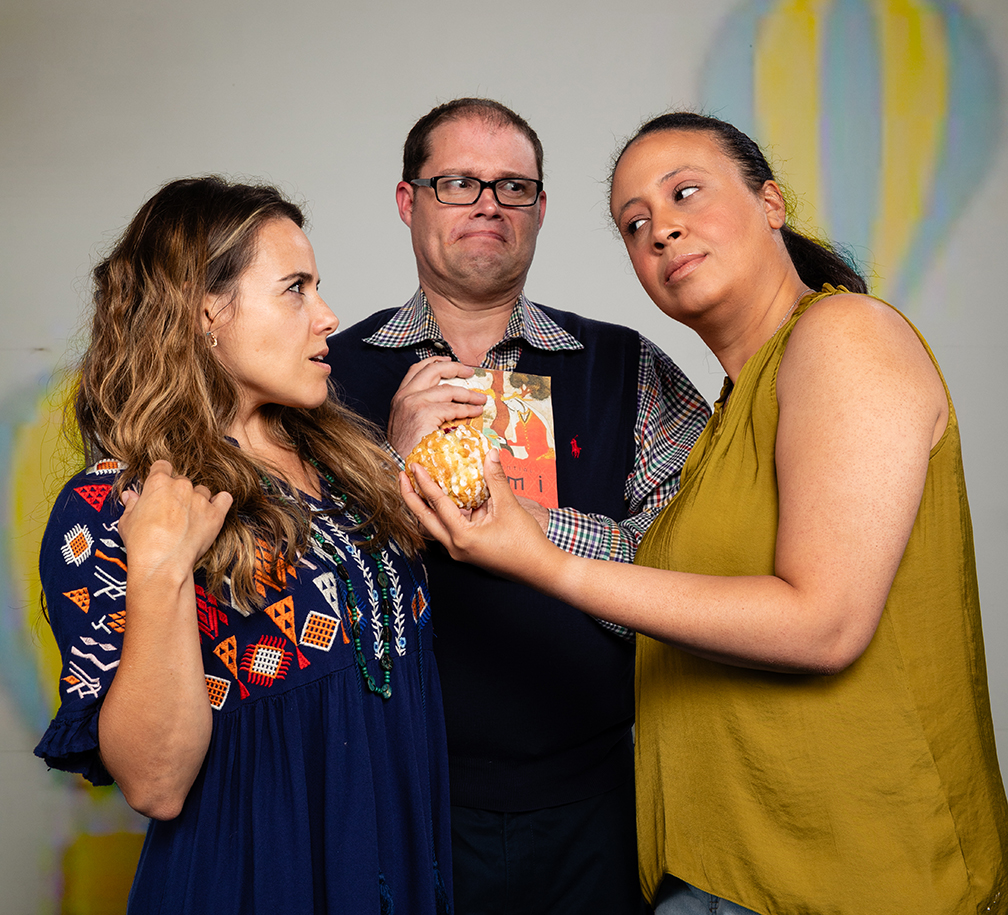


Last Tuesday, I travelled down to Mill Valley to catch the opening night of Marin Theatre’s new production: the Tony nominated, vaccine-focused comedy-drama “Eureka Day,” written by Oakland playwright Johnathan Spector.
I liked it. It made me laugh, and it made me think.
It also made me remember it’s time to get my flu shot.
To tell the truth, I liked “Eureka Day” so much I’m planning to see it again in Healdsburg.
As it so happens, The Raven Players are about to open their very own production of the show, running September 6-21 at the Raven Performing Arts Theater.
Different cast. Different director. Same play.
For entertainment-obsessed folks like me, if we play it right when such things happen, we have the opportunity to see two “Eureka Day” productions back-to-back, maybe even in the same weekend. And if we really get our ducks in a row, we might even get to see both performances on the same day. In this case, that can only happen on Saturday, Sept. 20, when there is a 2 p.m. matinee in Mill Valley, followed by 7:30 p.m. show in Healdsburg, with plenty of time in between for a drive and a nice dinner out.
Does such a thing sound outrageous, over-achieving, impossible, weird? It’s really not.
Baseball fans have always recognized the appeal of a good “double header,” one of those magical days where fans get to watch a ballgame, take a little break, then watch a completely different ballgame.
Remembering double features
Remember double features at the movies? Repertory houses like Petaluma’s legendary Plaza Theatre knew how enticing it was to pair two similar films together, as in 1981 when I watched Steve McQueen’s 1963 WWII prison camp film “The Great Escape” back-to-back with Sylvester Stallone’s 1981 “Escape to Victory,” and later on when I saw Lily Tomlin’s 1981 “The Incredible Shrinking Woman” on the same bill as its black-and-white 1957 predecessor “The Incredible Shrinking Man.”
How the Plaza missed screening Blake Edwards’ “The Pink Panther” along with John Waters’ “Pink Flamingos” I can only guess.
The thing is, by coupling together viewings of a play or a movie or a baseball game, we can expand a run-of-the-mill experience into something even more fun, more interesting, sometimes even enlightening.
Years ago, in 1990, in preparation for seeing Francis Ford Coppola’s “Godfather Part 3” at the Cinema Theater in Corte Madera, I joined my brother Jef and his girlfriend Lora to watch the first two films in the series. In between the films, we cooked up a homemade spaghetti dinner using the same pasta sauce recipe that Clemenza teaches Michael Corleone in the original movie.
And yes, we used Clemenza’s “sugar trick.” It was delicious.
Sometime later, I attended a party, of sorts, at the home of two friends. Around 25 people, all Shakespeare fans — or the invited guests of Shakespeare fans — gathered to watch Lawrence Olivier’s 1944 film adaptation of “Henry V” followed by Kenneth Branagh’s 1989 “Henry V.” As with the “Godfather” marathon, we had dinner in between, and a very spirited conversation afterwards about which film captured the true essence of Shakespeare’s play.
Now admittedly, while absorbing back-to-back Hank Five’s might sound oppressively intellectual to some, I should probably add that I brought a date that night, and we’re married now — so all of that iambic pentameter clearly wasn’t a turnoff.
Comparing and contrasting, for fun
It’s hard to say what the attraction is to such cultural compare-and-contrast events.
Why was “Barbenheimer” such a big thing two years ago? Literally millions of people accepted what was initially posed as a “challenge,” to see “Barbie” and “Oppenheimer” in the same day, and they obviously had a blast. What might have been two major movie studio releases canceling each other out, dividing the box office into two, instead became a massive cultural phenomenon, racking in the bucks as folks ignored the question of whether they’d attempt seeing both films one-after-the-other, and instead just figuring out which one they were going to see first.
In the case of the two simultaneous productions of “Eureka Day,” a play about a Bay Area private school in 2018 dealing with a mumps outbreak and how to handle it, there’s just something fun about the idea of seeing both close together — out of sheer curiosity if not as an act of support for hard-working theater artists.
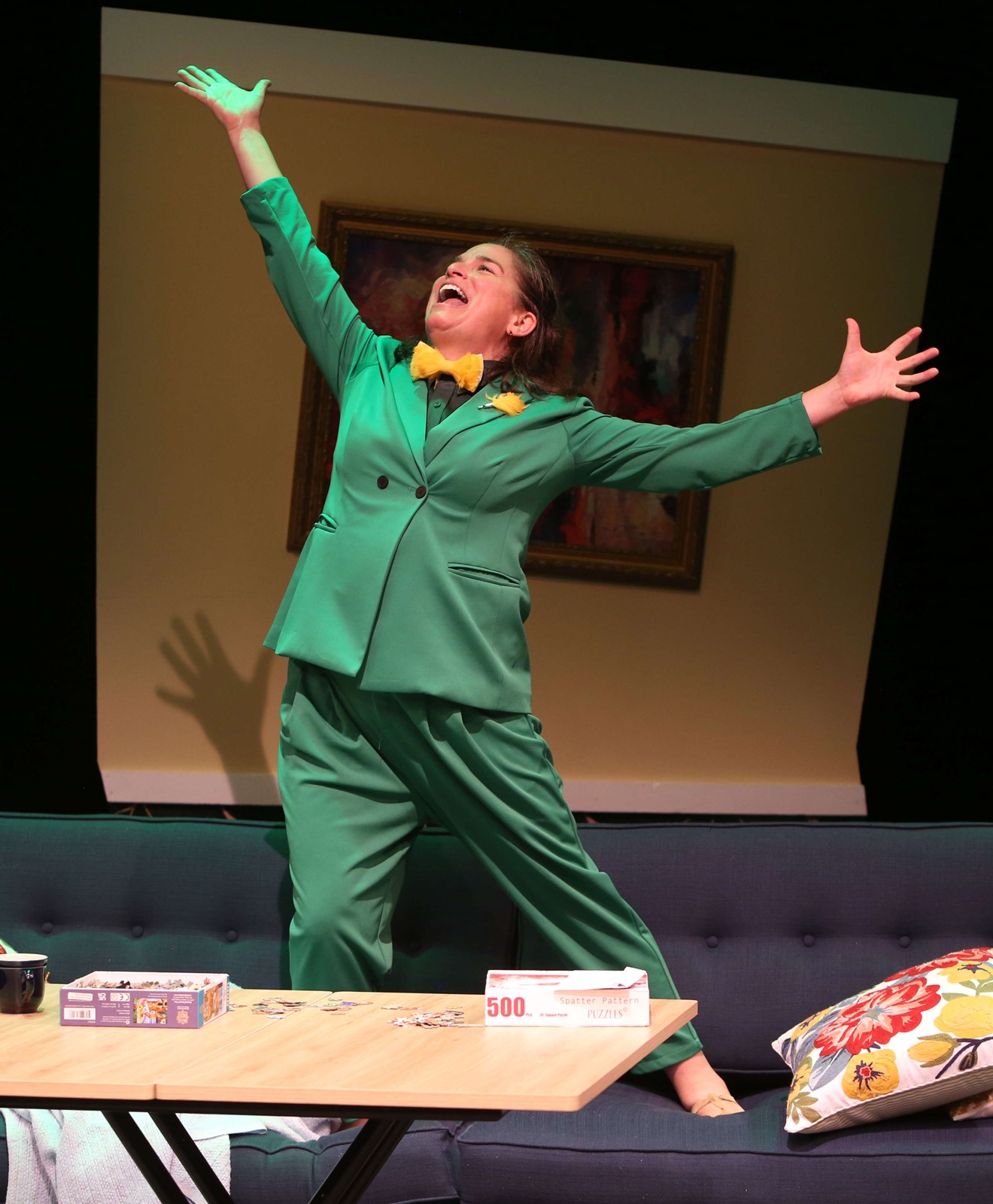
I’m watching something like that happen right now with Spreckels Theatre Company’s current production of my own stage comedy “Featherbaby,” which has four more performances this weekend. It’s the story of two competitive jigsaw puzzlers and the foul-mouthed parrot they share for a while, and the director, Skylar Evans, decided to cast two different actors as the bird. Matt Cadigan and Gina Alvarado have been alternating performances since the show opened on Aug. 29, and what’s happened is a surprising number of people seeing the show, then buying a ticket to see it again with the other Featherbaby.
In fact, since this coming Saturday will have a 2 p.m. matinee with Cadigan as the bird and a 7:30 p.m. show with Alvarado donning the green suit and yellow-feathered bow tie, at least a half-dozen people I’ve heard about have snagged tickets for both performances, planning to see them back-to-back, with dinner in between.
Rumor has it that the appropriately avian-themed Rohnert Park eatery Waterhawk is the preferred spot for dinner in between Featherbaby performances.
That’s what I’m doing myself.
A similar thing happened a few years back in Ashland, when the Oregon Shakespeare Festival cast two different King Lears in Shakespeare’s epic tragedy, with two actors also alternating performances. For months, late night conversation in the local bars and restaurants was flavored by debates about which Lear raged the loudest and deepest against the injustices of life.
It was, to put it succinctly, a lot of fun.
All kinds of double features
Of course, none of this is really all that new — or all that unusual.
In the world of entertainment, double features come in all shapes and sizes. Copperfield’s bookseller Ellen Skagerberg enjoys reportedly reading books by Virginia Woolf and Haruki Murakami back-to-back, as there are stylistic and thematic similarities, though separated by cultures and decades. Skagerberg is not alone in doing the Woolf-Murakami pairing. It’s an actual thing. Google it.
The self-described “Accordion Babe” Renee De La Prada recently saw Carl Orff’s “Carmina Burana” in concert in Davis, and then caught a Marin Community choir presenting its own rendition of the piece a few weeks later.
So, which one was better?
She’s not saying. But one of them was evidently hilarious. And “Carmina Burana” is not especially funny.
Petaluma’s Val Richman recently told me that she went to see Spike Lee’s “Highest 2 Lowest” at the Rialto Cinema in Sebastopol, and almost immediately rented the film it is a reinterpretation of, Akira Kurasawa’s 1963 “High and Low.”
“I often read books that films are based on,” she said, “either immediately before or immediately after seeing the films.”
So it seems I’m not alone in my appreciation for chasing that special thrill that comes from seeing two juxtaposed versions of something similar in close proximity to each other. However it is that you personally define a “double feature,” or a “double header,” it remains undeniable that pairing closely similar experiences together really does elevate both of them to a new level.
And if nothing else, it’s an opportunity to practice your diplomacy skills when someone asks which one you liked better.
In the case of “Eureka Day,” well, I haven’t seen both productions yet. When I do, I’m sure I’ll have something to say about them. Like De La Prada, however, I might just decide to keep those views to myself.
I guess I’ll let you know.
The award-winning column Culture Junkie runs once a month or so in the Argus-Courier. David Templeton is the Community and Arts & Entertainment Editor of the Petaluma Argus-Courier. You can reach him at david.templeton@arguscourier.com.
 PREVIOUS ARTICLE
