


She wants to help poor, broken feel Almost Home
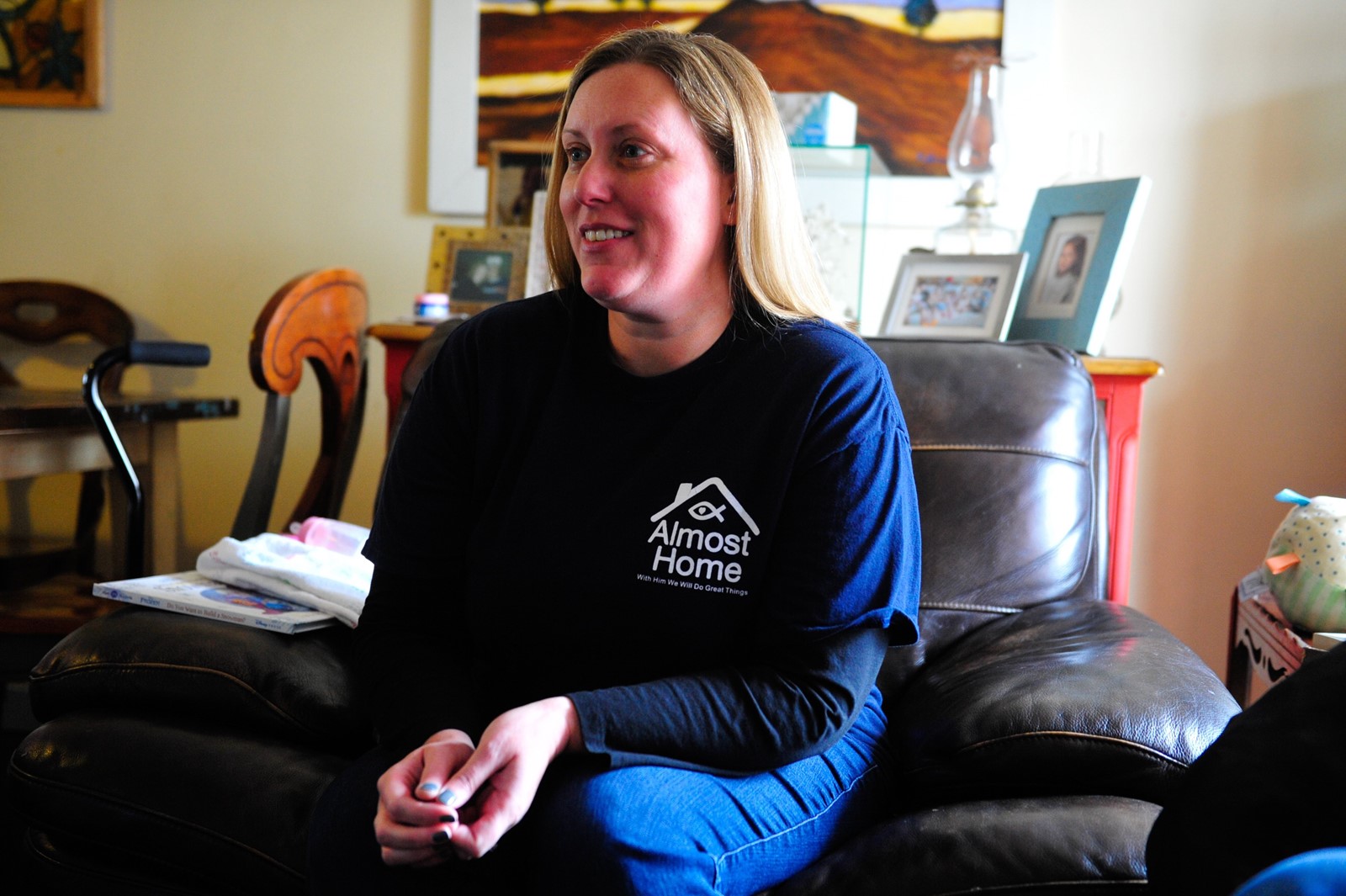


They call her the Mother Teresa of Hometown, a soft-spoken mom of six who arranges haircuts for the homeless, raises funds to cover rent for people on the verge of losing their place and who brings meals to the “forgotten” people living under south suburban bridges.
Sarah Galvan says her heart is filled with compassion for people in need, in part because she has a kind heart, and in part because she's been there.
The 37-year-old graduate of Oak Lawn Community High School was on maternity leave with her fifth child in 2013 when she got the call that she was being “let go” from her job helping people with disabilities. Six weeks later, she said, her husband's employer, who did home improvement jobs, ran out of work.
“So suddenly we were without an income,” she said.
Months passed, and their Hometown duplex fell into foreclosure.
“The lights were out. We started selling everything — electronics, our children's toys, our wedding rings, my husband's tools. Everything,” she said.
Two days from eviction and deeply depressed, Galvan said, she and her husband, Adrian “Andy” Galvan, hatched a plan.
“We were going to live in our van and in the shelters,” she said. “With our children.”
But what happened next Galvan can only call a miracle.
“With the help of my mom and dad and with the help of a complete stranger, all of our bills were paid in full,” she said.
To this day she doesn't know the identity of the “big” benefactor who went directly to her debtors to settle things up and who left a “large money order in our mailbox,” but she said her gratitude is as strong as the day her family was rescued from the brink of homelessness.
“I went from the lowest point in life to complete joy. I promised myself I would pay it forward. I promised my family. I promised God,” she said.
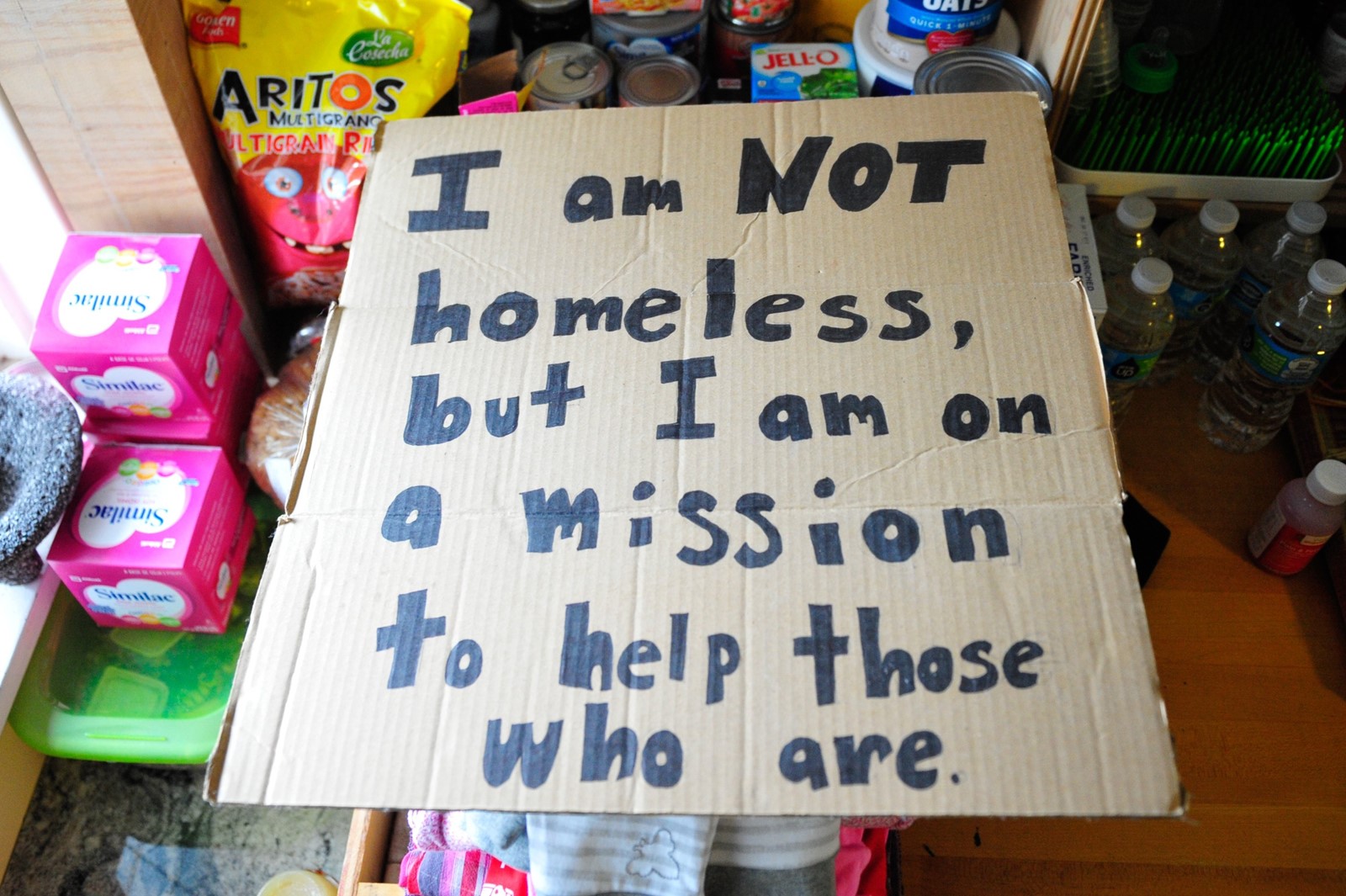
Seated one Tuesday morning in the living room of her 900-square-foot home, surrounded by the trappings of a family of eight, as well as stacks of donated packages of toilet paper and jars of peanut butter, Galvan and two of her homeless “friends” talked about the difference the nonprofit Almost Home has made in the community.
In the months following her family's brush with desperation, Galvan set up a home improvement company for her husband. He hasn't gone a day without work since, she said. And she pondered the dream she'd had when she was 17 and living in Oak Lawn.
“It was very vivid and in it, I was working with the homeless” through an organization called Almost Home, she said. She'd thought about that dream many times over the years but wasn't sure how to translate it into anything until one day two years ago, when she was on her way home from a Christian woman's book club meeting.
An epiphany
It was March 14, 2015, and she was waiting at a stoplight at 87th and Cicero when she noticed “men on every corner holding cardboard signs.
“I was just filled with compassion for them, so much so that I thought I was going to burst,” she said. Something, she said, told her it was time to get to work.
She went home and Googled how to start a not-for-profit.
Now a 501(c)3, Almost Home gives the haves an opportunity to help the have-nots. Galvan's efforts are divided among the homeless and those on the brink of losing shelter. She helps single moms, survivors of domestic violence and families experiencing hardship.
Through the generosity of businesses and caring south suburbanites, she's able to supply food, toiletries and gift cards for coffee, gas and meals to homeless “friends,” as well as raise cash for people like a Lemont woman who recently needed $900 to make rent.
Most of Galvan's connections are made through her Facebook page. When she learns of a specific need, she posts about it.
“We've been able to provide rent and mortgage payments for a lot of families to prevent homelessness,” she said. “My favorite is one who was two days away — very similar to my story. We were able to step in and save them from homelessness.”
Recently, Galvan said, a shopper outside Mariano's in Oak Lawn told a woman who was panhandling to call Galvan. She did.
“Something told me I needed to go to her. She said she had nothing. But everybody's definition of nothing is different. So last Saturday (March 18), Jamie (Chazinski, Almost Home board president) and I went there. She literally had two sheets on the floor and one sheet hanging on a window. She had gotten a place through Chicago Housing Authority but a place was all she had,” Galvan said.
“We put out a post and started collecting stuff. By 9 Saturday night, we had all kinds of things,” she said. “On Sunday (March 19), we delivered a kitchen table, a couch, a TV, a love seat, pots and pans, food, toiletries. Her house is so full now, so full of love and that happened in like 24 hours, you know.”
Cathy O'Hara owns O'Hara and Friends Salon in Alsip. During the summer, she came across a Facebook post about Almost Home.
“She needed gift cards at the time. So I went to the local fast-food places and Walgreens and purchased $100 worth,” O'Hara said. “Our stylists have done haircuts at the shelter, and I had a fundraiser at Christmas to raise money to purchase 30 citypaks for the homeless.
“We have become good friends and we help her when we can,” O'Hara said. “We hired her husband to gut and remodel our bathroom — to help support her family.”
Friends in need
The Rev. Peggy McClanahan, pastor of Pilgrim Faith United Church of Christ in Oak Lawn, one of several local churches that open their doors to the homeless at least one night a week, said the number of homeless people in the southwest suburbs is “significant.”
Pilgrim Faith provides shelter for about 40 men, women and children on Thursday nights, and Calvin Christian Reformed Church in Oak Lawn houses another 25 to 30 on the same night, she said. Sometimes the numbers are higher when the weather is cold.
Both BEDS Plus and South Suburban PADS work to move those who are homeless into housing through a variety of programs, McClanahan said.
“The more quickly a family or individual can be moved into permanent housing the more successful they are in rebuilding their life. Once someone has been homeless for six months or longer the more likely they are to remain homeless for a long time. The survival skills that homeless persons develop when they are living on the street for a long time sometimes actually make it harder for them acquire and keep a steady job and maintain an apartment and the responsibilities that go with it,” McClanahan said.
Almost Home's greatest strength, the pastor said, is its ability to respond quickly. “When someone falls into financial crisis, by the time they have exhausted their own reserves and whatever assistance family and friends can provide them they are often on the brink of losing their home if they don't come up with rent money or a utility payment in the next few days. Or they will lose their car if they cannot quickly come up with a car payment. Or they will have their phone service cut off, which, of course, makes it almost impossible to get work,” she said.
That's where Almost Home often steps in, McClanahan said. Galvan can put out a call for help and in a matter of hours be able to save someone from a deep hole that will take a long time and lot of resources to climb out of, McClanahan said. A lot of the other agencies that provide assistance are more focused on long-term help and cannot respond quickly to an immediate crisis, she said.
Almost Home also fills in gaps like providing fresh water for homeless people who don't stay in the shelters.
McClanahan said, “Sarah and the other Almost Home board members and the many friends who respond to her appeals have a deep devotion to making a difference. The problem of homelessness is quite large, and all the different approaches the various agencies take in helping people acquire stable housing and the life skills to maintain it are important parts of the response.”
Among those who have been on the receiving end of Galvan's generosity is a middle-age woman named Cathy. She asked that her last name not be printed because some of her friends don't know about her current situation and she fears the stigma of homelessness could prevent her from finding a new job.
“I call Sarah an angel,” Cathy said. “She helps you in ways no one else does.”
Cathy has been homeless since 2015 when she lost her data entry job and then, soon after, her Palos Hills home.
A friend took her in, but six months later, after Cathy's dog bit the friend's adult son, she was given a choice. Having lost everything else, she said, she couldn't stand the thought of losing her dog, so she moved into her SUV. And there she stayed until her dog died.
Although she has family and friends, Cathy said no one is willing to take her in. It's a common story among the homeless, she said.
“There are people whose grown children, whose siblings, won't take them in. I've stopped asking. You get tired of hearing no,” she said.
Galvan, on the other hand, always says “yes,” Cathy said.
Galvan helped find someone to donate a car battery to Cathy. She's given Cathy money for gas and vehicle stickers.
“She's the only one who helps with those kinds of things,” Cathy said.
Fred Lorenz, a 56-year-old recovering alcoholic who suffers from COPD and hypertension as well as depression, is estranged from his family.
“I've been homeless since 2010. Because of my past history as an alcoholic, I lost everything,” he said. A South Sider, he ended up living on the streets on the West Side.
Two years ago, he came back south, Lorenz said. He met Galvan through the shelters.
The network of churches takes turns providing overnight accommodations and sustenance.
Galvan, he said, often provides gift cards for meals and coffee and bus fare from one shelter to another because without it, the homeless have to walk.
“I'm grateful for all the stuff she does for us,” said Lorenz, who said he has been sober since the day after his father's funeral on June 30, 2011.
“I understand why a lot of homeless people get a bad rap. A lot of guys (at West Side shelters where he used to stay) were drug addicts and alcoholics. If they got any money, that's what they spent it on. Sarah here is helping those of us who are trying to make something out of their lives. She helps to get people back on their feet. The shelters are good, they help you out, with a place to sleep and meals, but without people like Sarah there's is no way out of this,” he said.
Lorenz said he hopes to one day get his own place again. “I want to be independent,” he said.
Galvan's dream is to open a secondhand shop, to provide jobs for many of the homeless who can't seem to find work and to provide inexpensive necessities to people in need.
“I've wanted to open a shop for a long time but I am thinking now that a day center is needed more,” she said. She envisions a place with a shower and laundry facilities.
Society and local authorities often frown on homeless people hanging out at local libraries, businesses and train stations, she said. They need a place to spend the day between shelter visits, she said. But she is unsure how to go about securing a building.
“People are very willing to give items to people in need, but they are not that willing to give money to me for something like a day center,” she said.
It's about trust, Galvan said. One of the things that is unique about Almost Home, she added, is that benefactors always are given the option to meet recipients.
For example, when Cathy needed a car battery, a donor met her at the shop and paid the bill there, she said.
Galvan said she understands why people might be leery about donating cash. Still, she added, “It'd be nice if someone wanted to donate an old building so we could have a center.”
Creative solutions
Recently, Galvan learned about a program that is popular in Europe called “pending coffees.” When a customer buys a coffee, they can offer to spring for an additional “pending” coffee, which can be redeemed at a future date by a person in need.
She approached Papa Frank's Gyro's, a local fast-food eatery, about setting up a similar program for meals.
“The owner agreed,” she said. Patrons of Papa Frank's on Cicero can buy $5 meal coupons that are given to Galvan, who in turn hands them out to the homeless.
Once, someone donated a van to Galvan's cause and she had the idea of converting it into a mobile shower, which she could take to different sites so that homeless people could bathe.
“But then I learned of a local family with two little ones who didn't have a vehicle, so I donated it to them,” she said.
Until a recent windstorm blew it down, Galvan also had a Blessings Box on her front lawn. People could leave items as dish soap, foil and toilet paper, or take them as needed.
At Christmas, Cathy said, Galvan asked shelter dwellers to write down three things they'd like. Then she found people to make the wishes come true.
Most broken
“The bridge people are my favorite,” Galvan said. “The most broken souls are there. I feel like when you get to the bridge, you're broken.”
Lorenz said the people who live under the viaducts along Interstate 55 and under bridges in the south suburbs are elusive because “they have pride.”
You won't see them panhandling or seeking a bed at a local shelter, he said. “They think that is a hand out,” Lorenz said.
Galvan brings them meals a few times a week. She also gave them coolers and she regularly delivers ice and bottles of water.
During the summer after a local car dealership gave her some gift cards to Boston Chicken, Panera and Bakers Square, she posted a note near one particular bridge site, announcing a sitdown meal at a specific time on a specific day.
“I didn't know if anyone would show up. But I planned for six and six came,” she said.
She'd hauled tables and chairs, and flowers for centerpieces. Then, even though she was “very pregnant with my sixth child,” she fed them a real dinner.
“Everybody deserves to sit at a table, not on a concrete slab,” she said. “That was one of my favorite days.”
For more information, find Almost Home on Facebook, call 708-789-2911 or go to
 PREVIOUS ARTICLE
