


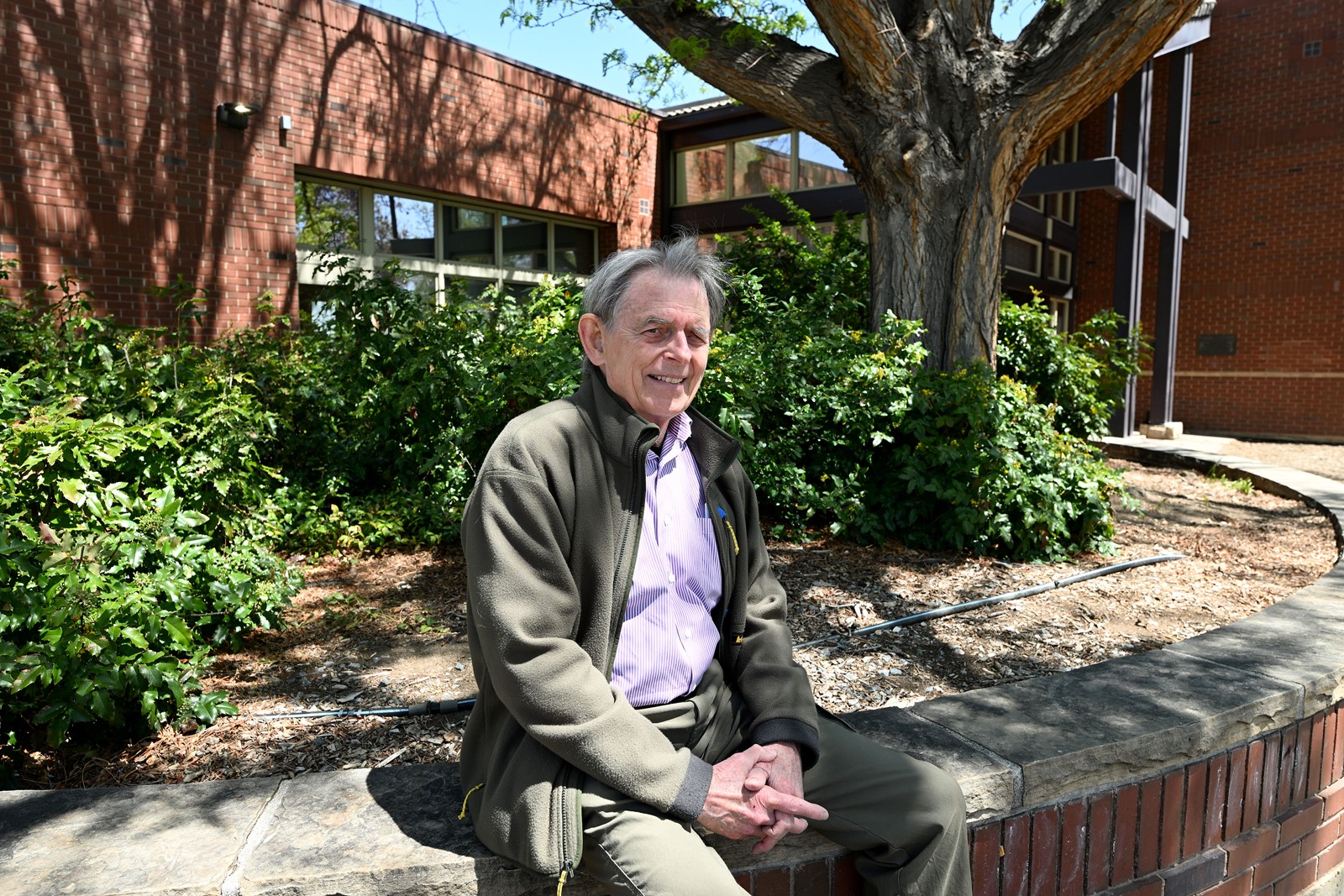


After retiring from the ministry and moving to Loveland in 2019, Chuck Hubbard didn’t wait very long before getting involved with local social justice causes. Almost immediately after arriving, the former Lutheran pastor joined up with faith-based advocacy group Together Colorado to continue his work on behalf of society’s most vulnerable members.
Now Hubbard is on a mission to bring Loveland’s faith community together to tackle an issue near and dear to his heart: homelessness.
“We have a special needs daughter, and so I have a self-interest in dealing with the unhoused, because she is vulnerable to becoming unhoused,” Hubbard said. “She would die on the streets.”
On May 15, Hubbard and other members of Together Colorado will host a gathering of local faith leaders to discuss how churches, synagogues and other religious institutions can work together to identify and implement meaningful solutions for the unhoused.
Invitations went out to more than 70 pastors, rabbis, spiritual and lay leaders in the Loveland area, with the goal of sparking a conversation and hopefully, coordinated action.
“We’re wanting to lean on the collective wisdom of spiritual leaders,” Hubbard said. “We’ve tried to make contact with anyone and everyone who is leading a church.”The Reporter-Herald caught up with Hubbard last week to discuss homelessness in Loveland and his work with Together Colorado.
What drew you to get involved in efforts to address homelessness?
For many years my heart has been drawn to those who live in the margins. It started with pizza. The university I attended allowed students to eat all the pizza they wanted when served. On one occasion the pasta effect put me to sleep right in front of a lecturing professor. About mid-hour he began to talk about Carl Jaspers who spoke of the grenza experiences; that is, living in the tenuous boundary areas between life and death when people struggle with illness, financial threat, and other life altering calamities.
I awoke with the strange but profound sense that I was to walk with people who were struggling in the boundaries, sharing their grenza experiences. That is exactly what I did in my career as a teacher, hospital chaplain (particularly in psychiatric care) and as a parish pastor. People who are unhoused struggle for survival; every day they are faced with the very basics of maintaining life.
What are the biggest misconceptions you think people have about Loveland’s unhoused population?
There are many and the answer might vary depending on the day. Here are two: First, there is a misperception that unhoused people are mean and dangerous. Certainly, I have encountered people exhibiting belligerent or bizarre behaviors. Thank heavens I have never experienced or seen a physical confrontation. It happens but rarely. The vast majority of unhoused people are simply focused on getting through the day and having their basic needs met. It’s sad that their mere presence often is perceived as a threat.
A second, common misperception is that homeless people “just need a job.” “Working Homeless …,” a study by Bruce Meyer (“Homelessness and the Persistence of Deprivation” 2023), University of Chicago, showed that roughly 52% of sheltered, homeless people had jobs. Roughly 40% of unsheltered people also had jobs either while being unhoused or the year they become unhoused. It’s important to keep in mind that many unhoused persons are unable to work because of mental/emotional or even physical limitations. The notion that homeless people don’t want to work is mostly untrue.
The problems they face are related to low pay and underemployment.
How did your experience in ministry help shape the way you approach homelessness?
Intentional relationship building and showing respect are fundamental to providing support to anyone. Mom was a wonderful listener; people loved her for it. Dad could be strikingly insightful. I benefited from my parental mentors. I also benefited from a couple of years of intense clinical training at Baylor University Medical Center. These formative influences have greatly shaped my practice as a pastor.
When the encampments were going strong in the Kings Crossing area, I would ride a bike along the river. I liked to engage people who I thought might be unhoused. To my surprise and delight, they were almost always willing to talk. I would hear again what I often heard early in my career of a profound loss or a cluster of losses that resulted in a crisis, such as becoming homeless.
Respecting boundaries is essential. I would never walk into somebody’s camp without announcing myself at a distance and asking for permission to approach. Though I was on public property, I kept in mind the fact that I was approaching somebody’s home, temporary though it may be. A home is deserving of respect.
How are local faith communities coming together around this issue and what role do you see them playing?
It’s not easy to bring faith communities or even their pastors together, which is something those of us associated with Together Colorado here in Loveland would like to do. Our hope is to examine the challenge Loveland faces in addressing the needs of unhoused people. We hope to do that in a meeting of faith leaders that crosses the religious spectrum. We want to benefit from a collective wisdom. That meeting will be held May 15, 1:00 — 2:30 p.m. at the library.
Most spiritual leaders are well meaning. We tend to agree that poverty must be addressed. As Moses says, “There shall be no poor among you.” Most Christians see “neighbor care” as fundamental to the mission of the church.
Faith communities and their leaders can play a central role in influencing civic leaders and public opinion. They also represent a source of potential donors to the cause of establishing and maintaining a resource center with temporary housing.
From your perspective as both a pastor and a resident, what gives you hope that Loveland can make meaningful progress on homelessness?
I am encouraged when I hear our mayor say, “I don’t want to see people dying on our streets.” Her instincts are right. One study found that “non-elderly people experiencing homelessness have 3.5 times the mortality risk of those who are housed” (Bruce Meyer, “Life and Death . . . ,” 2023). Living without adequate shelter is a harsh existence.
I am encouraged by council members who essentially say, “Our community has asked for a resource center and shelter, and we can’t keep kicking the down the road.” I enjoy hearing people express support for a local center at city council meetings. I also understand and respect people who give voice to their fears saying, “Not in my community!” The fear is real. I further realize that the fear tends to dissipate once a center is established, and that give rise to hope.
Finally, I am encouraged when reminded of The Landing. Just this past year the shelter opened for unaccompanied youth. It was years coming. That gives me hope that the community will eventually contribute personal resources along with tax dollars to provide a resource center with a shelter inside to help those who have fallen into the difficult state of being unhoused.

