




ROUND ROCK, Texas — Paper planes whizzed and dipped and careened into the audience while parents gleefully ducked for cover. At the front of the drab hotel conference room, a man deadpanned, “You all signed a waiver before you came in here?” The speaker, Chris Cardiff, was urging the room of parents to take control over their children’s understanding of American history. His presentation raced through the “competing narratives” that young children faced: “Celebrate ‘diversity,’ ” it went, versus “e pluribus unum.”
“Why would you have targeting of young children?” Cardiff said. “Because, first of all, people on the left side of the political spectrum are targeting preschoolers with their version of history.”
It was the start of a gathering, one of several run across the country by a group called the Great Homeschool Conventions, which brings together families who are part of America’s fast ballooning and politically forceful homeschooling movement.
In July, these families descended on a water park resort in Round Rock, Texas, where conference rooms were steps away from colorful megaslides and plaster hippopotamuses. The children hit the lazy river while their parents attended sessions about designing Bible-driven curriculums and helping their offspring “safely navigate our hypersexual culture.” They discussed how to instill patriotic values in their children and whether to send them off to college, where some speakers worried they would be fed left-wing values.
“At this point, I’m generally advocating people not going to college, unless you’re going into STEM,” one speaker, Lisa Nehring, told the room, later adding, “I sound like, ‘Oh, my gosh, the world is going to end’ — and it is!”
End times on the horizon or not, there was a sense at the convention that these parents were part of a movement on the cultural up-and-up. A perfect storm of politics, policy and cultural shifts had combined to create the conditions for homeschooling to spread.
Many of them had decided to homeschool because they worried about their children going into classrooms where they could absorb lessons their parents found objectionable: that the human species evolved instead of being created by God, for example. Or that America’s Founding Fathers were fallible. Others wanted to give their children a level of one-on-one attention they did not feel would happen in larger classrooms. Some had flirted with the idea of homeschooling for years, before the COVID-19 pandemic pushed them into action.
COVID-19 supercharged homeschooling. Survey data from the Census Bureau, collected in the 2022-23 school year, showed that nearly 6% of America’s school-age children were being homeschooled, compared with 2.8% in 2019, before the pandemic. That’s a change that crisscrosses geographic and political lines, including in left-leaning areas and districts with high-performing public schools.
All this has collided with a cultural moment in which influencers on the right are encouraging a traditional conception of marriage and family, where one income, earned by a man, should suffice, and a wife’s role is to stay at home. This notion seems to have caught fire particularly in its most social media friendly incarnation, where softly lit asparagus tarts and phonics lessons are appealing to certain members of a new generation, which also leads to newcomers finding homeschooling.
“I get this comment a lot: ‘I want to homeschool, but I don’t know how,’ ” said Jessica Ellis, a public school teacher-turned-homeschooling mother in Florida, talking to her 128,000 TikTok followers. “I truly believe there is nobody — nobody in the world — that is more equipped to teach your child than you.”
For many civil rights and family law experts, the rising number of homeschoolers set off alarms. It can seem, to many, like yet another set of fractured realities being formed, mirroring the sort of dueling narratives that compete for airtime on social media or partisan news.
“If we just look at society right now, one of our problems is that we’re so polarized and different segments of society are getting different versions of reality,” said Elizabeth Bartholet, a retired family law professor at Harvard Law School and a former head of its child advocacy program. “What homeschooling allows and encourages in its unregulated form is that people from different political and social groups can raise their children with little to no exposure to the larger society’s shared values.”
It’s not clear whether the COVID-19 bump in homeschooling will keep building. But the groups organizing to regulate homeschooling have tended to be less politically powerful than those pushing for its growth, according to Bartholet.
At the Great Homeschool Conventions gathering, parents celebrated their sense of ascendance. “It’s more mainstream than it’s ever been,” said Meghan Ashe, 39, a mother from Bentonville, Arkansas, who homeschools her two children.
Ashe is one of the relative newcomers to the community who wanted to have control over what her children, who are 10 and 6, learned during the school day. “Talk about evolution — that’s pretty common in public schools, and you’re not going to find that in a biblical worldview,” said Ashe, who teaches her daughter the biblical creation story.
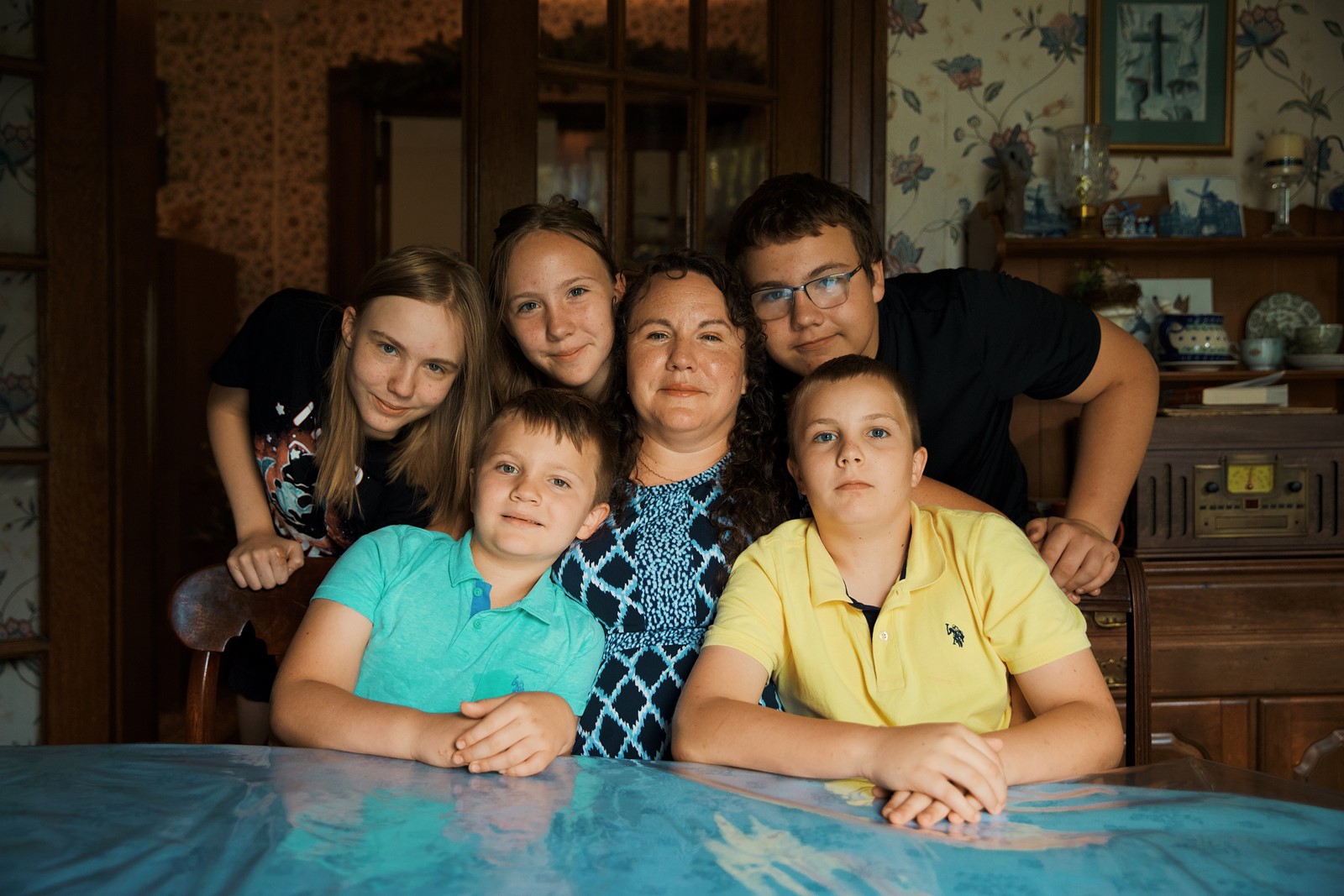
Plenty of these homeschooling parents are themselves the product of public school or other traditional classrooms. Some never anticipated having interest in this movement. Take Susanna Pawling, 43, whose parents were both teachers at a Christian school and whose two sisters taught in public schools. When Pawling began entertaining the idea of homeschooling, family members were skeptical. She ignored them.
Pawling, who lived in Fairfax, Virginia, at the time, and now lives in San Antonio, did not want her children to be in schools with gender-neutral bathrooms. She also did not like the way schools taught American history. “The demonization of Washington and Jefferson — it’s a totally different version of history than what I learned in the 1980s,” said Pawling, who has five children. “I never thought I’d do homeschooling. I thought those people were kind of weird. I can’t believe I joined them.”
Wandering the exhibit hall at the convention, where vendors sold picture books and flashcard sets, Pawling was struck by her own comfort: “It’s like: ‘There’s my old friend! Oh, and I love that book over there.’ ”
There was one convention speaker, John De Gree, who, with his wife, chose to homeschool their seven children until eighth grade, even though he is a public school teacher. De Gree, 56, felt that his children would get an education from his wife that was simply not possible in a big classroom. (He was also put off by a public school teacher who downgraded his oldest son over sloppy art on a book report; this was one inciting event for pulling his children out of the school.) De Gree recalled that his father, another public school teacher, was initially dubious of the decision to homeschool but became more accepting over time.
“You have a 6-year-old child, 7-year-old child, who loves that child the most? Who expresses it? The mom, right? There is no question about that,” De Gree said. “In school, there’s a bunch of people, and you have to organize them, and that’s time wasted.”
As a veteran home-schooler, De Gree said he had been attending various homeschooling conventions for more than a decade. He noted that even though the movement had grown bigger, it seemed to him that conferences such as the Great Homeschool Conventions had become smaller, because more parents were finding their curriculums and teaching tips on social media.
Cardiff, the American history speaker, told the audience at his session that he and his wife started homeschooling in 1990 and that they had decided to do so years before, during the “dark ages of homeschooling.” His wife was a founder of a large homeschooling support group in California’s Silicon Valley that had more than 100 families at its peak. His family then decided to start a nonprofit that helped parents teach their children about American history, partly because they were alarmed by what they saw as the progressive narratives in children’s books and classrooms.
“Parents are under siege here,” Cardiff said. “We want to take advantage of these early years when kids are just sponges soaking stuff up.”
Beyond an interest in teaching history on their own terms, which many parents expressed, health and science are also a growing fixation. In a session about homeopathy, Paola Brown, an educator and homesteader, talked about homeschooling as a way for parents to impart their own beliefs about health to their children. (A 2017 paper, published in the Californian Journal of Health Promotion, surveyed 137 parents in Washington state and found that homeschooling parents reported lower rates of vaccination among their children and lower perception of the value of vaccines, compared with public school parents.)
“There are times and places for Dr. Pharma,” Brown told a jammed conference room. “Heroic, lifesaving circumstances.” She recalled having “crunchy” friends who sent their children off to college and were alarmed to find them taking “unnecessary” antibiotics.
 PREVIOUS ARTICLE
