


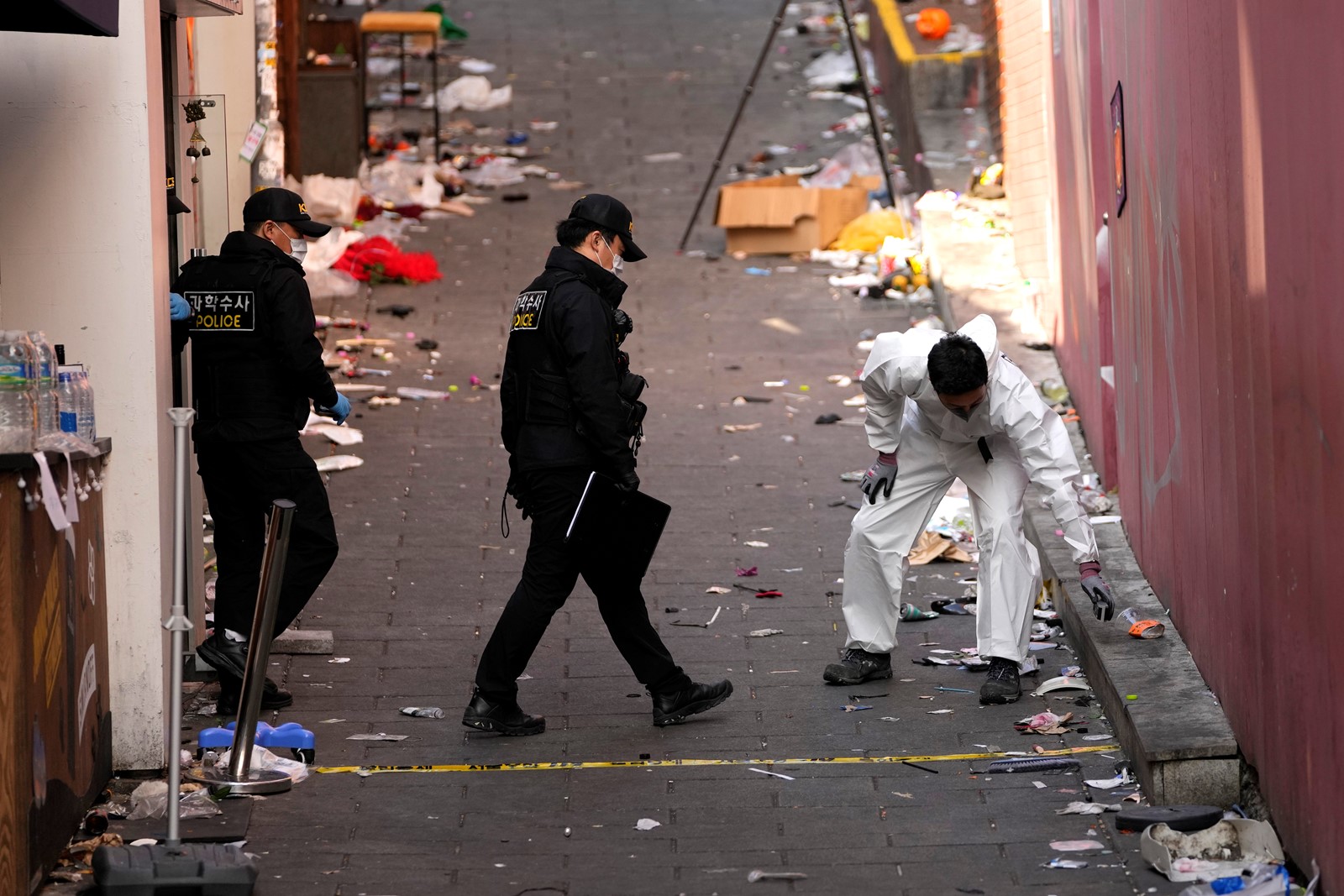


SEOUL, South Korea — Seoul police assigned 137 officers to manage a crowd of Halloween revelers anticipated to number more than 100,000 over the weekend — a decision that has come under criticism following the deaths of more than 150 people when the group surged.
By comparison, nearly 7,000 police officers were sent to another part of the South Korean capital Saturday to monitor dueling protests that drew tens of thousands but still fewer people than flocked to the popular nightlife district of Itaewon the same night. Even the task force created to investigate why the crowd surged, with 475 members, is more than three times larger than the detail assigned to crowd control.
As South Korea mourns, officials are facing tough questions about preparations for the celebrations and demands for accountability in the wake of the country’s worst disaster in nearly a decade.
The national government has insisted there was no way to predict the crowd would get out of control.
Experts disagree.
Deploying so few police officers, they said, showed officials were poorly prepared despite knowing ahead of time that there would be a huge gathering following the easing of COVID-19 restrictions in recent months.
On top of assigning more personnel, police and officials in the Yongsan district, which governs Itaewon, should have pedestrianized some streets and taken other measures to ease the crowding in narrow lanes like the one where the deaths occurred, experts said.
Instead, the 137 officers in Itaewon were assigned to monitor crime, with a particular focus on narcotics use, meaning that for all practical purposes “no one was looking after pedestrian safety,” said Kong Ha-song, a disaster prevention professor at South Korea’s Woosuk University.
The deaths should be seen as a “man-made disaster,” said Lee Changmoo, an urban planning professor at Seoul’s Hanyang University.
Authorities have come under similar criticism in national media and on social networks.
The headline of an editorial in the Hankyoreh newspaper Sunday described the tragedy as “all too avoidable.” The paper said its reporting showed that a pedestrian got knocked down by a crowd in Itaewon a day before Halloween festivities — although no one was hurt.
Saturday’s deaths occurred in an alley running between a row of store fronts and the Hamilton Hotel. The path became clogged by partygoers before some of them fell and toppled over “like dominos,” witnesses said.
Kong said more police and government workers should have been called on to monitor potential bottleneck points. He suggested that the crush may have been prevented if authorities had enforced one-way walking lanes, blocked entry to some narrow pathways, and temporarily closed Itaewon’s subway station to prevent an excessive number of people moving in the same direction.
Officials also could have also temporarily closed Itaewon’s main road to cars, as they did during the annual Itaewon Global Village Festival earlier in October, thereby giving people more room to spread out, Kong said.
Lee criticized Interior and Safety Minister Lee Sang-min, who claimed, without elaborating, that having more police and fire department personnel on the ground wouldn’t have prevented the tragedy.
Kong added that the lack of a central organizer Saturday may have contributed to the tragedy.
“Our country usually does a good job in following the manual and maintaining crowd control at events where there’s a specific organizer,” he said. “But officials are often unsure what to do or even don’t care about events that aren’t created by a specific organizer ... although it’s those events that usually require a closer watch.”
 PREVIOUS ARTICLE

