




President Joe Biden has been highly attuned to the politics of electric vehicles, helping to enact billions in subsidies to create new manufacturing jobs and going out of his way to court the United Automobile Workers union.
But as the union and the big U.S. automakers — General Motors, Ford Motor and Stellantis, which owns Chrysler, Jeep and Ram — hurtle toward a strike deadline set for tonight, the political challenge posed by the industry’s transition to electric cars may be only beginning.
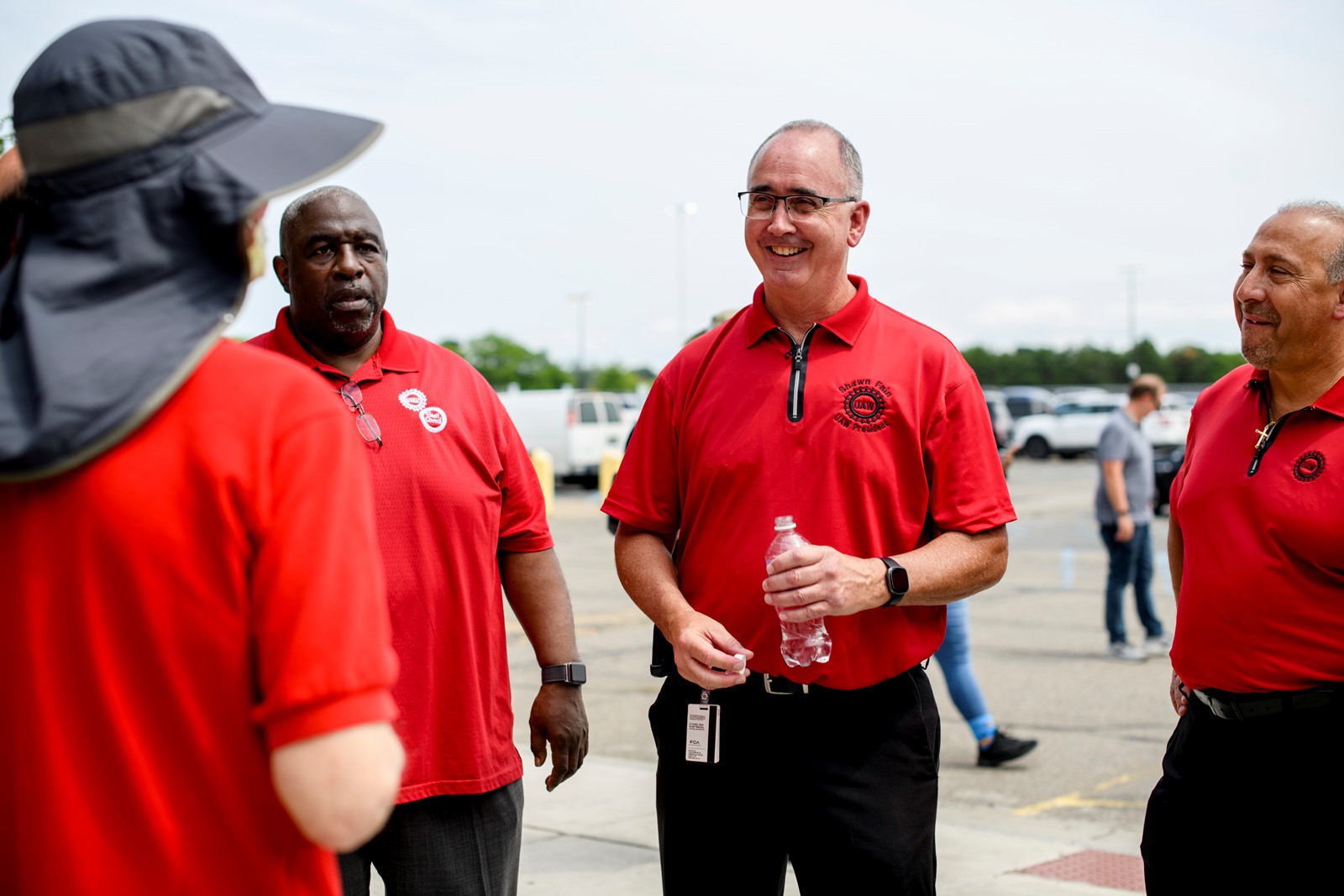
The union, under its new president, Shawn Fain, wants workers who make electric vehicle components such as batteries to benefit from the better pay and labor standards that the roughly 150,000 UAW members enjoy at the three automakers. Most battery plants are not unionized.
The Detroit automakers counter that these workers are typically employed in joint ventures with foreign manufacturers that the U.S. automakers don’t wholly control. The companies say that even if they could raise wages for battery workers to the rate set under their national UAW contract, doing so could make them uncompetitive with nonunion rivals, like Tesla.
And then there is former President Donald Trump, who is running to unseat Biden and has said the president’s clean energy policies are costing American jobs and raising prices for consumers.
White House officials say Biden will still be able to deliver on his promise of high-quality jobs and a strong domestic electric-vehicle industry.
“The president’s policies have always been geared toward ensuring not only that our electric vehicle future was made in America with American jobs,” said Gene Sperling, Biden’s liaison to the UAW and the auto industry, “but that it would promote good union jobs and a just transition” for current autoworkers whose jobs are threatened.
But in public at least, the president has so far spoken only in vague terms about wages. Last month, he said that the transition to electric vehicles should enable workers to “make good wages and benefits to support their families” and that when union jobs were replaced with new jobs, they should go to union members and pay a “commensurate” wage. He is encouraging the companies and the union to keep bargaining and reach an agreement, one of Biden’s economic advisers, Jared Bernstein, told reporters Wednesday.
A strike could force Biden to be more explicit and choose between his commitment to workers and the need to broker a compromise that averts a costly long-term shutdown.
“Battery workers need to be paid the same amount as UAW workers at the current Big Three,” said Rep. Ro Khanna, D-Calif., who has promoted government investments in new technologies.
Khanna added, “It’s how we contrast with Trump: We’re for creating good-paying manufacturing jobs across the Midwest.”
At the heart of the debate is whether the shift to electric vehicles, which have fewer parts and generally require less labor to assemble than gas-powered cars, will accelerate the decline of unionized work in the industry.
Foreign and domestic automakers have announced tens of thousands of new U.S.-based electric vehicle and battery jobs in response to the subsidies that Biden helped enact. But most of those jobs are not unionized, and many are in the South or West, where the UAW has struggled to win over autoworkers. The union has tried and failed to organize workers at Tesla’s factory in Fremont, California, and Southern plants owned by Volkswagen and Nissan.
As a result, the union has focused its efforts on battery workers employed directly or indirectly by GM, Ford and Stellantis. The going wage for this work tends to be far below the roughly $32 an hour that veteran UAW members make under their existing contracts with the three companies.
 PREVIOUS ARTICLE
