


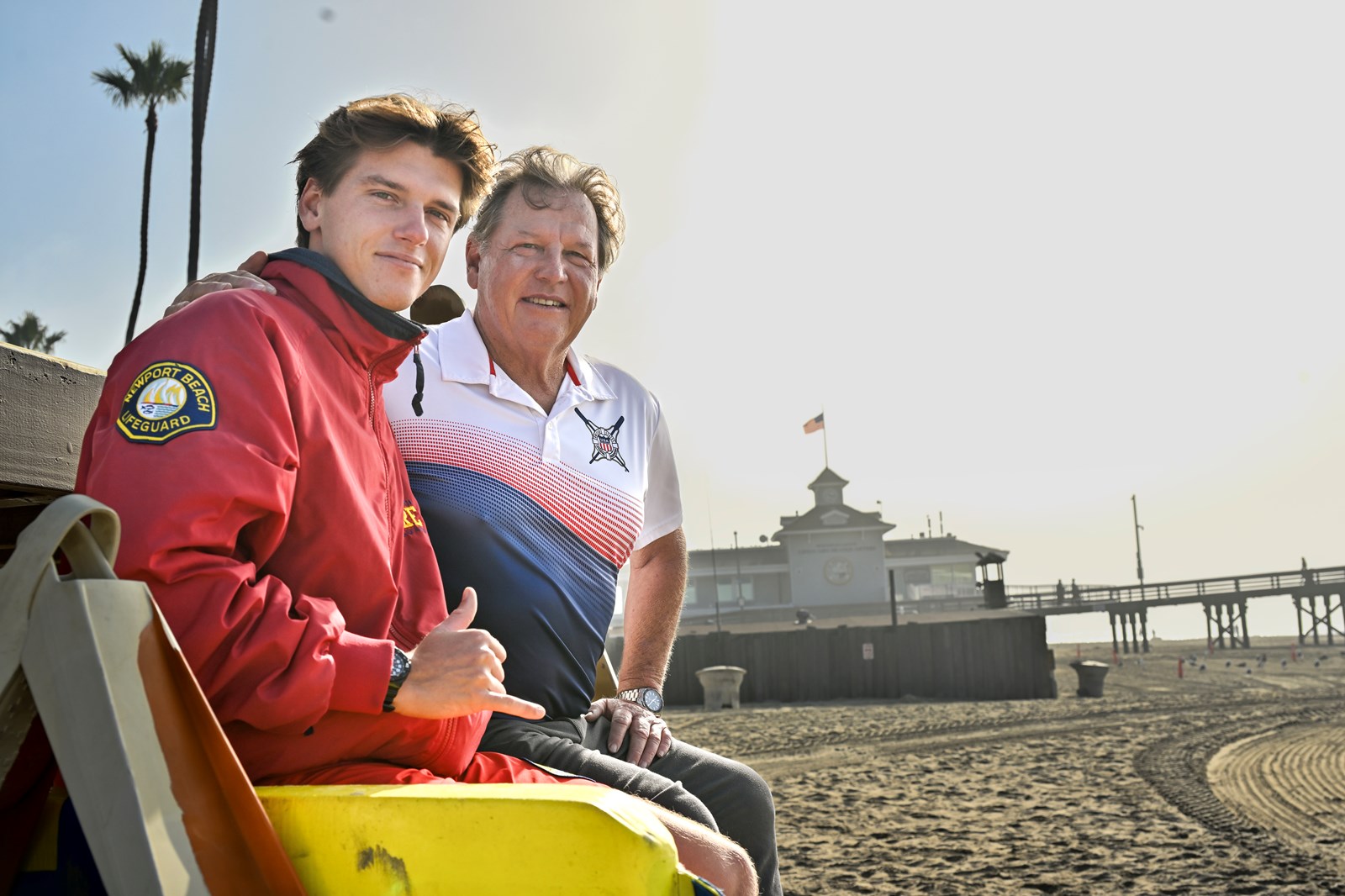


It’s a foreign exchange program, but with a lifesaving twist.
For Nolan Weisser, a trip to New Zealand isn’t just a chance to learn lifesaving techniques from the other side of the world, but an opportunity to follow in his father’s footsteps as he embarks on the same trip his dad, Kai Weisser, did nearly 40 years ago.
It’s believed to be the first second-generation exchange involving a California guard to New Zealand in the program that dates back to the 1960s.
“It gives you goosebumps. I know exactly what he’s doing, because I was doing the same,” said Kai Weisser, who spent 30 years as a Huntington Beach city lifeguard. “This one is such an incredible life experience, I’m so proud. It’s just incredible. ... He’s super excited about it. He’s going to have the adventure of a lifetime.”
Mike Beuerlein, former president of and adviser to the California Surf Lifesaving Association, said the program started with a junior lifeguard exchange between New Zealand and the Huntington Beach city Marine Safety Division.
“We have always had roots there,” he said.
By 1969, leaders wanted to expand the program to professional lifeguards, so they teamed up with the association to coordinate the effort and open it up to lifeguards across the state, Beuerlein said.
“We’ve had lifeguards from almost every agency in the state go as delegates,” he added. “We’re really proud of it.”
It’s important because they get to share lifeguarding techniques, traditions and history.
“That was where the camaraderie started,” Beuerlein said.
Lifeguards have an inherent bond, he said, typically enjoying the same type of ocean-focused recreation and training.
As far as Beuerlein said he knows, there have been siblings who have done the program, but never a multigenerational, father-son duo.
“That’s one of the benefits of having an exchange that has been around for so long,” Beuerlein said. “Now, we’re into the next generation. It is truly unique when you get to see the generational experience passed on, within one family.”
Kai Weisser recalled that he got to go to New Zealand in 1986, when he was just a few years older than his son is now and when he was just starting out his lifeguarding career. The locals rolled out the red carpet treatment, he said, taking the California guards up and down the coast to various surf clubs where lifeguards operate.
In New Zealand and Australia, lifeguarding used to be a voluntary position. The guards would stay and socialize at the surf clubs for the busy weekends, making it more of a lifestyle pursuit than a job.
“It’s just a different culture there, it’s so wide open,” he said. “They have a flag system, where you get swimmers to stay between the flags. Here, you can swim where you want and we have lifeguards everywhere.”
The lifeguards Down Under also used to swim out to a victim with a line, called a landline, with a few guards on the beach to pull the person to shore.
“It’s like a big fishing line. The swimmer swims with the line attached to the buoy, the lifeguards on the beach will pull them in like a fish,” Kai Weisser said.
After seeing California’s preferred floatation buoys in the late 1960s, and how effective they were during rescues, the Australian and New Zealand lifeguards changed their response techniques, he said.
“It’s a true educational exchange,” Kai Weisser said.
The New Zealanders, in exchange, send two guards to California each summer, with local lifeguards showing them around, housing them and teaching them about the local lifeguarding techniques.
There, surf lifesaving is almost like a national sport, with competitions highlighted on television and iron man lifeguards spotlighted on Wheaties boxes.
Newport Beach’s Lifeguarding Operations Division Chief Lifeguard Brian O’Rourke said the training the guards receive is a valuable experience.
“Everyone who has gone through the program comes back with a really great appreciation for being a lifeguard,” O’Rourke said. “To have a father and son, over a huge period of time in a whole different generation, is just a very cool thing. It’s great for lifeguarding. It’s great for them. It’s so special.”
Nolan Weisser, 22, grew up around the lifeguarding community, naturally gravitating to the water as a surfer and junior lifeguard growing up.
He’s been with the Newport Beach division for six years as a seasonal lifeguard, each summer teaching the junior lifeguard program, just as his dad did at the neighboring beach at about the same age.
He is traveling with Seal Beach lifeguard Samantha Hall for the exchange program. Both are required to come back to give a presentation to the California Surf Lifesaving Association next spring.
“I hope to have a really good time. I’ve heard it will be, but I also hope to learn a lot about lifeguarding, as well as the culture over there,” he said. “And hopefully in return, give that back.”
 PREVIOUS ARTICLE

