


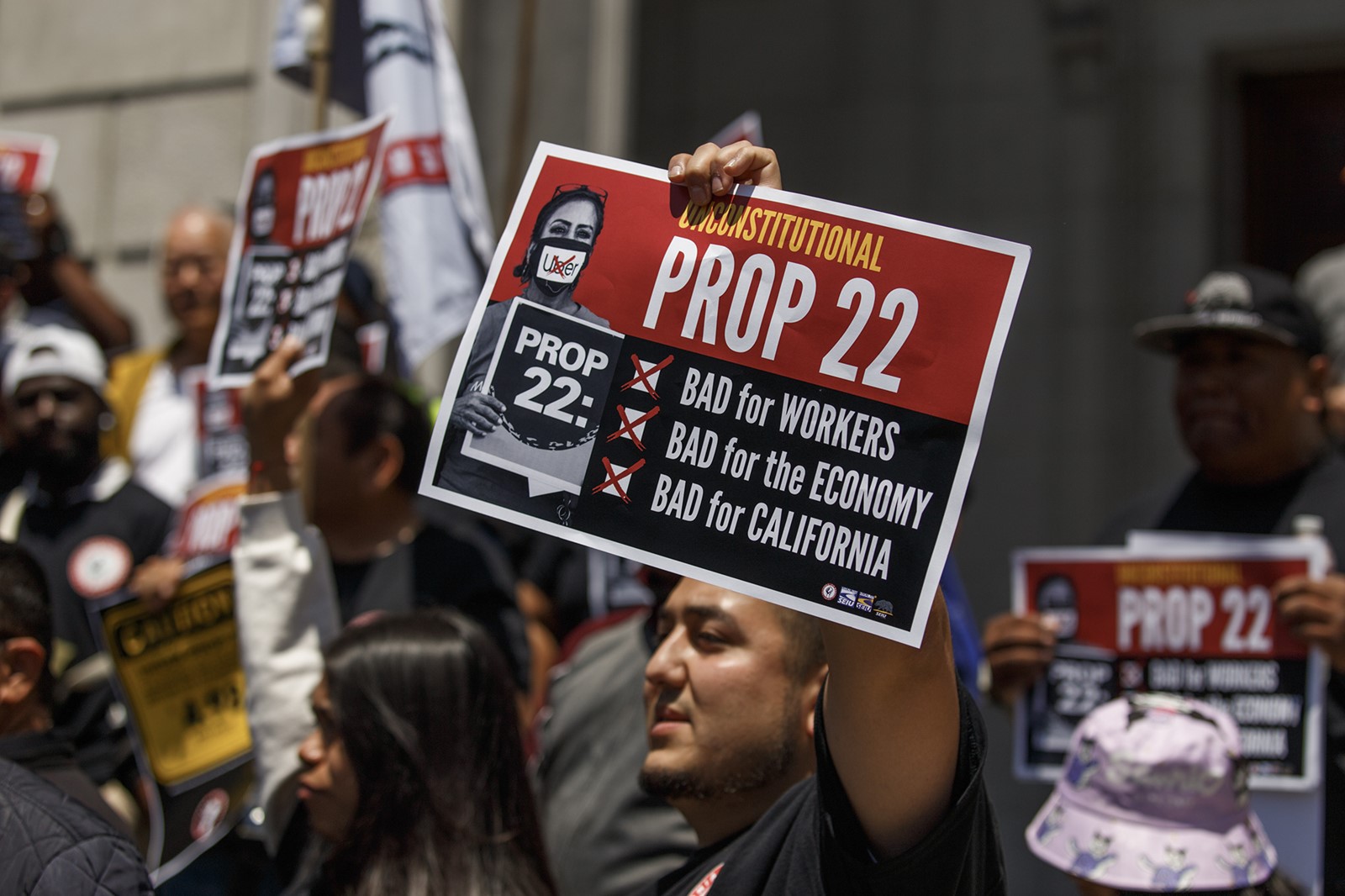


Nearly four years after California voters approved better wages and health benefits for ride-hailing drivers and delivery workers, no one is actually ensuring they are provided, according to state agencies, interviews with workers and a review of wage claims filed with the state.
Voters mandated the benefits in November 2020 when they approved Proposition 22. The ballot initiative was backed by gig-work companies that wanted to keep their workers classified as independent contractors and were resisting a 2019 state law that would have considered them employees. Proposition 22 stipulated that gig workers would remain independent contractors but be treated better.
The state Industrial Relations Department, which handles wage claims, now tells CalMatters it does not have jurisdiction to resolve those related to Proposition 22, citing a July 25 California Supreme Court ruling that upheld the law and therefore maintains that gig workers are not employees. That effectively passes enforcement responsibility on to the state attorney general, whose office was noncommittal when asked about its plans, saying that it does not adjudicate individual claims but does prosecute companies that systematically violate the law.
The lack of enforcement leaves in limbo workers who in many cases already have been waiting for months or years for the state to resolve their complaints. Workers have filed 54 claims related to Proposition. 22 since it went into effect in December 2020. At least 32 of them are unresolved, state records obtained by CalMatters show, although at least two of those are due to workers not following through.
Of the unresolved claims, one goes back to 2021, several are from 2022 and 2023, and about half are from this year, through May.
Emails included with the claims show that the Industrial Relations Department told one worker it was severely understaffed, and seven others, starting in 2022, that it did not have jurisdiction to help them since they were independent contractors rather than employees.
Although the number of claims filed with the state represent just a fraction of the more than 1 million gig workers in California, they give a glimpse into what happens when workers turn to the state for help instead of the companies that backed Proposition 22.
Workers say in the claims, and in interviews with Cal-Matters, that companies such as Uber, Lyft and Instacart failed to provide higher wages and health care stipends under the law, and that the companies’ representatives sometimes act confused or take a long time to handle their requests for Proposition 22 benefits. The gig companies have touted the law as something that has boosted pay and benefits, and have said it has helped gig workers hang on to work they can do whenever they want.
Laura Robinson is among the workers who have had to aggressively pursue what they believe they’re owed under the law. For the past year, she has filed claims with the state and fought two different gig-work companies for different benefits promised under Proposition 22.
She was making a delivery for Instacart a year ago, she said, when a driver making a U-turn hit her, totaling her car. Now, she said, she has lingering back pain, and has only been able to make a total of a few deliveries the past few months.
Robinson, who lives in Irvine, tried to get Instacart to retroactively provide her with occupational accident insurance as required under Proposition 22.
When she first contacted Instacart about the collision, “four or five different (representatives) told me on chat ‘we don’t provide insurance,’ but I told them this is California,” Robinson said. “Finally someone said ‘Oh, yeah, I know what you’re talking about.’ ”
Robinson had some difficulties documenting the accident, because, she said, the responding Torrance Police Department officer rode away on his motorcycle without writing a report. But after about seven months, she finally heard back from Zurich, Instacart’s insurance provider. She received a lump sum, and monthly payments for the time that she has been largely unable to work, according to bank statements and emails from Zurich to her, which she shared with CalMatters.
Instacart spokesperson Charlotte Healow said all the company’s shopper support agents should know about “shopper injury protection” and that there is information in the app about how to go about filing claims.
What gig workers are complaining about
The Proposition 22-related wage claims reviewed by CalMatters were part of a larger set of nearly 200 claims that gig workers filed with the Industrial Relations Department since the law took effect in December 2020.
Citing the California Public Records Act, CalMatters sought all wage claims in that time frame involving gig companies, but the state did not provide any claims against DoorDash, which is one of the biggest of the app-based gig companies.
A department spokesperson could not explain why.
Most of the claimants sought delayed or unpaid wages, including adjustments owed under Proposition 22. Others sought health care stipends required under the gig-work law, and one driver said he sought occupational accident insurance but did not receive it.
The claims also shed light on the mechanics of how app companies are allegedly withholding wages. In them, some gig workers claimed that they were deactivated — kicked off or fired by the app — before receiving all their wages.
The records also indicate the state had trouble holding app companies to account in a timely fashion. In emails about the claims, some workers frequently asked for updates about their cases and complained about limited communications from the state. This prompted one supervisor in the Industrial Relations Department’s San Francisco office to respond by email on May 30, seemingly noting that gig workers’ complaints were just a fraction of the array of worker complaints the state fields: “I am working with 40% staff shortage. There are over 3,000 cases, most of which are older than yours, and only seven people (total) to handle them.” The department did not respond to requests for comment on whether this shortfall persists.
Monetary wage claims ranged from about $2 to nearly $420,000. Most — 54% — were against ride-hailing and delivery giant Uber and 25% were against its rides competitor Lyft. There were 17 claims against grocery-delivery app maker Instacart, seven against food-delivery platform Grubhub, four against Target-owned delivery service Shipt and three against UPS-owned delivery service Roadie.
In an unsigned email response to CalMatters’ questions after the state Supreme Court decision, including whether it planned to pursue Proposition-22-related cases against gig-work companies, the attorney general’s office said gig workers can submit complaints at oag.ca.gov/report.
The email added: “Although the attorney general does not represent individual workers or adjudicate individual complaints by holding administrative hearings like (the Department of Industrial Relations), DOJ brings lawsuits to hold accountable companies that systematically break the law, for example through widespread violations of wage and hour standards. Reports or complaints of employer misconduct are an important part of our work.”
When CalMatters previously asked the attorney general’s office for copies of any wage complaints it had received from gig workers thus far, a spokesperson responded that the office was representing the state in its effort to defend Proposition 22 before the California Supreme Court — and referred CalMatters back to the Industrial Relations Department.
Gig companies have said that, due in part to the initiative’s earnings guarantee, workers now make more than $30 an hour. But a May study by the UC Berkeley Labor Center found that, for California ride-hailing drivers, average earnings after expenses, not including tips, is about $7.12 an hour, and for delivery workers, $5.93. With tips, drivers’ average hourly earnings are $9.09 an hour, and $13.62 for delivery workers, the study found.
To better understand the impact of Proposition 22, CalMatters asked each of the four largest gig companies — Uber, Lyft, DoorDash and Instacart — the following:
• How much they have spent on delivering on each of Proposition 22’s four main promises:
• 120% of minimum wage earnings guarantee.
• Health care stipends, occupational accident insurance and accidental death insurance.
• How many gig workers have received each of the promised benefits.
• Whether they have passed on costs to consumers, and if so, where they account for those customer fees in their public financial filings.
• How they handle complaints or issues related to their promises.
Lyft said 85% of California Lyft drivers who have driven for the company since Proposition 22 went into effect have received at least one wage “top up” — the additional money drivers receive under the earnings guarantee — through the end of the fourth quarter of 2023, though spokesperson Shadawn Reddick-Smith would not provide specific numbers of Lyft drivers in the state. None of the other companies would give any information on its delivery of the wage guarantee.
Instacart spokesperson Healow said the company has paid out about $40 million in health care subsidies to its delivery workers, which she said number in the tens of thousands in the state. She also said about 11% of California shoppers have become eligible for a health care stipend since Proposition 22 took effect, and that 28% of those eligible shoppers have redeemed their subsidy.
To qualify for the health care stipends, workers must work at least 15 hours a week each quarter, and be enrolled in health insurance that is not provided by an employer or the government.
 PREVIOUS ARTICLE

