


Local Muslims express surprise, disappointment in Trump victory


Muslim-Americans, who were a frequent target of Donald Trump's divisive rhetoric throughout his presidential campaign, expressed surprise and disappointment with his election victory Tuesday, but said they would not jump to conclusions about what a Trump presidency might mean for them and their families.
“I was a little shocked, concerned, worried,” said Western Springs resident Nader Zughayer, who went to bed around midnight Tuesday, before the election was called, because he couldn't stomach the impending result. “But, as of now, the only thing we can do as a community is support the president, hope for the best, and if you don't like it, next time, if you didn't vote, get out and vote.”
Zughayer's gracious, wait-and-see sentiment mirrored that of numerous Muslims interviewed Wednesday morning across the Southland.
“It's foolish for anyone now to stand up and try to pretend to know how (Trump) is going to govern,” said Safaa Zarzour, superintendent of the Universal School, an Islamic school in Bridgeview, and chairman of the Council on American Islamic Relations in Chicago. “There are signs both ways, and so, most people have the wait-and-see attitude.”
Zarzour, who emigrated from Syria some 30 years ago to attend school in the United States, said he tried to reassure Universal School's student body during an assembly Wednesday morning that, despite Trump's campaign rhetoric about banning Muslim immigration to the United States, America is still a country of laws with a constitution.
“He is not governing Somalia, not governing a lawless place,” Zarzour said. “He's governing a country that has a constitution, that has institutions, civil society. A country that has struggled to reach better places constantly, and not cheaply, with sweat and blood, whether it's the civil rights movement or whether it's the suffrage movement before that.
“And it will continue,” he said of Americans' struggle for a more perfect union. “We, as a community, will basically continue to do what we are doing. We are a community that is about family, about faith, about working hard, about earning your money every day to feed your family, and we will just continue to do that.”
Zarzour said he also thought it important, due to students' concerns over Trump's anti-Muslim rhetoric, to remind them that they were Americans, whose faith did not make them less of an American than any other citizen.
“We wanted to reassure them that, ‘You are an American,' and don't let anybody make you feel inferior,” he said he told them, “and use your brains and your rights as a citizen to basically make sure that you have a place in this country.”
Tammie Ismail, the principal of Aqsa School, an all-girls Islamic junior high and high school in Bridgeview, said she also spent much of the day reassuring concerned students that Trump's election would not mean the deportation of their families or the loss of their agency to effect change as Muslim-Americans.
“We talked a lot about the idea of our democratic process and that we had checks and balances and that no one person can hold ultimate power,” said Ismail, who stressed to students that the foundational concepts of the United States, such as freedom of speech and religion, would not change.
“I just don't want my students to lose their sense of hope, or to lose faith that they can be an integral part of the system and of their greater community,” she said.
Ismail said she had made a concerted effort throughout the campaign season to assure students that there were non-Muslim members of the community who stood with them, citing a Catholic woman who showed up at the school unannounced with flowers during an especially low point in the campaign to show interfaith solidarity.
“I am very cognizant of sharing these experiences with my students so they realize that in our community there are many people who believe in coming together and celebrating our differences and not being divisive,” Ismail said.
Zarzour attributed Trump's appeal to the fear some Americans feel over the country's changing demographics and said that many “good-meaning white Americans” voted for Trump out of that fear.
He expressed surprise, however, that in today's day and age, that sort of appeal remains convincing to so many people.
“I thought that that kind of politics and playing to fear were over in America,” he said. “I thought that we were beyond that.”
Nihad Hannoun, who moved to the U.S. from Palestine in 1995 and now lives in Tinley Park, also was shocked and disappointed by Trump's victory, which has caused America to lose some of its luster for him.
“I never thought it was going to come to this point, that somebody like Trump could be a president of this country,” said Hannoun, who drives a cab in Chicago. “It was sad to see this country go into this direction because growing up you always dreamed to come here.”
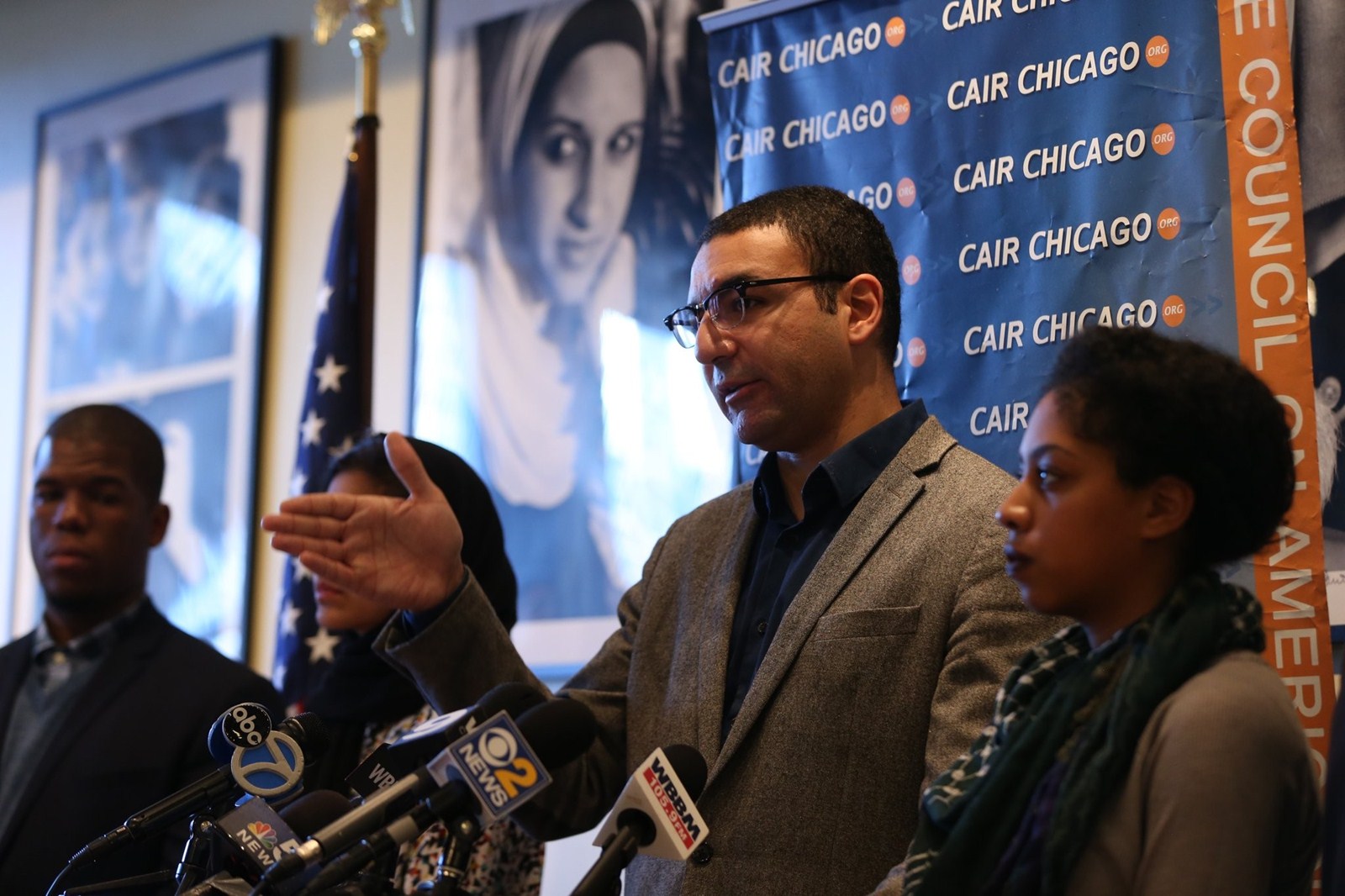
At an afternoon news conference Wednesday, the head of the Council on American-Islamic Relations' Chicago chapter expressed his “personal shock” at Trump's victory, and pledged to form alliances with other groups to organize and fight back against attempts to make Trump's campaign rhetoric a legislative reality.
“I'm very concerned as a Muslim,” Ahmed Rehab, CAIR's executive director, told reporters. “I'm concerned about a candidate who is now going to be president who said on the campaign trail he wants to ban all Muslims en masse just because they're Muslim.”
Despite Trump's calls for unity after his Election Night victory, CAIR officials said the Muslim community has many misgivings about a candidate they say scapegoated minority communities.
Rehab, who at different points referred to the president-elect as a “boastful misogynist and sexual predator” and a “detached billionaire” who was similar to a third world dictator, said Trump's rhetoric had caused major concern within the Muslim-American community, which is growing increasingly disenfranchised and mistrustful of the government.
Zarzour said that while most Muslims are not naive to the fact that many Americans hold anti-Muslim beliefs, Trump's campaign rhetoric had mainstreamed intolerance of Muslims in the U.S.
He believes Trump will be blamed for any flare-ups of violence and hate speech directed at Muslims in the coming years, but doesn't anticipate that an increase in outward anti-Muslim speech will necessarily cause rates of homegrown radicalization to grow among young Muslims.
“My contention is that the Muslim community in the United States is far more mainstream and less radical than any other group there is, more law-abiding,” he said. “In part, because a lot of people feel like they need to prove something, because of the media, because of the rhetoric, and I don't see that changing.”
Zarzour and other Muslims interviewed are holding on to hope that Trump's demonization of wide swaths of the country's minority population was a political tactic, an effort to rile up his base supporters that is not indicative of his actual beliefs.
“It may be that his bark is a lot worse than his bite,” said Zarzour, who does not view Trump as an unreasonable ideologue. “That he's, again, throwing the red meat at his people, but, he, as a businessman knows he has to try to deal. He knows that he has to try to govern this country. He knows he has to deal with the world outside.”
Mohamad Khawaja, a 55-year-old Chicago Ridge resident who works in retail, agrees and believes that Trump's past promises about his plans for immigrants and the Muslim community are likely fantasy.
“I believe he doesn't mean 90 percent of what he said,” said Khawaja, who suspects much of the rhetoric was merely campaign promises.
Khawaja called Trump “unpredictable,” and not in a good way. The millionaire reality TV star and real estate mogul is all about money and business, he said.
“I don't think he cares about people,” Khawaja said.
While most Muslims interviewed by the Daily Southtown said they, like most Muslims they knew, feared a Trump presidency and actively supported Hillary Clinton, the community is by no means monolithic in its beliefs.
Dr. Raad Rashan, 64, said he supported Trump during the campaign, even though he didn't vote in the election.
The Iraqi-American doctor, who lives in Burr Ridge and has offices in Bridgeview, agrees with Trump's criticisms of Obamacare and said his practice had lost money since the health care exchanges were established. He hopes the president-elect follows through on promises to repeal it.
Rashan, who is originally from the city of Mosul, said he wants to see what Trump will do to fix the mess left by the war started under the George W. Bush administration and by the troop pullout under President Barack Obama's watch.
“We are witnesses to history for what he's going to do,” Rashan said.
In the event that Trump does indeed double-down on the aggressive anti-immigrant and anti-Muslim sentiment he expressed at times during his campaign, Zarzour believes minority communities will be ready to respond accordingly.
“The silver lining is that, at least with Trump, you have so many people placed in a broad brush category — immigrants, Latinos, African-Americans, Muslims — that's a pretty decent front that you have in front of you, and for them to stand together would be hard to ignore, for Trump or anybody.”
Zughayer, who grew up in Oak Lawn, said a Trump presidency makes him fear for the fate of the entire world, and especially for his children's futures, but agrees that Trump deserves a chance.
“He didn't do anything yet, so I mean, it might not be the popular answer, but you gotta give him a chance and see what happens,” he said. “And then based on what he does and the things that he does, if you need to mobilize and it can make a difference, then by all means mobilize.”
 PREVIOUS ARTICLE
