


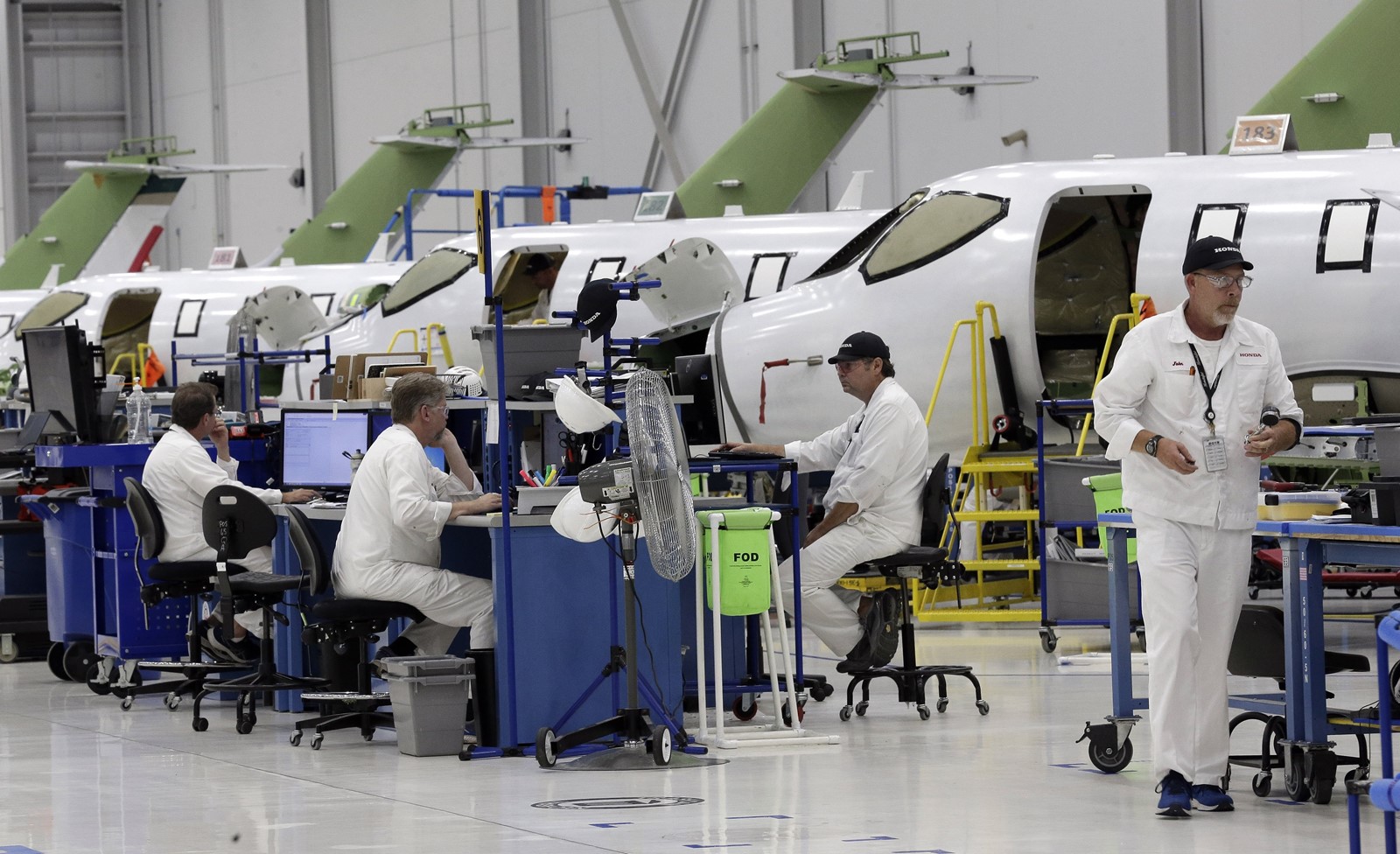


Honda Aircraft CEO Michimasa Fujino said that a current plant expansion aimed at improving efficiency is part of the aviation division’s long-term strategy and should also slightly increase production of the seven-seat, $5.2 million HondaJet Elites.
“We are looking at this aviation business long-term, not quarterly or annual basis,” Fujino said at the company’s Greensboro, North Carolina, headquarters. “Our goal is to create new value and new technology as a personal mobility company.”
But amid environmental concerns about the impact of hydrocarbons burned by jets, fears of a possible global recession and declining profits that have led Honda to retrench its automobile offerings, analysts say the Tokyo-based corporation faces decisions about how much to build its aircraft division.
Whether Honda expands, maintains its current footprint or even scraps its aircraft division is “very much their choice,” said Richard Aboulafia, an aerospace analyst at Teal Group.
It would cost Honda billions of dollars to expand into a family of light jets or establish a sales and support network to match competing jet-makers, Aboulafia said. But such a move would be necessary for growth in an industry where — much like automakers offer models in different sizes and prices — wealthy customers who like Honda’s planes may want to buy something nicer, said aviation business analyst Brian Foley, who thinks Honda could announce a new model soon.
“In this industry, you need to have a step up for customers. Just like boat owners, airplane owners — when they’re ready to trade in and move up — do that. They move up. They don’t move laterally,” he said. “So since HondaJet doesn’t have a move-up airplane from the current Honda jet that would force the customer to have to jump over into a competitor’s airplane.”
The company is recruiting engineers with expertise in wing, fuselage and systems design, which indicates they could be developing new models, Foley said.
Meanwhile, Honda reported a 29% profit decline in the quarter ending in June and lowered its profit forecasts for the fiscal year. In May, the company announced it would streamline its auto product offerings, consolidating model variations, and increase parts-sharing to cut costs. The warning signs come as Honda has invested billions in the past year in General Motors’ autonomous vehicle unit as automakers look to the future.
On the plus side for its planes, Honda has deep pockets, a history of long-term planning and has stuck with the project despite repeated delays before the first deliveries in December 2015. The company has delivered 140 planes since the first model was cleared by the Federal Aviation Administration.
 PREVIOUS ARTICLE

