


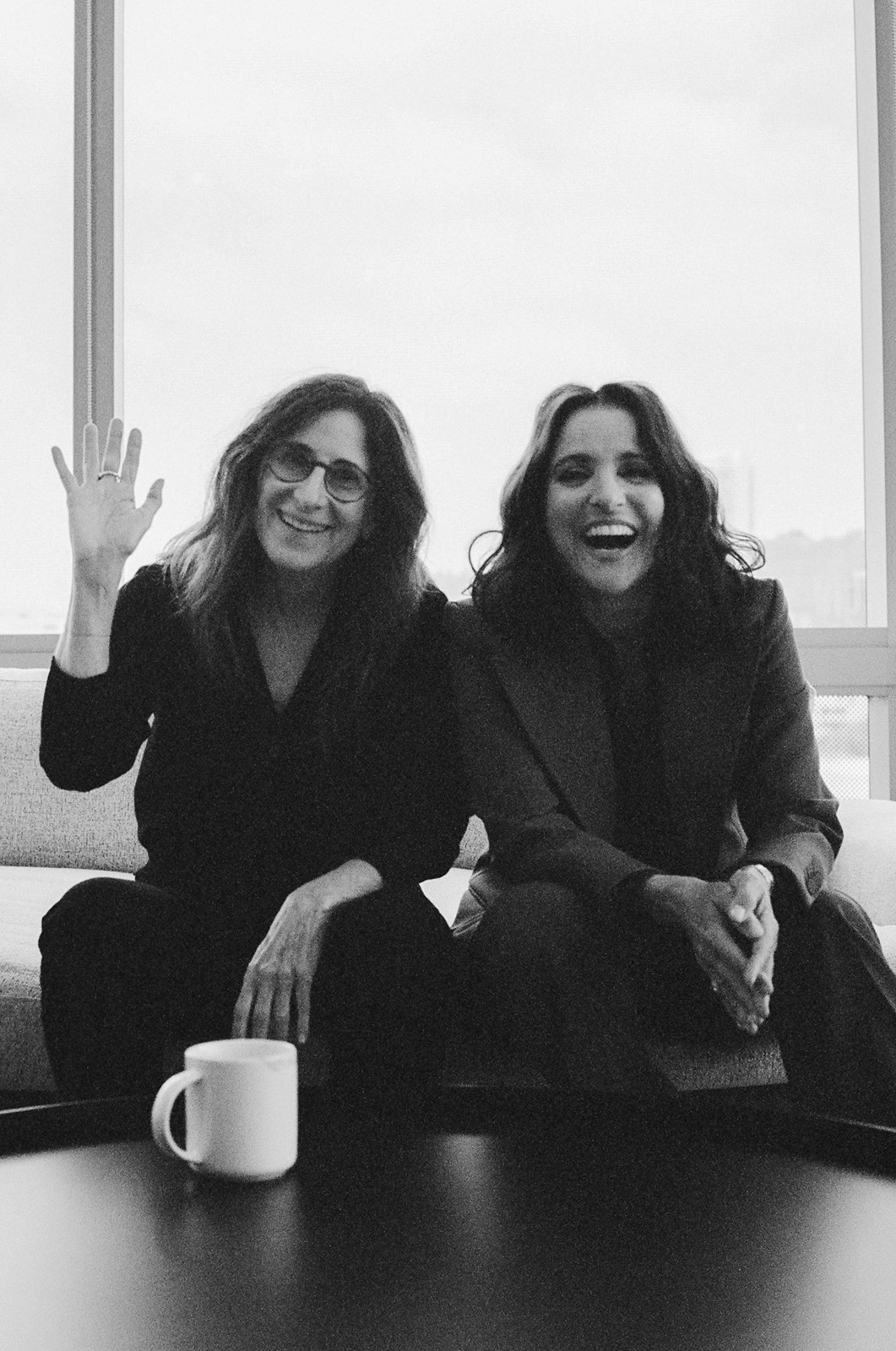


SANTA MONICA, Calif. >> Sisters from another mister. Cinematic alter egos. However you define it, Julia Louis-Dreyfus and Nicole Holofcener have a connection that rivals the great movie partnerships of our time. New York transplants who are similar in height and in age, Louis-Dreyfus, 62, and Holofcener, 63, each have two grown sons, a healthy self-deprecating attitude and the ability to riff on any topic: cake (it’s their favorite dessert), Hollywood gossip (yes, Robert De Niro did just have a baby) and the indignities of aging.
Holofcener arrives at the restaurant at Shutters on the Beach first, takes glass cleaner out of her purse and cleans her brown-rimmed spectacles. Five minutes later, Louis-Dreyfus grabs a chair, pulls out the same glasses in green and her own bottle of glass cleaner, and wipes them clean. (Am I the only one who doesn’t carry glass cleaner in her purse?)
On the set of their new film “You Hurt My Feelings,” they were like two halves of the same person. Louis-Dreyfus was styled similarly to how Holofcener usually dresses: loose-fitting pants, button-down blouses. With COVID protocols firmly in place at the time — those not in a scene were masked up — they were often mistaken for each other.
“You definitely feel like they are separated at birth,” said producer Anthony Bregman. “They are both mothers before filmmakers. They have the same sense of humor, the same honesty, the same potty mouth. But I think what’s at the core is that they have the same disbelief, or wonder, at the narcissism of social interaction.”
The two first met a decade ago, when they partnered on “Enough Said,” the 2013 romantic comedy about a divorced woman grappling with sending her daughter off to college while contemplating a new love. They later collaborated on an Amy Schumer sketch that went viral but weren’t able to make another film together, until now. “You Hurt My Feelings” follows Beth (Louis-Dreyfus), a somewhat successful and happily married writer who overhears her husband, Don (Tobias Menzies), criticizing her new novel. The fallout proves devastating.
Q: Was there an inciting incident that prompted this film?
Holofcener: It started brewing as soon as I started screening my movies or having people read my scripts, wondering if they’re telling me the truth or not. And believing that I can tell. What a nightmare this situation would be, if somebody that close to me revealed to someone else that they didn’t like my work, or even just one of my movies. They have to love everything, in other words, for me to feel safe.
Louis-Dreyfus: She’s very sensitive.
Holofcener: I just came up with a what-if. What would be the worst scenario of somebody telling me they love something and me not believing them? I do have friends that I don’t believe. And there’s one person in particular that I don’t believe. I’m actually OK with it. Because I know they love me and get me and clearly they’re wrong. I mean, it hurts a little. They didn’t admit it.
Q: Since Nicole wrote this script with you in mind, did you connect to it immediately?
Louis-Dreyfus: Yes. I think it’s interesting to consider the notion of worth and self-worth. Am I my work? And who am I without my work? That’s certainly something I like to think about. And that this is ostensibly a great relationship between a married couple, and then the wheels just totally fall off the bus. That was kind of terrifying to consider.
I told Frank Rich (a former New York Times columnist who was an executive producer of her series “Veep”) the premise of this before we shot it. He audibly gasped.
Holofcener: Oh, good. That’s my audience. Not the people who would hear the premise and go, ‘Yeah, so what? Like, what planet are you from?’
Q: Since you wrote this with Julia in mind, did that change your approach?
Holofcener:(To Louis-Dreyfus) Just don’t listen, because it’s going to sound stupid.
(Louis-Dreyfus throws her cappuccino-stained napkin over her head to avoid eye contact.)
Holofcener: When you have Julia in your head, it’s bliss, because it just makes me funnier, knowing that she’ll do it. She just sparks my imagination.
Q: How difficult was it to shoot the scene in the street right after she’s overheard her husband trash her novel?
Louis-Dreyfus:That was very nerve-wracking because we had paparazzi issues that day.
Holofcener: It was our first day.
Louis-Dreyfus: Which sucked, by the way. We didn’t own the street. It was just brutal trying to shepherd people and get them out of the shot or into the shot or whatever. And then we have paparazzi across the street, as I’m trying to legitimately look as if I’m going to vomit. You know, that’s not a good look.
Holofcener: And they want to take your picture.
Louis-Dreyfus: I’m trying to stay in the scene. But that look of when you’re actually heaving. I defy the most beautiful woman in the world, Isabella Rossellini is not going to look good, doing that.
Holofcener:She did it so well that someone walked by and asked her if she was all right.
Q: The majority of the characters in this film are experiencing doubt over their careers and if they can or should pivot to doing something else. Clearly, that topic was on your mind, Nicole.
Holofcener: I wonder how much time I have left, and do I want to be doing the same thing. Is it too late and what would I do? I think a lot of my friends feel the same way. Or they’re retiring early and making pottery and are very happy. I can imagine retiring.
Louis-Dreyfus: You can?
Holofcener: Yeah, just like, leave me alone already. I have no more ideas.
Q: Do you really feel that you’re out of ideas?
Holofcener:Well, at the moment I’m out of ideas.
Q: Do you usually feel this way right after you’ve finished making a film?
Holofcener:I’m usually out of ideas every day. That’s why I make so few movies. So it’s really true. I don’t know if I’ll make another movie. I hope that’s not the case. I did think that before this movie, so, you know, I’m assuming I’ll keep going for a while.
 PREVIOUS ARTICLE
