


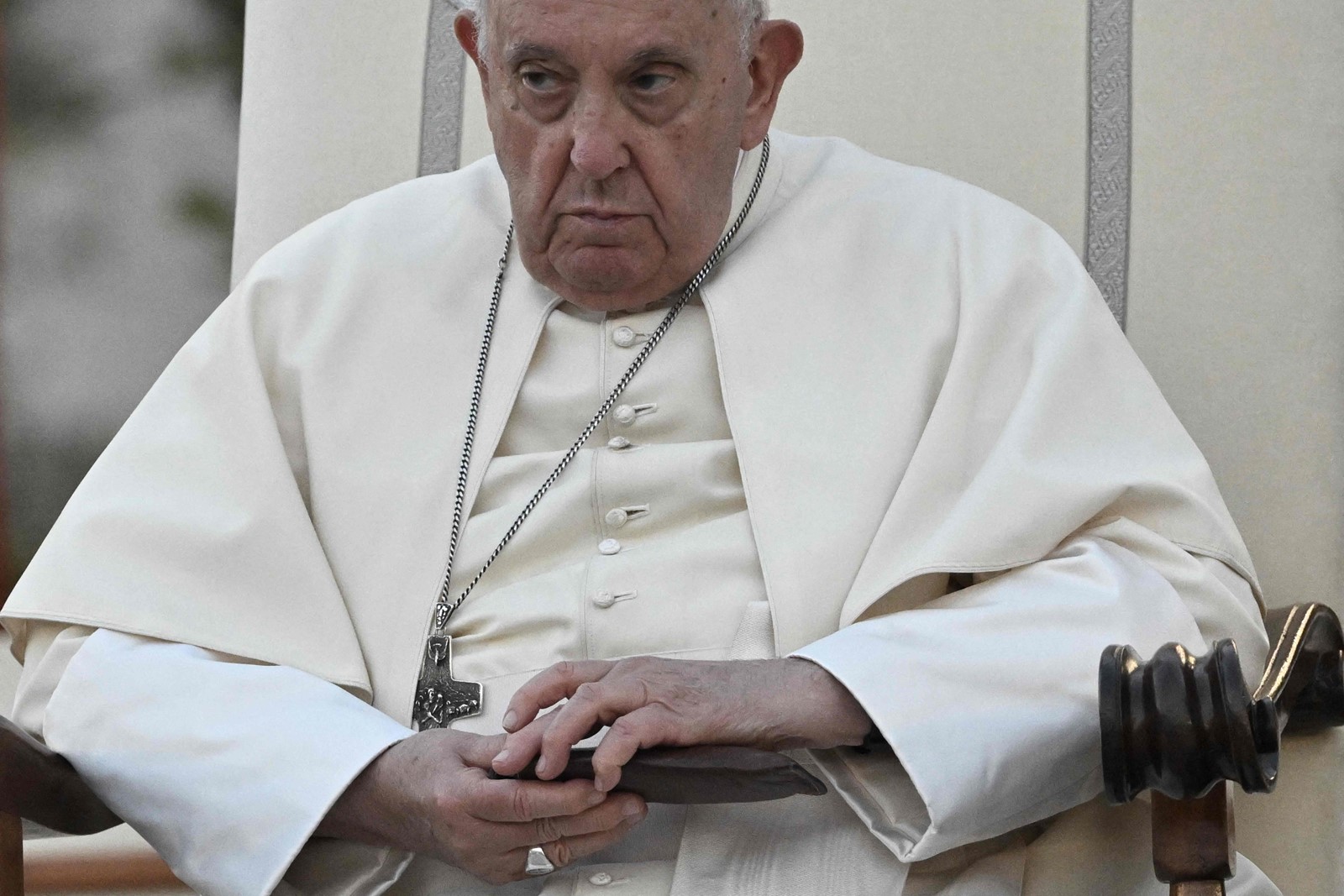


ROME — Throughout his decade as leader of the Roman Catholic Church, Pope Francis has allowed debates on previously taboo topics and set in motion subtle shifts toward liberalizing changes that have enraged conservatives for going too far and frustrated progressives for not going far enough.
This month, starting Wednesday, Francis’ desire for the church to discuss the concerns of its faithful, even the most sensitive topics, will culminate at the Vatican in an assembly of bishops from around the world that will allow, for the first time, lay people, including women, to attend and vote.
The issues under discussion will include priestly celibacy, married priests, the blessing of gay couples, the extension of sacraments to the divorced and the ordination of female deacons.
Detractors are wary of the very nature of the assembly, known as a synod, and have criticized it as a bureaucratic talkathon or as an insidious Trojan horse for progressives to erode the church’s traditions under the cloak of collegiality.
Supporters see a chance to put into practice the pope’s bottom-up view of the church as an inclusive institution that upends the traditional hierarchy and forces bishops to listen to and work with their flock more.
For them, more than any single issue on the table — and more even than culture war favorites like abortion, same-sex marriage or euthanasia, which were left off it — it is the process of bishops and lay people working and voting together that amounts to the most potentially transformative change.
“It is an amazing moment,” said Renée Köhler-Ryan, the dean of the School of Philosophy and Theology at the University of Notre Dame Australia, who will be a voting participant in the meeting, one of the first women ever to do so.
Still, many church watchers say, it remains to be seen whether the gathering becomes an instrument for the transformation that traditionalists dread or another opportunity for the papal punting that has left the church’s liberals disappointed.
It may end up as neither, and in any case, it is only the first phase of a two-year process. The participants will reconvene in Rome in October 2024, after which the pope is expected to issue a document endorsing or rejecting any recommendations.
“Hopes and fears for the synod are overinflated to the point where it’s hard to see a resolution or an outcome from either this October or next October that doesn’t leave at least one large part of the church feeling not just disappointed but deceived,” said Stephen P. White, a fellow in Catholic studies at the Ethics and Public Policy Center, a think tank in Washington.
There are other reasons the assembly — formally called the Synod on Synodality, essentially a working meeting on how to work together — may disappoint.
It follows two years spent canvassing local churches to better understand the concerns of rank-and-file faithful around the globe. But, as White pointed out, only a fraction, perhaps a few percent, participated in the canvassing process.
Many of the issues to be discussed are contentious because the faithful themselves had put them on the table, Köhler-Ryan said, adding that she hoped the inclusion of lay people would lend a more quotidian perspective — a “kind of grittiness” — to the synod.
But, she noted, her vote was not part of a democratic process because the decisions rested with the pope alone.
“The big question becomes,” she said of the issues, “how does the synod deal with them?”
The answer is slowly and in secret.
“This is not a TV program where they talk about everything,” Francis said last month.
He has conceded that the process may appear obscure.
“I am well aware that speaking of a ‘synod on synodality’ may seem something abstruse, self-referential, excessively technical and of little interest to the general public,” Francis said in August. But, he added, it “is something truly important for the church.”
Francis is relying heavily on what Jesuits, the order to which he belongs, call discernment, a deliberately pensive decision-making process that creates the space and time for a spiritual dimension to enter the equation — and perhaps for wider support for important changes to coalesce.
Critics of Francis often roll their eyes at the mention of the word. And church observers have noted that his reliance on discernment has allowed him to delay on big decisions, either out of a lack of boldness or to build support and perhaps political cover among his bishops. The Synod on Synodality is built, experts say, to do just that.
Yet the process has prompted some bewilderment.
“I’ve been trying to explain this one to myself and others for the last little while,” Köhler-Ryan said. In her understanding, synodality referred to different members of the church working shoulder to shoulder. “It’s a moment in the church where we practice what we’re trying to become,” she said.
The assembly’s leading officials have characterized it as reflecting the church’s diversity and its diversity of concerns.
Some participants were coming with the hope of important shifts.
The Rev. James Martin, a Jesuit priest and an advocate for LGBTQ+ Catholics who was personally invited by Francis to participate, said he hoped the assembly would listen to their experiences.
“That’s enough of a change because in many parts of the world, they’re not listened to,” he said, pointing out that many are kicked out of parishes for being gay or have to worship under church leaders who support laws criminalizing homosexuality.
Helena Jeppesen- Spuhler, who works for the Swiss Catholic Lenten Fund, a Catholic relief agency, will also participate in the assembly. She said the church required change to survive, adding that she would “pragmatically” argue for women to be ordained as deacons as a first step to becoming priests and bishops, which was, she acknowledged, a bridge too far for now.
“That’s what I’m carrying here to this assembly, to the worldwide church,” she said, arguing that the focus on women in all of the continental surveys showed that there was a desire for such a change, and “I really see a chance.”
But she also recalled the disappointment and frustration in 2019, at a previous synod, when Francis balked at allowing some married men to become priests and women to become deacons, despite receiving an overwhelming vote of support from bishops.
“The question is, ‘Will he do that probably again?’ ” she said. Or perhaps a “consultation from all over the world and the reports from all over the world” would demonstrate the support he needed to follow through.
 PREVIOUS ARTICLE
