


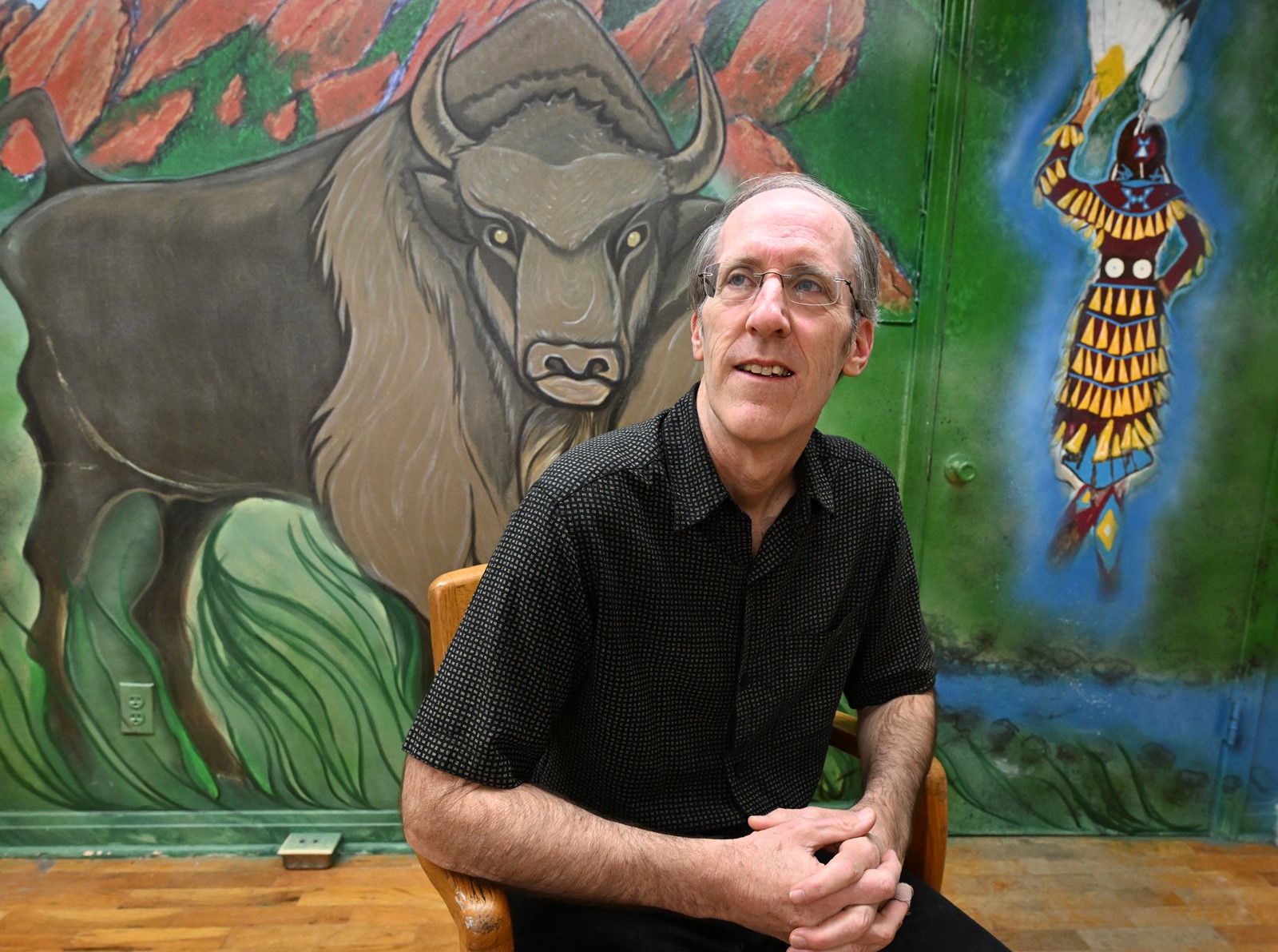


There are only about 50 people worldwide who are native speakers of the Arapaho language.
The only native speakers left are part of the Northern Arapaho Tribe in Wyoming, according to University of Colorado Boulder linguist and professor Andrew Cowell. The Southern Arapaho Tribe in Oklahoma has no native speakers, people who grew up learning Arapaho as their first language.
“Can we save a language that’s down to around 50 (native) speakers in the world?” Cowell said. “That’s a pretty scary bottleneck to confront.”
Despite the challenge, Cowell is doing just that. He has created two digital databases to preserve the Arapaho language so it can be taught to younger generations. One database is a collection of words, similar to a dictionary, and the second database is similar to an anthology, containing recordings of more than 100,000 sentences spoken by about 100 native Arapaho speakers.
“It’s a collection of conversations and stories and so forth that I’ve compiled from many different speakers over the years,” Cowell said.
Cowell has been working on the Arapaho language for about 25 years, and some of the text in the database goes back that far. Over the years, he continued to build his archives of information by recording and transcribing and translating many speakers across genders and ages.
He built relationships with the Arapaho people in Wyoming, even becoming a speaker of the language himself and getting adopted into the tribe. During a ceremony, Cowell was given an Arapaho name and was adopted into one of the families. He visits regularly and partakes in family gatherings, weddings and funerals.Raphael Youngchief is part of the family that adopted Cowell. When Cowell first started working with the tribe, he stayed with Youngchief’s grandfather, and Cowell gained knowledge and learned a lot about the language from him.
“I basically grew up knowing Andy as a relative,” Youngchief said, who is now 30 years old.
Youngchief is now a middle and high school Arapaho language teacher for the Wyoming Indian Schools. He relies on Cowell’s databases as a resource to help him teach the language. Arapaho is not his first language, and he’s not completely fluent. There might be a word a student asks about that he doesn’t know off the top of his head because he doesn’t use it every day. But now he has the power to look it up to jog his memory.
Youngchief’s grandparents, who were first-language speakers, are no longer alive, and he no longer can rely on them for language help.
“A lot of that database actually comes from some of the written material from my grandparents and the other speakers that (Cowell) worked with,” Youngchief said. “I use (the database) quite a bit, and … my grandpa was basically the same way as how Andy is. He worked tirelessly preserving the language and kept many documents of the language written down.”
The online dictionary database is available publicly online. The second database, which is not publicly available, has phrases and sentences which allow for more in-depth analysis, such as searching for how common a certain part of the grammar is, or how many times a word is used. Users can also listen to recordings of native speakers. Both databases have been used to develop student dictionaries and curriculum for native students that is built from real-world language patterns. It’s being used already by teachers such as Youngchief at Wyoming Indian Schools to teach students the Arapaho language.
‘Our language is everything’
The Arapaho people were a tribe of Native American nomadic buffalo hunters who historically lived on the plains of Colorado and Wyoming. Today, the Arapaho people are federally recognized as part of the Northern Arapaho Tribe in Wyoming or the Cheyenne and Arapaho Tribes in Oklahoma.
The Arapaho language is not dead or extinct, Cowell said, but there are roughly 50 native speakers left who grew up with it as their first language in their home. And, all of them are now in their 70s or older.
Elena Singer, the language and culture director at Wyoming Indian Schools, said the databases are a vital piece of preserving and moving the language forward. Language teachers are using it to develop lessons, curriculum, assessments and activities. Singer is also part of the Northern Arapaho Tribe, and her dad and grandparents were speakers.
“Our speakers are a precious resource, our language is everything,” Singer said. “It contains our worldview. … It connects you forward and it connects you to the past.”
When he began this work, Cowell never anticipated it would result in this type of technology — which didn’t exist when he started — that could help teachers develop curriculum.
“It really shows that as a person, you have to do something you care about and trust that the value will happen,” Cowell said. “But I think it also shows the value of universities and the value of investment in research. We have to trust that there’s an outcome of this that’s going to happen. There’s going to be value that’s going to be produced, and if you try to say, well, what’s the value of that right now, you probably wouldn’t find a lot of the research that we’re doing. But the outcomes far exceed anything you would ever imagine.”
Now, Cowell said, he’s focused on helping a few people speak the language well. By finding 10 to 15 people in their 20s to 40s, they can develop teachers who can pass on their knowledge of the language to young kids. The long-term goal is to start immersion schools for preschool and kindergarten students, where students learn in Arapaho and are immersed in it. That way, the kids can learn the language naturally. Cowell said immersion schools are proven around the world as an effective strategy for revitalizing native languages.
Cowell is also working with the Southern Arapaho in Oklahoma, where people he works with are also learning the language.
“I’m not going to be around forever. The native speakers aren’t going to be around forever,” Cowell said. “We’ve got to make sure this language gets passed on to people who will have an understanding.”
There’s already a wide variety of people learning the language, from 10-year-olds learning as children to 25-year-olds who never learned it as children and 40- to 50-year-olds who know some of the language but aren’t fluent.
Speaking Arapaho connects Youngchief to his grandparents and promotes his sense of belonging, he said. The language is a central part of tribal identity for the Arapaho people.
“You’re not Arapaho unless you talk Arapaho, so you need to talk as much as you know,” Youngchief said. “It might not be a lot sometimes, but that’s fine. As long as you’re willing to learn and talk and put the language into the universe like that … you’ll get the hang of it.”
These databases are going to have a deep, meaningful impact on the Arapaho people, Youngchief said.
“It reaches not just me, but there’s going to be future speakers and future teachers who are going to be using these databases,” Youngchief said. “And maybe (they will) be able to collect more work and continue adding into these databases with more stuff we can do to preserve the language even more.”
‘Part of our state’s history’
Cowell said the world appears differently when looking at it from an Arapaho perspective, and the language is a big part of that. The names for animals, plants and places are often more descriptive, for instance. The word for hummingbird in Arapaho means little metallic bird, and Longs Peak is called the Two Peaks in Arapaho, who considered Mount Meeker and Longs Peak as one.
Place names around the state are also still based on the Arapaho language. Kawuneeche Valley in Rocky Mountain National Park is named after the Arapaho word koo’ohwuuniicii, pronounced kah-ah-woo-nee-chee, and it means coyote river. Nearby, the mountain range known as the Never Summer Mountains is a name that comes from the Arapaho word niiciibiicei’i, pronounced nee-chee-bee-chay-ee, which means never summer, because it’s never summer in those mountains.
Arapaho words have internal meanings to them, which often translate into a much more detailed meaning than the equivalent in English, Cowell said. One of his favorite Arapaho words is hiniito’eibetiit, pronounced hee-nee-tah-ay-bah-teet. It is normally translated as making peace or friendship, but what it literally means is “become relations of one another” or “taking each other as relatives.” Cowell said that’s much more expressive than just “making peace.”
Another word is heeteenebetiit, pronounced hah-tan-ah-bah-teet, which often is translated as respect but actually means “thinking of each other as important or significant.”
“They are part of our state’s history, and I think learning about the Arapaho people and the Arapaho language can enrich, to at least a small degree, the lives and experiences of everyone in Colorado,” Cowell said.
 PREVIOUS ARTICLE
