




The slogan says it all: “Let this Native be your creative.”
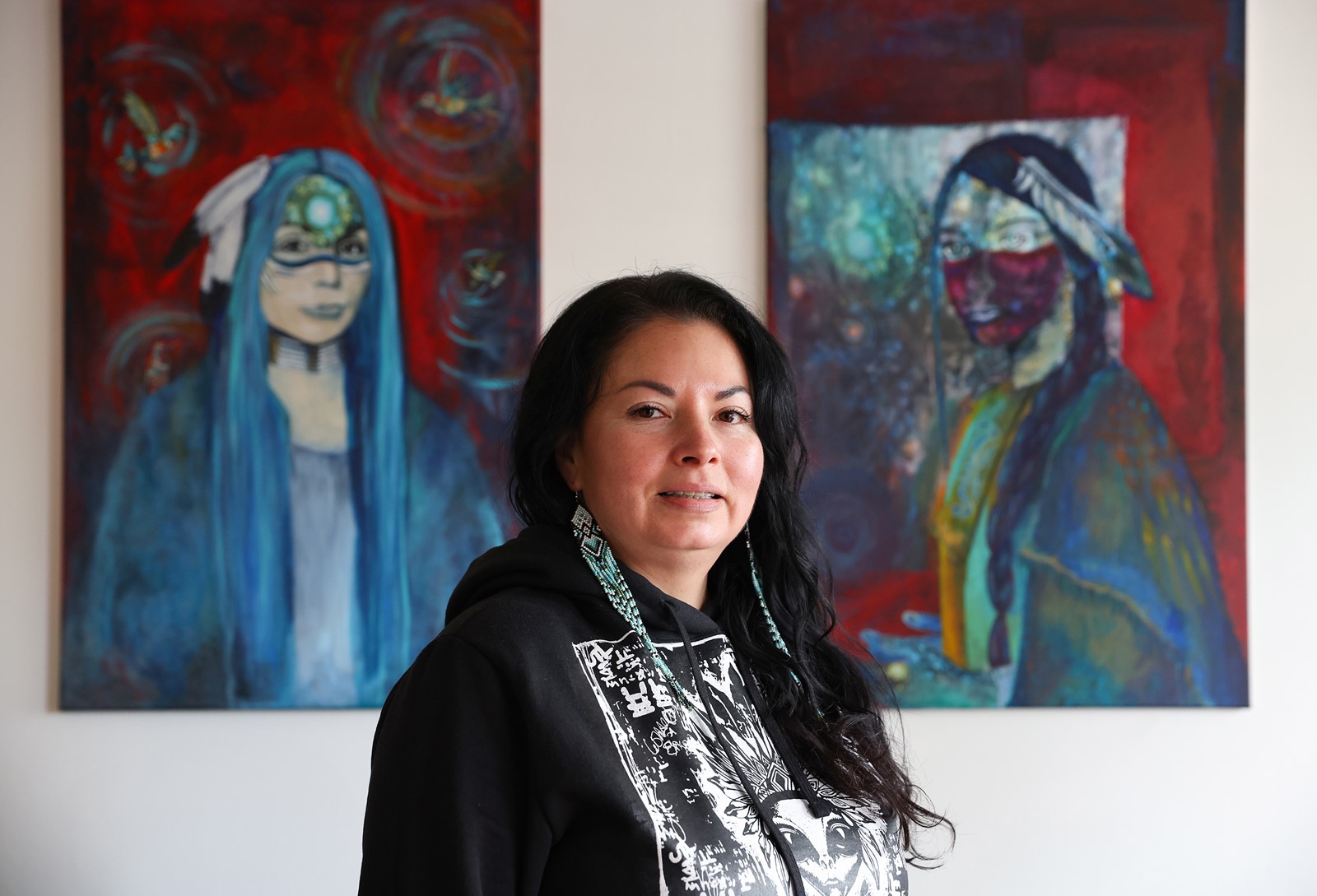
These six words greet visitors to the website of Sarah Joy Tang, a Native American artist and graphic designer who lives in Windsor.
Tang, an enrolled member of the Ho-Chunk Nation in Wisconsin, has been a full-time artist for the past 20 years, and rose to regional prominence last year when she won a contest to design a logo for the San Jose Sharks’ annual Native American Heritage Night at the SAP Center this past fall.
When she’s not crafting logos, she’s creating other stuff: Tang is a classically trained fine artist whose talents span media including sculpture, photography, mono-printing, drawing, painting, woodworking, graphic design, web design and silkscreen printing.
Much of her work, including her apparel and accessories, is inspired by Sasquatch and Star Nations Indigenous artwork. Tang also creates beautiful jewelry using abalone shells, turquoise, dentalium shells, freshwater pearls, buffalo bones, deer/elk antlers, labradorite and other precious stones.
Put simply, there isn’t much the 44-year-old Tang can’t do.
“I had a guidance counselor who used to tell me I had a polymathic personality,” she said, using the technical term for Renaissance woman. “It definitely keeps things interesting.”
Art in the veins
Tang was born into a mixed-race family: Her birth father was Ho-Chunk and her mother was Scandinavian. Her mother later married a Chinese man, which is how the artist ended up with the name Tang.
The family left the reservation and moved from Wisconsin to California in 1987. A young Tang developed a love of art immediately. She started off sketching characters and animals. As she got older, a neighbor taught her more sophisticated art techniques, and she began designing brochures.
Later, in college and beyond, she added other skills to her repertoire: beadwork, sculpture, jewelry-making, photography, and woodworking.Eventually, she got into graphic design and started a business in that.
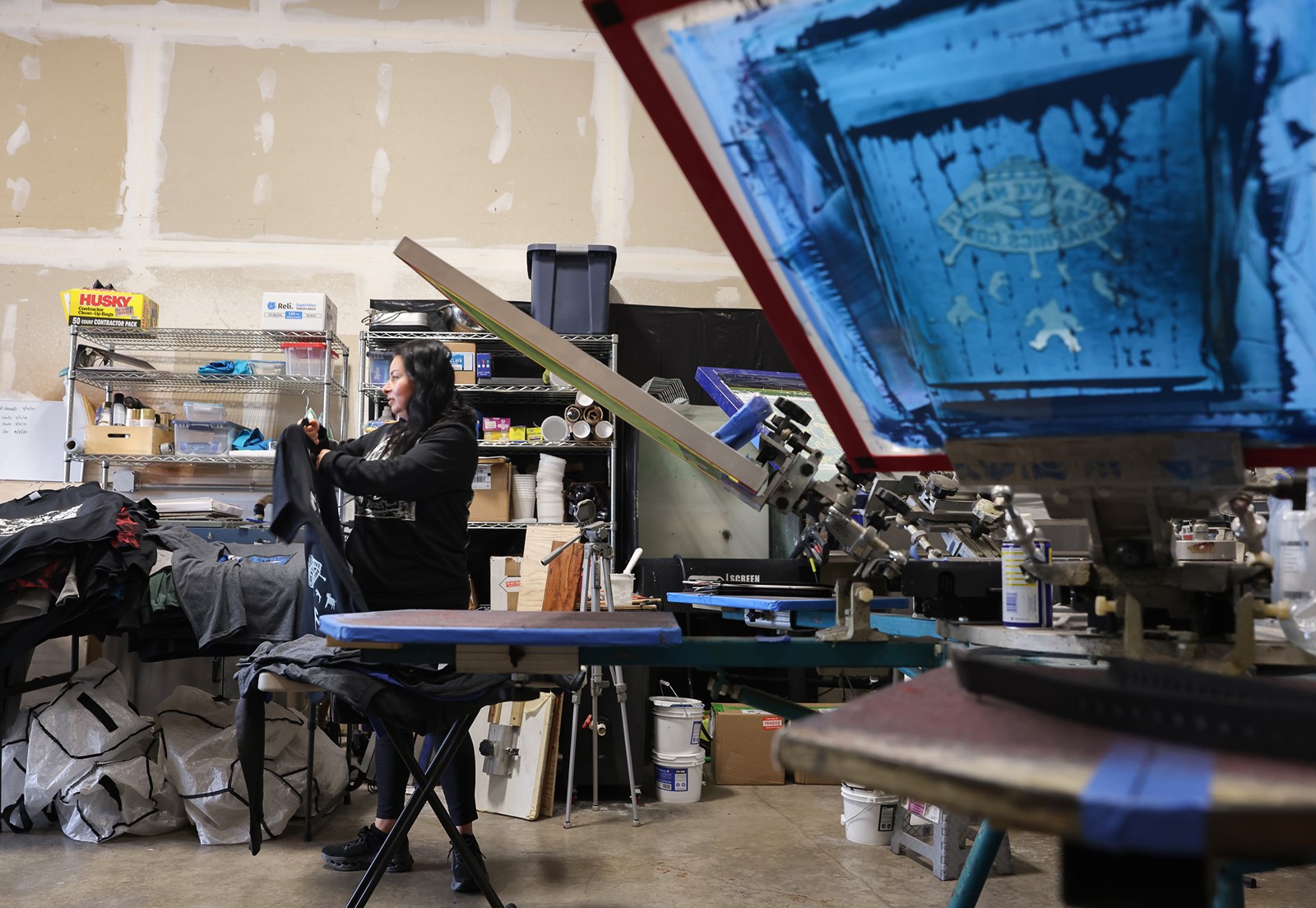
Finally, in 2021, she taught herself how to do silkscreen printing, and, with her own silkscreen machine, began printing original designs onto t-shirts and sweatshirts.
Many of these designs blend cult-culture icons such as aliens and Sasquatch with Native American patterns and forms. Some go so far as to juxtapose the face of an alien with the face of an old-timey Native American warrior.
The shirts are incredibly popular. Tang advertises them on her Instagram page and sells them (online and) all over the country. Last year, she was an artisan vendor at various events throughout the West, including the UFO Festival in McMinnville, Oregon; the Sierra Bigfoot Music Festival in Twain Harte; the Seattle Seafair Powwow; and the Bay Area American Indian Two-Spirits Powwow in San Francisco.
One big break
Despite the popularity of her silkscreen work, Tang earns most of her living doing graphic design from a modest warehouse in Windsor’s Shiloh Business Park behind Home Depot.
This line of business also has created her most lucrative work. She also leveraged graphic design chops to create the winning logo for the Sharks’ Native American Heritage Night contest last year.
Tang didn’t really think she had a chance to win the contest; she didn’t even know about it until someone from the Sharks organization emailed her and asked her to apply. At first, Tang thought the whole thing was a scam. After some web searches, she realized it was legit, and she got to work.
It took Tang three weeks to come up with the winning image, though the bulk of the work was done in a five-hour flurry right before the deadline.
In the end, the image depicted an angry shark against a background with a basket design that resembles one from the Coast Miwok. It was shown on the Jumbotron at The Shark Tank the night of Nov. 1.
“It was awesome to be recognized, not only as a graphic designer but also for my Native American heritage,” she said. “My mom is a huge Sharks fan and playing ice hockey is huge in my family, so it was a big deal for a lot of (my family members) as well.”
Rave reviews
Tang has become such a presence in the Native American community that people have taken notice.
John “JD” Duran, Native American Center Coordinator at Santa Rosa Junior College, said she has served as a role model for his students interested in entrepreneurship.
“The students have benefited from seeing her build her business and actively participate in so many events promoting her clothing line while being a woman in the small business sector,” said Duran,
who is Sicangu Lakota and an enrolled member of the Rosebud Sioux Tribe.
Fellow artists have expressed respect for Tang’s work, too. Karen Wilder, a web designer and document specialist in Point Arena, said she has known Tang for many years, and has watched her grow as an artist in that time.
Specifically, Wilder noted the color in Tang’s work as exceptional.
“I was immediately drawn to the bold color palettes and striking imagery; her designs are vibrant on the surface, yet layered with thought and purpose,” Wilder wrote in an email. “The more I have come to know Sarah, the more I recognize how her color choices reflect her inner world — her emotions, her resilience, her humor, her determination, and her deep creative spirit. Her work is unapologetically authentic, grounded in identity and lived experience.”
It’s important in telling Tang’s story to talk about one of the challenges she overcame along the way: alcohol addiction.
The drinking started in college and escalated from there. Tang was struggling with her identity — she was a Native woman growing up in a Chinese house, devoid of her birth culture. She said she turned to alcohol to ease the pain.
Finally, in her 30s, she went to rehab at a facility in San Francisco called Friendship House.
This program is for Native Americans and by Native Americans; there’s a huge metaphysical component that includes spiritual work at a sweat lodge. Tang said the experience helped her reconnect with her Ho-Chunk roots.
It also helped her manage her addiction; she has been sober since Oct. 17, 2019.
Looking back on this tumultuous time, Tang said she considers her experiences with addiction to be “pivotal” to her art journey, and she hypothesized that she wouldn’t be who she is now if she hadn’t gone through that experience and healed.
Tang added that she remains affiliated with the sweat lodge at Ya-ka-ama in Forestville, and continues to participate in these rituals to connect with her spiritual self.
“This culture, these traditions are a part of me,” she said. “I do what I can to honor (them).”
Matt Villano is a writer and editor based in Healdsburg. Learn more about him at whalehead.com.
 PREVIOUS ARTICLE
