


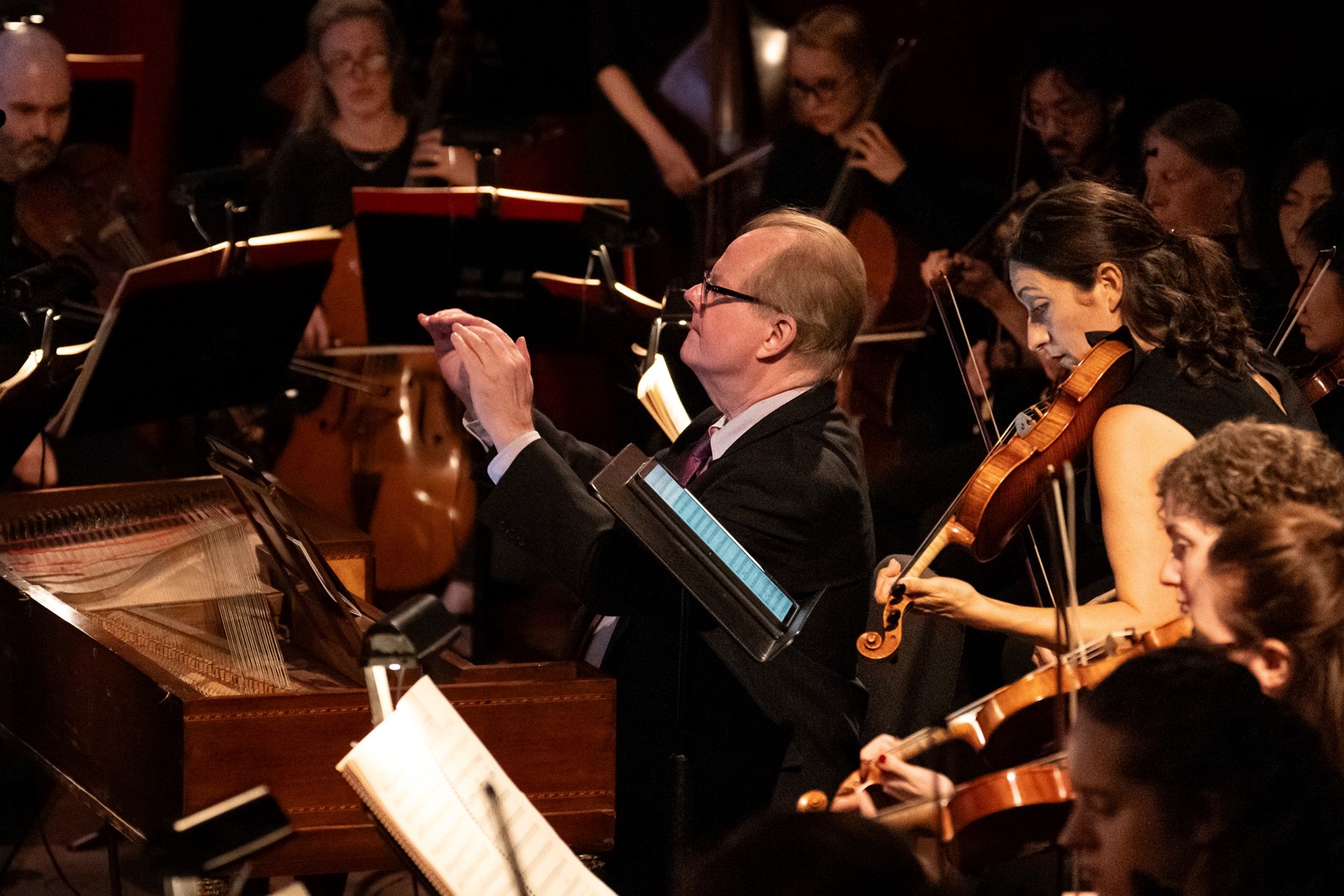


NEW YORK — Verdi can be played on original instruments, too.
While historically informed performances of Baroque music are not surprising, Will Crutchfield and Teatro Nuovo are using period pieces for the rarely heard initial version of “Macbeth.”
“You wouldn’t think that architecture from the mid-19th century would resemble the architecture of today,” cellist Hilary Metzger said. “The instruments and the way they had to make music back then were very different.”
“Macbeth” and Bellini’s “La Sonnambula” were presented by Teatro Nuovo last weekend at Montclair State’s Kasser Theater in New Jersey and repeated this week at New York City Center.
“I feel like I’m in Scotland,” said soprano Alexandra Loutsion, the Lady Macbeth. “Modern instruments have a sharpness to them and a pristine quality that period instruments don’t.”
Crutchfield, 68, was a music critic for The New York Times in the 1980s. He established Bel Canto at Caramoor in Katonah, New York, in 1997, then launched Teatro Nuovo as general and artistic director in 2018, showcasing scholarship and furnishing foundations for singers.
“I got bitten with the bug of historical recordings, and I realized very early on, oh, we think are doing traditional Italian opera nowadays but really what we call traditional means the 1950s,” he said. “What they were doing in the 1900s was totally different, radically just night and day different from the 1950s. ... and that just made me really curious. OK, if it was that different in 1910, what was happening in 1880, what was happening 1860?”
Crutchfield noted Bellini, Donizetti, Rossini and Verdi all were born from 1792 to 1813 and early Verdi is in the Bel Canto manner.
“The only reason we think of Verdi as belonging to another era is because he was still composing in his 80s and writing masterpieces after the others were long gone from the scene,” Crutchfield said. “He is based on the same tradition. He learned his craft from hearing their operas.”
“Macbeth” premiered at Florence’s Teatro della Pergola in 1847, just before Verdi’s middle-period masterpieces. Verdi and librettist Francesco Maria Piave revised it for a run at Paris’ Théâtre Lyrique in 1865 that was performed in French.
 PREVIOUS ARTICLE

