


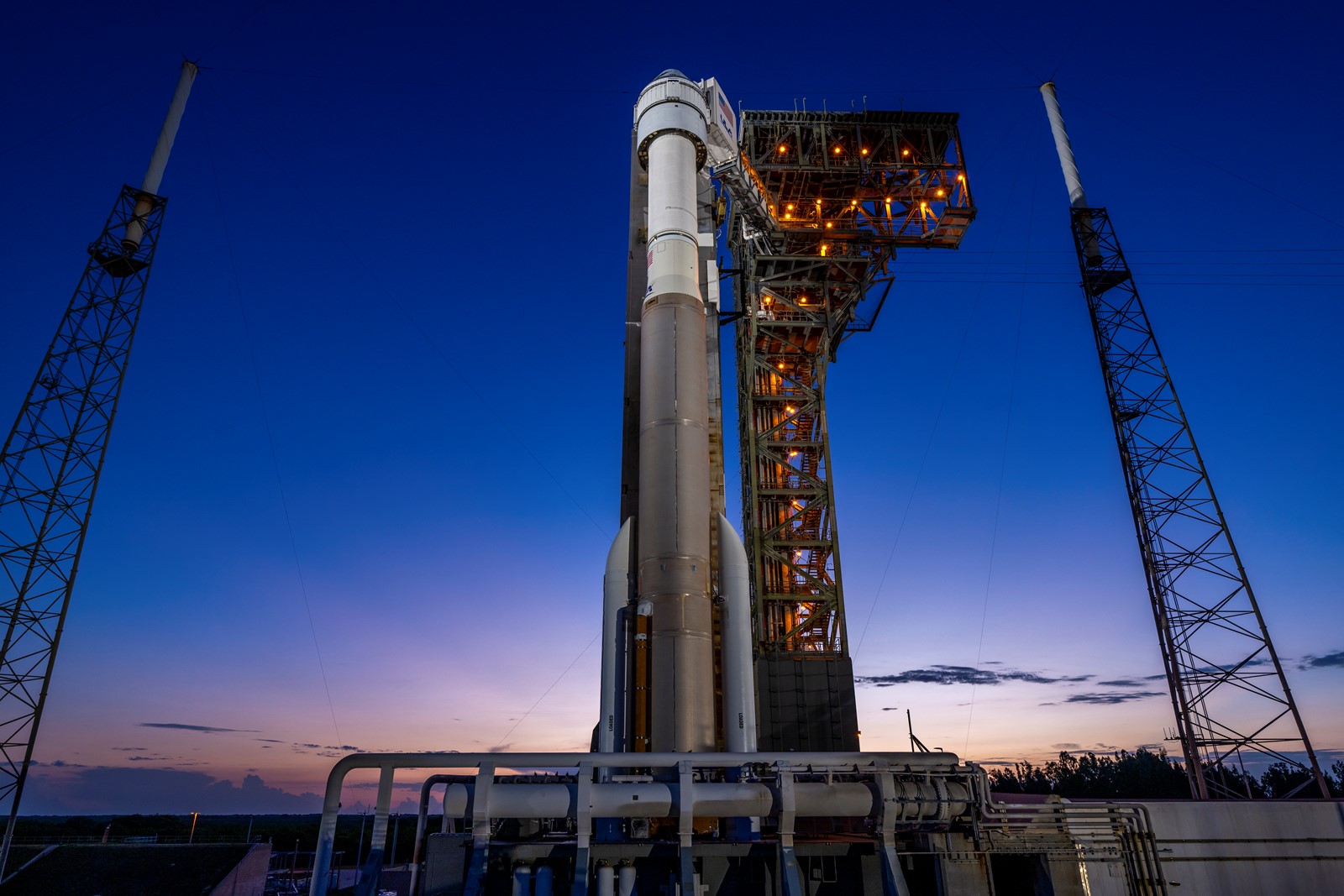


A pair of NASA astronauts were ready to go, but a single valve caused a scrub of their ride on Boeing’s CST-100 Starliner on Monday night. The next shot to fly won’t be until at least May 17.
“I know everybody was eager to see a launch,” said NASA’s Ken Bowersox, associate administrator of the Space Operations Mission Directorate during a Monday night news conference after the scrub. “ … But all I want to say first is that good things are worth waiting for, and we’ll get a chance to see that rocket and spacecraft lift off the pad here soon.”
Butch Wilmore and Suni Williams were strapped into Starliner sitting atop a United Launch Alliance Atlas V rocket at Cape Canaveral Space Force Station but with just over two hours before the planned liftoff, teams called off the launch attempt.
The reason was a technical issue with a valve within the upper Centaur stage on ULA’s rocket designed to regulate pressure on a liquid oxygen tank.
Teams at the pad reported unexpected sounds from the rocket after NASA’s astronauts had already entered the spacecraft.
“We saw the self-regulating valve on the (liquid oxygen) side had a bit of a buzz and so it was moving in a strange behavior,” said NASA Commercial Crew Program manager Steve Stich. “The flight rules had been laid out for this flight ahead of time with the crew at the launch pad. The proper action was to take the scrub and the United Launch Alliance team did a great job of assessing the data, talking through various options and put us into a scrub condition.”
ULA President and CEO Tory Bruno said the decision to scrub was more about flight rules in place vs. the actual problem.
“Our philosophy is we don’t change the fueled state of the vehicle when the crew is present,” he said. “You can do it otherwise from that, and other people do, but that’s our philosophy. So we built our flight rules around that.”
He noted the issue was something they had seen before on ULA rockets, and had humans not been on board, the fix in place was a simple one.
“It’s not dissimilar to many other valves like that, and you have one in your home on your hot water tank that’s not all that different,” he said. “Every now and again in rare occasions, a valve like that can get into a position where it’s just off the seat. Its temperature, its stiffness, everything is just right and it’ll flutter or it’ll buzz in this case, in cycle.”
He said the fix is to force the valve closed to cycle it.
“Once we had the crew off, we cycled the valve and it stopped buzzing,” he said. “If this were a satellite, that is our standard procedure, and the satellite would already be in orbit.”
But with humans on board, ULA’s rules meant not changing the fueling state of the volatile cryogenic propellants.
“I promised Butch and Suni a boring evening,” Bruno said. “I didn’t mean for it to be quite this boring. But we’re going to follow our rules and we’re going to make sure that the crew is safe.”
But another issue has to do with the lifespan of the valve. Bruno said it had been qualified to open and close 200,000 times at full pressure. Based on the Monday night data, it’s possible the fluttering on the valve, if it was, in fact, opening and closing fully, it would be nearing that 200,000 limit.
Bruno said ULA was checking the possibility that the pressure exerted was not at full capacity, meaning only a partial debit against that 200,000 limit.
After looking at data overnight and throughout the day Tuesday, NASA said the decision was made to replace the valve, which means rolling the rocket back to Boeing’s Vertical Integration Facility.
The new target launch date is Friday, May 17 at 6:16 p.m. The rollback will take place Wednesday, so the rocket can be “stretched” to allow access to the valve, but Starliner can remain atop the rocket without being removed.
“We have spare valves. We know how to do it. We’ve done it before, but it would take several days,” Bruno said.
 PREVIOUS ARTICLE
