




OAHU, Hawaii>> Just past daybreak, before they began to weave, Emma Broderick and her mother, Maile Meyer, gathered beneath a canopy of sinuous leaves to greet the pu hala tree, a touchstone of Hawaiian culture that for generations has provided the raw materials for weaving moena, the traditional floor mats that were once ubiquitous in Hawaiian homes.
Broderick introduced herself to the tree, with its lattice of stiltlike roots, addressing it as she might a loved one. “Of course flattery never hurts,” she said. She had a pink plumeria blossom with an intoxicating aroma tucked behind her ear.
“You want to come with me?” she asked the tree, seductively. “Would you like to live in a house and be in a mat?”
Broderick, 33, is executive director of the Pu’uhonua Society, a group dedicated to reviving age-old Hawaiian practices, like weaving and coconut growing, that were on the verge of vanishing. (The word “pu’uhonua” means refuge.) Along with a growing number of weavers on other islands, it is collectively energizing a tradition brought by the first Oceania settlers who arrived in Hawaii on canoes powered by woven sails.
Broderick is third generation, inheriting the leadership role from her mother, who in turn inherited it from her mother, Emma Aluli Meyer, who founded the group in 1972.
The pu hala — scientific name, Pandanus tectorius — was growing in a landscape lush with lipstick-red heliconia flowers, orchids on lichen-covered branches and myna birds flitting overhead. Only thick brown leaves, or lau, on the verge of dropping, are harvested for mats, the longer the better. The leaves are also used to plait hats, bracelets, fans, place mats, ceremonial baskets and other items.
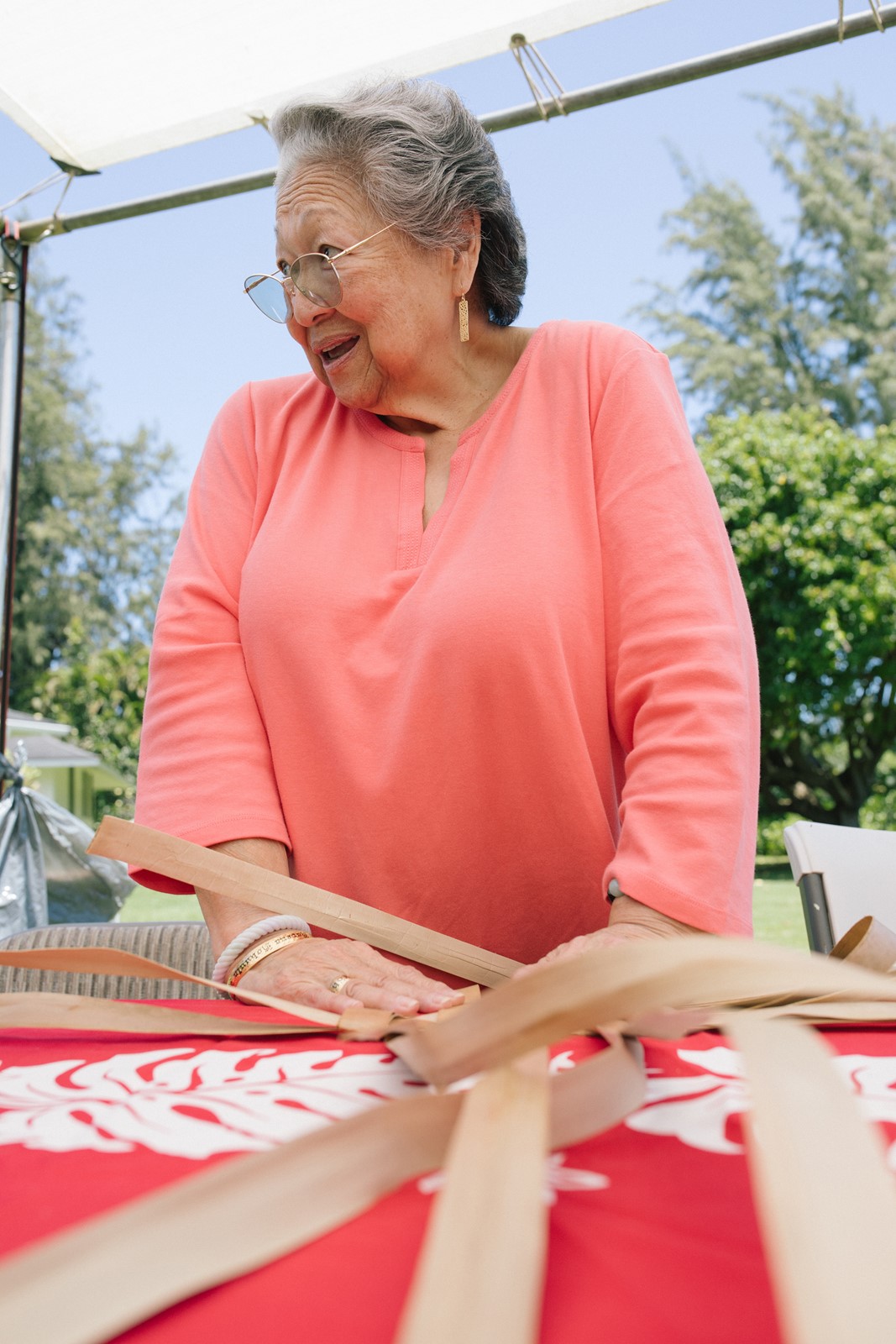
About 30 weavers were assembled in the living room of a venerable estate in Laie, on Oahu’s northeastern shore. The compound, Kikila, was built in 1924 by a Hawaiian family that, as is customary, cushioned the floors with mats that are now sorely in need of rejuvenation.
The weavers held hands in a circle in front of a huge lava rock fireplace, singing a morning prayer before plunging into the laborious task of preparing the lau for weaving. The process begins by ridding the leaves of fire ants and centipedes before cutting, measuring, smoothing, drying and then spooling the pliable leaves around their hands.
This weaving group calls itself Keanahala — “the hala cave” — a nod to historical accounts of weavers seeking shelter in cool dark caves to prevent their precious lau from buckling and cracking under the tropical sun.
“It teaches you how to weave relationships, past and present,” said Lorna May Pacheco, a 77-year-old master weaver known as Aunty Lorna, “and incorporate them into the future, so people don’t get lost.”
The weaving of relationships is at the heart of Pu’uhonua’s work. It is also the goal of an ambitious new national initiative called “Arts for Everybody,” designed to show the potential for cultural and artistic practices to heal, leading to healthier lives and communities. The Pu’uhonua Society is one of the groups, dispersed in 18 cities and towns around the country, intended to encourage arts participation as an antidote to social isolation during the pandemic. Last Saturday all 18 places simultaneously staged a crazy quilt of happenings and performances that included Pu’uhonua’s “reawakening” of ancestral cultural knowledge in historic Thomas Square in Honolulu, where sovereignty was restored to the Hawaiian Kingdom in 1843.
“The common understanding in Hawaii is that the health of our people is tied to the health of our land,” Broderick observed. “There’s a deep healing that happens when people gather and weave together, because to weave lau is to have a connection to aina, the land,” she added. “To be a weaver is to be a healer. Our ancestral knowledge is being passed on.”
Over four barefoot days at Kikila, with nary a sandal in sight, the grounds of the old estate were infused with a sense of purpose and of healing. The less experienced weavers learned to plait their first mats, and the most accomplished ones formed a repair squad to triage mats that had been trod and slept upon for nearly a century.
Among them was 30-year-old La’Noa O Pono A. Keahinu’uanu — the “A” is from his great-great-grandfather, who was assigned an English name, Adams, by the U.S. Navy. Keahinu’uanu became intrigued by weaving while caring for historic photographs at the Bishop Museum, the state museum that celebrates Hawaii’s natural and cultural history.
“I thought it would be cool to not have the tradition die out,” he said. “It was on its way to becoming a lost art.”
Weaving was originally practiced within families, providing “baskets, mats and all the things they needed,” said Marques Marzan, a fiber artist and the museum’s cultural adviser. Floor mats doubled as mattresses, with a thick end functioning as a pillow.
But foreign influences, beginning with the arrival of Capt. James Cook in 1778 and continuing with the presence of Christian missionaries, began to chip away at Hawaiian cultural practices. Many here, including Marzan and Broderick, regard the illegal overthrow of the Hawaiian monarchy in 1893 by the islands’ white businessmen — backed by U.S. troops — as a cultural inflection point. Shortly thereafter, the Hawaiian language was banned from public schools and the ancient practice of hula dance lost some of its spiritual underpinnings.
“It shifted people’s mindsets about what was important for the heritage,” Marzan said.
Marzan grew up with his great-grandmother’s hats around the house, many crafted to shield sugar and coffee plantation laborers from the sun. As was true in many families, the art skipped generations, followed by soul-searching among those coming of age in the 1930s, ‘40s and ‘50s. “As they got older,” Marzan said, weavers “realized that the only way for the tradition to live on was to teach people outside the family.”
The sound of bare feet on a mat is not replicable on rugs or carpets; nor is there a golden patina burnished by years of feet.
“It reminds me of who I am,” said Maile Meyer, Broderick’s mother, who founded stores featuring Native Hawaiian books and arts and crafts in Honolulu. “I put my feet on hala and I’m grounded to place.”
When her own mother started the Pu’uhonua Society in the family garage outside Honolulu, it was called the Young at Heart Workshop and Gallery. The name Pu’unhonua was chosen by her grandfather, Noa Webster Aluli, a lawyer and community activist.
Meyer and her sister, Manu, had an unusual childhood, with a constant stream of arty guests around the dinner table: Bob Hope, Jerry Lewis, Robert Goulet and Dave Brubeck.
Manu Meyer cofounded Niu Now, a branch of the Pu’unhonua dedicated to affirming the cultural importance of coconut groves. Coconuts, unbeknown to tourists, are endangered; they are routinely snipped off picturesque Hawaiian palms to protect people from falling nuts. The mission of the group, which is based at the University of Hawaii at West Oahu, is to reestablish groves and give away coconuts as a food and cultural staple.
Threats still abound. Scale insects have destroyed most of the hala trees on Maui, making it impossible to find the raw materials for baskets. The coconut rhinoceros beetle, a fearsome-looking pest native to Southeast Asia, has decimated Oahu’s coconut groves and has begun moving on to hala.
“It’s like fighting the gods,” Indrajit Gunasekara, co-founder of Niu Now, said, speaking to volunteers at the coconut groves planted at the University of Hawaii, where both he and Manu Meyer work. “It’s the holy enemy,” he said of the beetles.
The weavers have a phrase: “building pilina together,” which means getting your strength from closeness.
After the wildfire that raged through the town of Lahaina on Maui last August, when 102 people died, the Pu’uhonua weavers quietly built pilina together with the survivors. They spent a month picking and preparing lau to take to those who had been displaced from their homes and plaited hina’i — traditional funerary baskets for bones and ash. The group traveled from Oahu with finished baskets and enough spools to weave hundreds more, setting up shop in the ballroom of a hotel that provided temporary housing.
With the bereaved, the weavers fashioned baskets for family members and pets who had died, leaving enough materials behind so Maui residents could continue to weave in the coming months. “In our culture, we don’t celebrate alone and we don’t grieve alone,” Maile Meyer said.
 PREVIOUS ARTICLE

