


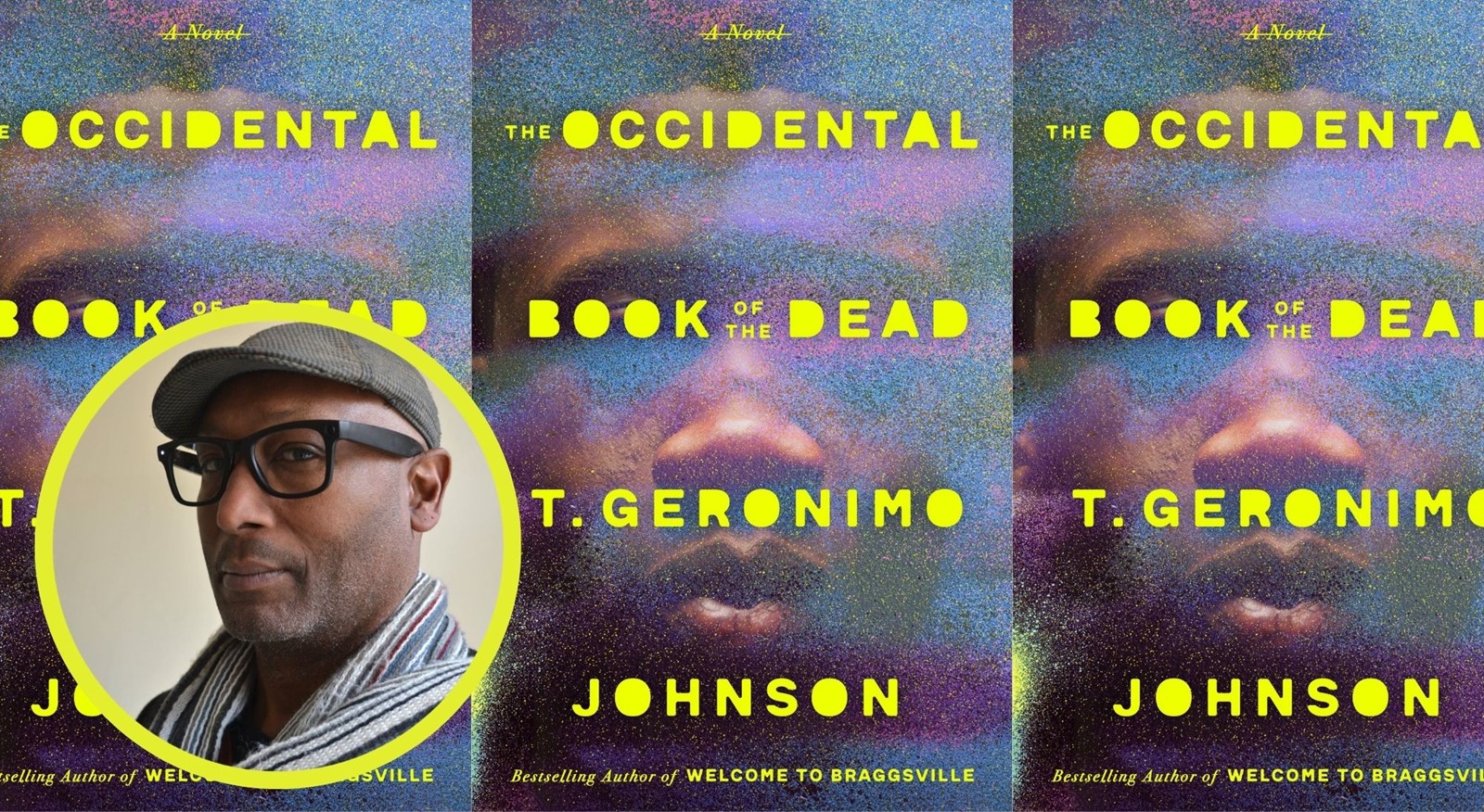


T. Geronimo Johnson’s latest novel has been a long time coming.
The origins of the author’s third novel, “The Occidental Book of the Dead,” out from William Morrow, go back about 20 years. The novel follows George Washington Jonson, a Black police officer in a city very much like Atlanta who patrols a neighborhood grappling with gentrification. After Jonson’s White partner shoots and kills a White teenager, the fallout changes the lives of the two police officers — and their colleagues and families — forever.
The book follows Johnson’s two previous critically acclaimed novels, “Hold It ‘Til It Hurts” and “Welcome to Braggsville,” the latter of which won the Ernest J. Gaines Award for Literary Excellence, and was longlisted for a National Book Award and an Andrew Carnegie Medal. “Hold It ‘Til It Hurts” and “The Occidental Book of the Dead” both stemmed from the same project.
“I was working on this story cycle when I was living and working in the Old Fourth Ward in Atlanta, and I was trying to capture about seven or eight individual perspectives to create this collage of what gentrification feels like to different stakeholders, because it’s such a different experience,” Johnson explains. “My thesis director at the Iowa Writers Workshop, (Lan Samantha) Chang, said I should make one of them into a novel, and that would probably be better for my career. I took her advice, and that became ‘Hold It ‘Til It Hurts,’ but I never completely left this project.”
“The Occidental Book of the Dead” has drawn praise from critics, including fellow novelist Jason Mott, who wrote in The New York Times, “It’s funny when it needs to be, hard to track when it wants to be, and meticulously engineered at every moment. It is storytelling from a writer who knows the fundamentals of the craft well enough that he can break all the rules and still build a propulsive story.”
Johnson discussed “The Occidental Book of the Dead” via telephone from Paris, where he was visiting family. This conversation has been condensed and edited for length and clarity.
Q: How did the character of George Washington Jonson come to you?
A: He was part of the original cast of characters, and I am not sure why I made him a police officer. I can’t remember that at all, but I was intrigued by this idea of there being someone in the neighborhood who’s from the neighborhood but no longer lives there, observing the change. He was also a father, or an aspiring father, more than he was a cop. I was really thinking about him as this guy who wanted more than anything else to have a family, and that’s where he came from.
Q: The book is set in Atlanta, Georgia, kind of, but it’s called Atlantis, Gorgeous. A lot of the other place names have these similarities to actual Georgia locations. Why did you decide to go with that naming convention?
A: A part of it is an artistic impulse, and I had this feeling that I didn’t want to write a history of Atlanta per se, but I felt like I needed to feel as if the book was pointing at a place. I was in Atlanta when I started working on the project, but I was thinking of this as more of a bird’s-eye view and also an intimate view of what’s happened in so many cities in America. It just happens to be that I know a lot more about Atlanta because I’ve lived there during this time. But when I would talk to friends and relatives around the country about what I was working on in brief, they’d always say, “Oh, this sounds like where I am in New Orleans. It sounds like where I lived in New York.” There’s this weird thing where sometimes you have to reframe something a little just to see it more clearly.
Q: This novel is a police procedural in a lot of ways, although of course it’s much more than that. Was it difficult writing in that genre?
A: No, that part didn’t feel difficult. That didn’t feel harder than doing anything else, really. I did feel a tremendous burden to try to get it right, so I felt like I had to do a lot more research around policing practices and policing history, but I never felt like I had taken on the project or task of writing a procedural. What I was really trying to do is slow things down around the shooting to give the reader a chance to feel what it’s like and also what it’s like on the other side, what’s going on with the cops, what’s going on with the press office. I was thinking about just following this particular process, trying to capture it from more angles than we often see on the news.
Q: What was the research process like? Did you talk to law enforcement officers?
A: I did some talking, asked some questions, also read a couple of books about policing and its emotional toll. I tried to do enough research to get a general sense of things, and then also be receptive to everything else that was going on in the media with books and movies to have a sense of how it is represented away from reality — to avoid falling into clichés because this is really what I’m working with: the representation of reality, not reality. Most people only know the representation; this is the problem. So I was doing this research, and then I generally graft the research onto the emotional truth that I’m trying to work through at the time.
Q: There’s a lot of focus on economics, personal finance, and predatory loans and interest rates in the novel. Why was it important to you to include those themes in the book?
A: We tend to assume that everyone knows what we know. We forget that you can grow up in places in America where you never learn things that other people take for granted about money, financing, checkbooks.
In my opinion, I think that Americans have been screwed over with the shift from pensions to do-it-yourself 401(k)s and IRAs. I just feel sensitive to that in general. I worked in finance. I did mortgages at one point when I was younger, and so I am of the mind that most of us, even people who are financially savvy, are not aware of the extent to which we are exploited financially.
Q: Despite the serious subject matter of this book, there are some very funny parts in it. Was it important to you to include humor in the novel?
A: Yes. I don’t know that I’d be able to do otherwise. I wasn’t trying to write a funny novel or a satire. I do think that it’s just funny in places. In terms of craft and formal decisions, I feel like this is part of the emotional undulation when you’re orchestrating the emotional flows of a novel. I prefer to try to be attentive to the ebb and flow of emotion and also the building of the heaviness. It can get too heavy, especially with something like this, and you need escape valves.
 PREVIOUS ARTICLE

