


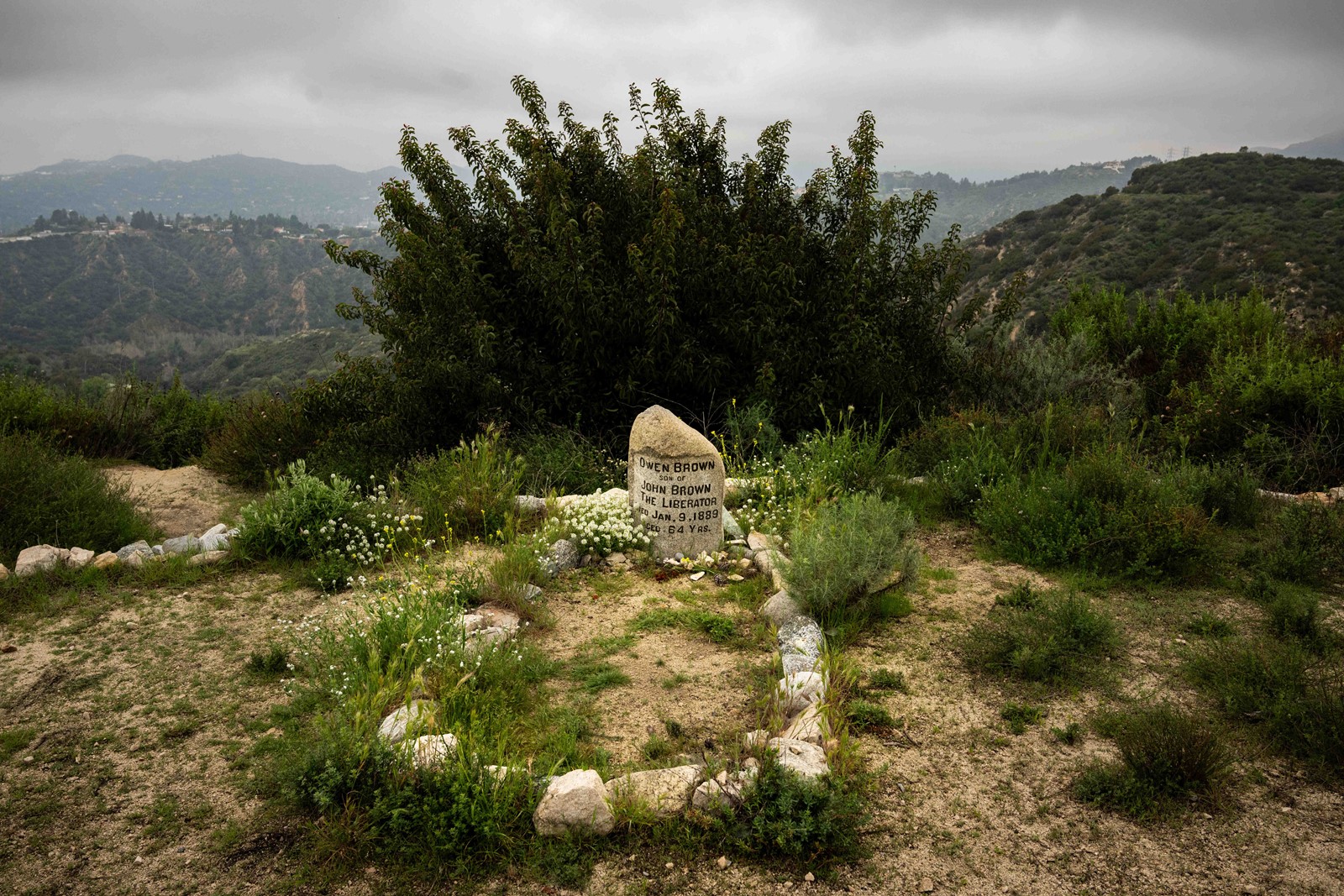


books, and a leader on a committee formed to renovate the gravesite and bring it recognition. In 1989, the application was rejected, she said.
“I just hiked up to Owen Brown’s gravesite,” she said after the vote. “I wanted to commune with Owen and tell him it is really done now. This time it is really final. It is done,” Zack said with emphasis.
Atop a hill in unincorporated Altadena lies the body of Owen Brown, who fought with his father, John Brown, and a ragtag group of 21 called God’s Army to raid the U.S. arsenal at Harpers Ferry, Virginia, in October 1859. The effort was an attempt to provoke a slave revolt in the Southern states. Though the raid failed, many historians agree it lit the match that helped provoke the Civil War.
While John Brown was arrested and executed, and eight of his man were killed in the raid, Owen survived and escaped. He was a fugitive on the lam for years until he found a sympathetic group in Pasadena, a city founded by pro-Union, anti-slave, abolitionist men and women. In 1884, Owen and his brother, Jason, homesteaded just north in Altadena Meadows.
Zack said he and his brother would go into town in Pasadena packing six guns, but in these communities they were left alone and not pursued by the law, she said.
When he died in 1889, it is said it was from catching pneumonia after walking home in the rain from a temperance meeting. He was buried on a hilltop called Little Round Top near his cabin, in the shadow of Brown Mountain named after his father. About 2,000 people attended his funeral at a Pasadena church, Zack said.
Fifth District Supervisor Kathryn Barger, the board’s chair, credited Zack and her team with restoration of the gravesite. She also singled out Tim Cantwell, a landowner and developer, who got permission to build more homes below the hilltop and in turn, allowed the noncontiguous 5.2 acres containing the grave to be preserved. Cantwell also agreed to give $300,000 to the committee for the site’s restoration and for education programs about John Brown, Owen Brown and Pasadena’s anti-slavery history.
“They are safeguarding a unique piece of American history,” Barger said. “This important piece of history will continue to inspire for generations to come,”
The naming of a lone gravesite, and not a Civil War cemetery, battle site or a general’s house as historical and related to the most divisive war in U.S. history is unusual, Zach said.
Also, there are only two or three historical monuments to abolitionists in California, despite being formed as a free state.
“California has more monuments to the confederacy than any state outside the confederacy,” Zack said. “A lot of political elites thought being a free state was a temporary inconvenience,” she added.
Zack’s group wants to pursue national historical status for the gravesite. And the U.S. National Park Service may be helping with that quest.
Recently, Daniel Ott, historian and western regions coordinator for the National Park Service, visited the grave of Owen Brown and met with Zack and the gravesite committee. Ott wants to put the site on the parks service’s Network to Freedom Program, and the group has applied for the recognition.
The program links 700 sites related to the abolition of slavery. It was born out of the National Underground Railroad Network to Freedom Act of 1998. Most sites regarding abolishing slavery are in the eastern part of the United States, and very few are in the West, Zack said.
Soon an animated movie using film graphics will be released as part of an educational effort to reach the younger generation, she said.
“Owen Brown’s Body,” a 24-minute short, will be shown at a community event Jan. 29, said Pablo Miralles, writer, producer and director of the film and a native Altadenan.
The film’s audience is middle school and high school students, he said. Using old photos and lithographs, the film is about Owen Brown’s life as well as the abolitionist stands taken by his father, both of whom were White and from a religious family.
“I came up with a historical film because I wanted kids to get it and talk about it,” Miralles said Wednesday. “Owen Brown’s life is a story about slavery and abolitionism. The Brown family are by far the most significant abolitionists.”
 PREVIOUS ARTICLE
