


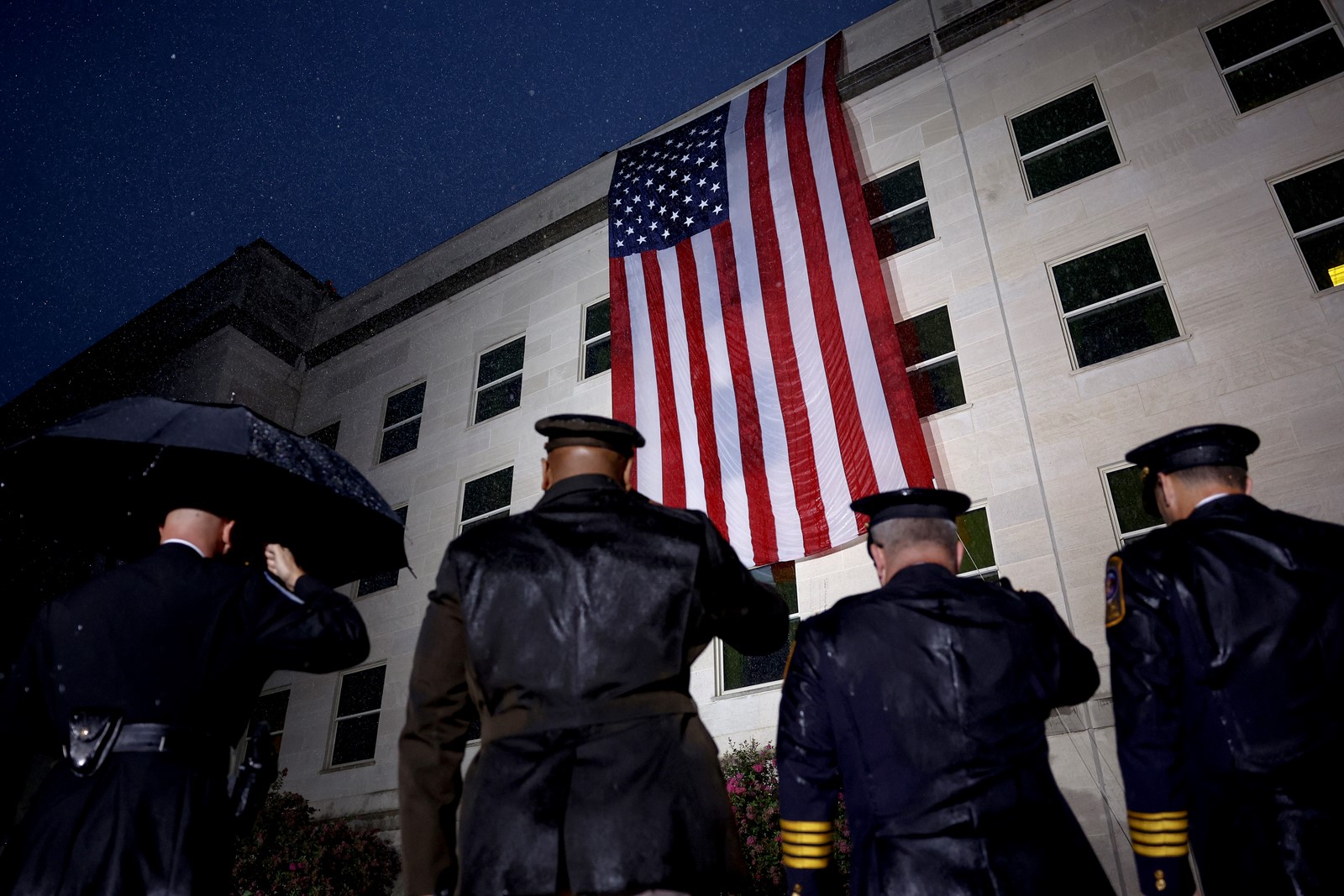


NEW YORK — Americans remembered 9/11 on Sunday with tear-choked tributes and pleas to “never forget,” 21 years after the deadliest terror attack on U.S. soil.
The loss still feels immediate to Bonita Mentis, who wore a necklace with a photo of her slain sister, Shevonne Mentis.
“It’s been 21 years, but it’s not 21 years for us. It seems like just yesterday,” she said before reading victims’ names at the World Trade Center to a crowd that included Vice President Kamala Harris and her husband, Doug Emhoff.
At the Pentagon, which also was targeted on 9/11, President Joe Biden vowed that the U.S. would continue working to root out terrorist plots and called on Americans to stand up for “the very democracy that guarantees the right to freedom that those terrorists on 9/11 sought to bury in the burning fire, smoke and ash.”
Biden noted that even after the United States left Afghanistan that his administration continues to pursue those responsible for the 9/11 attacks.
Last month, Biden announced the U.S. had killed Ayman al-Zawahri, the Al-Qaida leader who helped plot the Sept. 11 attacks, in a clandestine operation.
“We will never forget, we will never give up,” Biden said. “Our commitment to preventing another attack on the United States is without end.”
The president was joined by family members of the fallen, first responders who had been at the Pentagon on the day of the attack, as well as Defense Department leadership for the annual moment of tribute carried out in New York City, the Pentagon and Somerset County, Pennsylvania.
First lady Jill Biden spoke at the third attack site, a field near Shanksville, Pa.
On Sept. 11, 2001, conspirators from the al-Qaida Islamic terror group seized control of jets to use them as passenger-filled missiles, hitting the trade center’s twin towers and the Pentagon.
The fourth plane was headed for Washington but crashed near Shanksville after crew members and passengers tried to storm the cockpit.
The attacks killed nearly 3,000 people, reconfigured national security policy and spurred a U.S. “war on terror” worldwide.
Sunday’s observances came little more than a month after a U.S. drone strike killed a key al-Qaida figure who helped plot the 9/11 attacks, Ayman al-Zawahri.
Pierre Roldan, who lost his cousin Carlos Lillo, a paramedic, said “we had some form of justice” when a U.S. raid killed Osama bin Laden in 2011. “Now that al-Zawahri is gone, at least we’re continuing to get that justice,” Roldan said.
The self-proclaimed mastermind of the attacks, Khalid Shaikh Mohammed, still awaits a long-postponed military tribunal. An attorney for one of Mohammed’s co-defendants this week confirmed ongoing negotiations toward a potential agreement to avoid a trial and impose lesser but still lengthy sentences.
The Sept. 11 attacks stirred — for a time — a sense of national pride and unity for many, while also subjecting Muslim Americans to years of suspicion and bigotry and engendering debate over the balance between safety and civil liberties. In ways both subtle and plain, the aftermath of 9/11 ripples through American politics and public life to this day.
But like some other victims’ relatives, Jay Saloman fears that Americans’ consciousness of 9/11 is receding.
“It was a terrorist attack against our country that day. And theoretically, everybody should remember it and, you know, take precautions and watch out,” said Saloman, who lost his brother, Wayne Saloman.
By tradition, no political figures speak at the ground zero ceremony. The observance centers, instead, on relatives reading aloud the names of the dead.
Like a growing number of readers, firefighter Jimmy Riches’ namesake nephew wasn’t born yet when his relative died.
But the boy took the podium to honor him.
“You’re always in my heart. And I know you are watching over me,” he said.
Readers often add personal remarks that form an alloy of American sentiments about Sept. 11 — grief, anger, toughness, appreciation for first responders and the military, appeals to patriotism, hopes for peace, occasional political barbs, and a poignant accounting of the graduations, weddings, births and daily lives that victims have missed.
A few readers note recent events, this year ranging from the ongoing coronavirus pandemic to Russia’s war in Ukraine.
Some relatives also lament that a nation which came together — to some extent — after the attacks has since splintered apart. So much so that federal law enforcement and intelligence agencies, which were reshaped to focus on international terrorism after 9/11, now see the threat of domestic violent extremism as equally urgent.
“It took a tragedy to unite us. It should not take another tragedy to unite us again,” said Andrew Colabella, whose cousin, John DiGiovanni, died in the 1993 bombing World Trade Center bombing that presaged 9/11.
 PREVIOUS ARTICLE

