




You would be hard pressed to find anyone who puts more effort into helping the community’s most vulnerable than the staff and volunteers at local food pantries. But Marie Wilkinson Food Pantry in Aurora has acquired new help that might just put those other wonderful folks to shame.
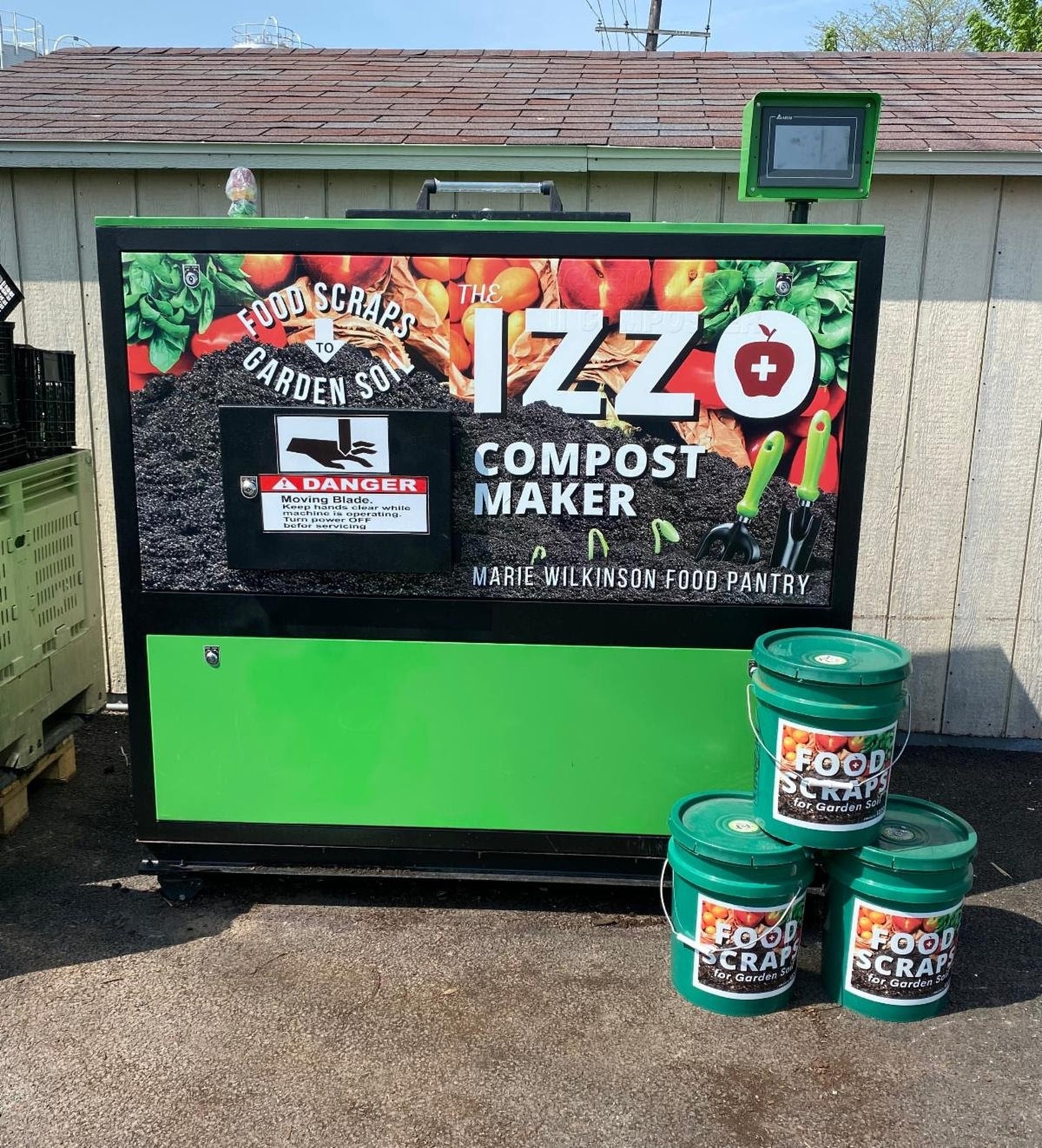
The Aurora pantry’s new help includes a power-worker lovingly known as “The Izzo” — a 450-pound composter that eats and digests around 150 pounds of food scraps, moldy breads, dried leaves, coffee grounds and other food waste per day.
Since April, The Izzo has been turning slop into soil that, after going through a two-week curing process, is then added to the pantry’s garden beds that provide fresh fruits and vegetables for those struggling with food insecurity.
Then there’s those workers that arrived just this week which have literally wormed their way into the hearts of the pantry’s leaders.
The food pantry purchased 1,000 “super red European night crawlers” that will do their “vermicomposting” in six equally new sub-pod composters, said Operations Director Sara Comfort, thanks to a grant from the Illinois Farmers Market Association, which on Tuesday was matched by a check from the Kane County Board.
The nutrient-rich soil made from these two different kinds of composters is great news for Marie’s Urban Farm, which has been continually expanding since it was developed in 2015 and last year alone produced over 7,000 pounds of produce on its nearly one acre that goes directly to its pantry shelves.
Marie Wilkinson Food Pantry Executive Director Diane Renner believes The Izzo might be the only composter in the state — for sure, in this area, she said — that is being used by a food pantry. And it was made possible because of the late Joseph Izzo, whose mission was to feed those in need.
Because the Naperville man hated seeing food go to waste, Izzo formed a nonprofit in March 2017 called RationAll Food Rescue, which rescued food from grocery stores, restaurants and other businesses and delivered it to pantries and shelters.
According to RationAll board member Brian Johnson, his friend affectionately became known as “The Onion Man” at Marie Wilkinson after Izzo showed up with a couple of hundreds pounds of the vegetable upon learning the pantry was in short supply.
Unfortunately, Rizzo died of cancer nine months after starting this operation. But his board continued to carry on the mission until the pandemic hit and food rescues were curtailed.
It was then, with his family’s blessing, that the board decided to dissolve the nonprofit and divert funds from his life insurance policy to the Marie Wilkinson Food Pantry. In tribute to Joe, the pantry used those funds to purchase the composter now known as The Izzo.
Both Renner and Johnson agree that this composter — cost including installation was around $35,000 - is a legacy to Joe that truly fits the pantry’s philosophy — not only helping people put food on their tables but preserving the environment by making sustainability a way of life.
And, by the way, it’s that same mission that brought those night crawlers into the pantry’s operation via six new subpods.
Vermicompost is the official term for worms eating food scraps, which become compost as it passes through their bodies and is cast out through the tail end as micro-nutrients.
Some red wigglers, considered the “Cadillac of worms,” have been donated for this project. But the night crawlers are also “hungry eaters,” says Comfort, who admits she now fits the bill as a greeky “worm lady,” and will be conducting experiments to see which type works better and how well these worms survive the winter. (Fun fact: Their life spans are between one and five years.)
“The Izzo is amazing, but as a pantry, we have no shortage of food that can go into a composter. So this just gives us another avenue,” said Comfort, who hopes to eventually hold classes for kids or for adults who want to do backyard composting.
“We’ve gotten ourselves into such a state of consumption and throwing away our food scraps,” she added, “rather than repurposing them back into the soil so as not to deplete what we have.”
Turns out, even though The Izzo takes in an impressive 150 pounds of food a day, Renner and staff quickly realized the pantry could have used one much bigger.
While the cost likely prohibits most pantries from such a big-ticket item, it could make sense for organizations, even municipalities, to look into the environmental impact such a purchase could have.
For example, what about an “Izzo” for downtown Aurora restaurants?
Certainly there would be some funding hurdles to clear. But you have to admit, for communities that pride themselves on being green, it’s definitely food for thought.
dcrosby@tribpub.com
 PREVIOUS ARTICLE
