


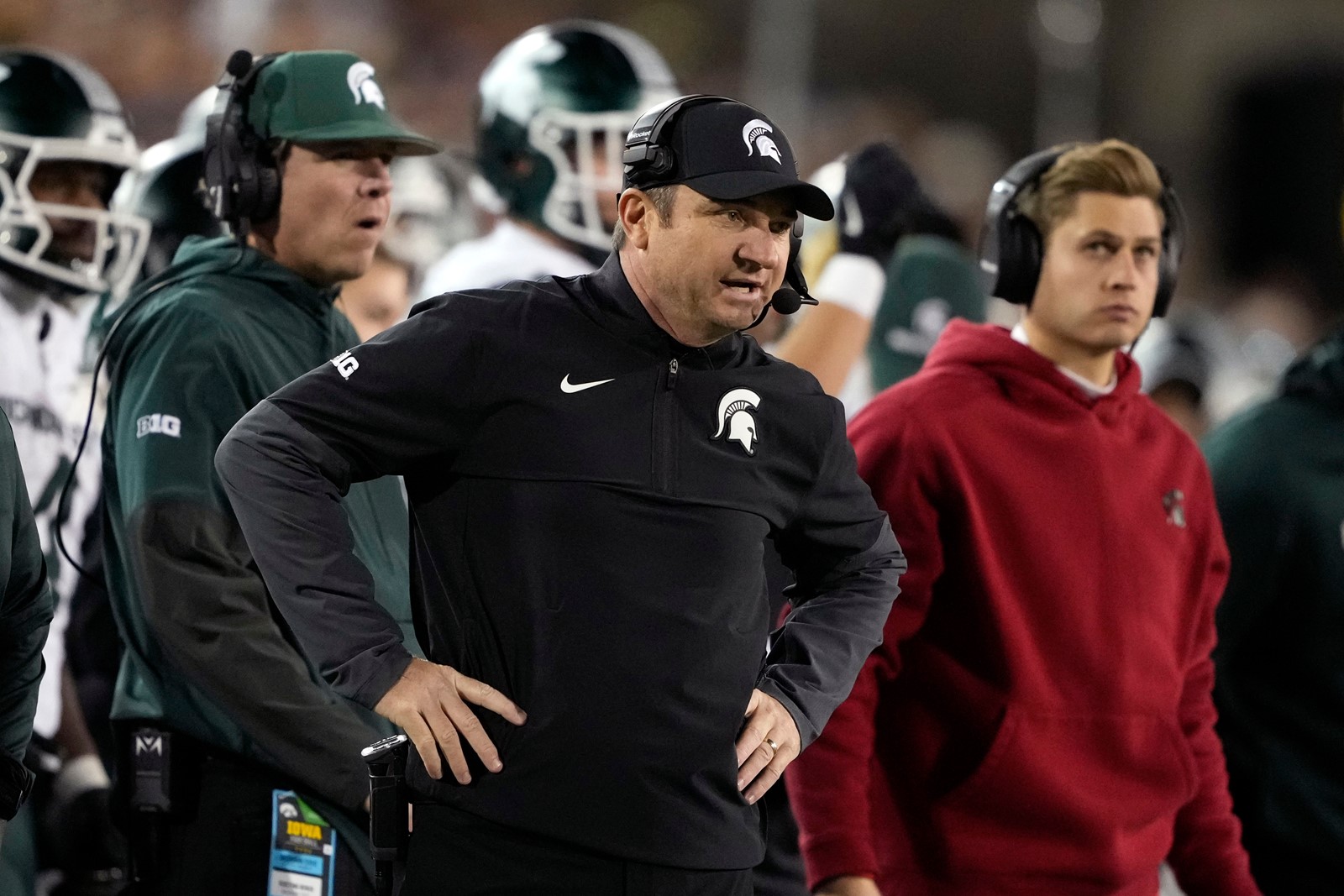


IOWA CITY, Iowa — Down the winding tunnels of Kinnick Stadium, where Iowa had just dominated Michigan State in the fourth quarter as the Spartans’ collapse yielded a numbing 20-17 loss on a walk-off field goal, MSU athletic director J Batt stood at the back of the interview room as Jonathan Smith fielded questions about his program.
About decisions to “challenge” the nation’s best return man, and the play calls gone awry. Signs of growth. Too many of the same old errors. For the eighth straight game, Smith had few answers for his program’s floundering status beyond a need for execution and development. Batt, stone-faced as ever, stood at the back of the room and watched.
When interviews ended and Smith walked out the door, so too did Batt — out of one at the back of the room, slipping quietly across the hallway into another room and out of sight. Away from the question he himself has to answer about this football program; one he can’t avoid addressing for much longer as the season ends.
Smith’s second year leading Michigan State has just about exhausted a fan base desperate for a winner. This postseason will mark the fourth straight Michigan State won’t play in a bowl game, a far fall from that 2021 Peach Bowl under Smith’s predecessor Mel Tucker. Some fans — many, even — have reached a point of apathy. Michigan State’s finale against Maryland this coming Saturday at Ford Field has sold so few tickets that the program is giving them away for free.
There are some people who won’t watch this team for free.
All this culminates to the question of when, and not if, Batt and the Michigan State brass must make a decision on Smith. At a time when other Big Ten programs have been decisive — UCLA and Penn State firing coaches midseason, Wisconsin and Maryland sticking by their headmen — Batt’s administration is notably quiet. No statements. No endorsements. No press conferences, not even after media asked for one when Michigan State announced NCAA sanctions a week and a half ago.
And though he attends postgame press conferences regularly, he hasn’t grabbed the microphone himself, though that’s not an anomaly among athletic directors across the country. Batt is a reflective, thinking type, who less than six months into his tenure is still getting his lay of the land.
Others who’ve been around longer have given their two cents (that ought to put a dent in that $33.5 million buyout).
Social media is rife with Smith criticisms, some fair and some piling on. Michigan State’s players, for one, have given their own endorsements of their coach.
Even after Saturday’s loss, the eighth straight this season to tie Muddy Waters’ 1981-82 seasons for the second most in a row by an MSU team, linebacker Jordan Hall and quarterback Alessio Milivojevic vouched for their coach.
“The (bashing) that Coach Smith gets, it appalls me,” Hall said. “He’s a great coach, a great man and he leads well, and I stand by him.”
“I think he’s a great coach, great leader,” added Milivojevic, a member of Smith’s first recruiting class scrambled together within two weeks of his hiring. “I’m obviously grateful for him for recruiting me here, and I just, I love playing for him.”
It’s important to look at how this all came to be. In the wake of Mel Tucker’s nasty departure, who was fired in September 2023 for violating the moral turpitude clause of his contract by allegedly sexually harassing anti-rape activist Brenda Tracy, former athletic director Alan Haller plucked Smith from Oregon State as the Pac-12 disintegrated. Michigan State hired Smith in November 2023 and signed him to a seven-year, $52.85 million contract a few weeks later. The deal was 85% guaranteed.
Few at the time could’ve thought this is where the situation would stand less than two years later. A touted program builder over six seasons at his alma mater, with a cumulative 34—35 record in Corvallis, Smith would get some latitude to rebuild the program. Everyone involved expected it to take time. But a lack of progress — a 5-7 debut followed by this year’s current 3-8 effort — exhausted patience.
Meanwhile, a negotiated resolution with the NCAA for about $11,000 worth of impermissible recruiting benefits in the Tucker era brought recruiting sanctions, three years of probation and the vacation of 14 wins for the use of three ineligible players, including Smith’s five wins in Year 1, for yet another blow.
Since an upset loss to UCLA five games ago (the first of two interim coaches MSU lost against this year), Smith has found himself subject to plenty of job rumors. False starts, but eventually Batt and his administration must make a decision.
If Michigan State chooses to bail on the Smith experiment early, it owes him 85% of his contract, to be paid in equal monthly installments through the duration of his contract, which runs through 2030. That can be lessened by the salary of his next job. Or if Smith himself leaves for a different job altogether; his $4 million liquidated buyout was halved to $2 million after the firing of Haller, which brought Batt into the fold in June to begin with.
Smith, for one, isn’t thinking of quitting.
“We’ve got to get better,” Smith said after last week’s loss to Penn State, another fourth-quarter collapse that ended far more lopsided. “We got to grow. We got to develop. We need another year of development of the current roster and a recruiting class to keep this thing getting into a better direction. I’m still confident in our approach.”
For the reserved Smith (one of the reasons he’s taken so much criticism), that flash was as close as he has gotten to a dogged defense of his work. It was a plea to get one more year, at least, to address the shortcomings of his program that take time — and more importantly, money — to correct.
Other programs in the Big Ten have faced a similar pressure to win in a crowded 18-team field. UCLA fired DeShaun Foster after three games, and Penn State fired James Franklin after three straight losses at the midpoint.
Even other schools who aren’t making a change have at least made up their minds. Wisconsin AD Chris McIntosh publicly backed Luke Fickell after another down year (4-7, 2-6 Big Ten). And Mike Locksley, who will take Maryland (4-7, 1-7) to Ford Field this Saturday, at least knows he’s got his job next year after his own AD, Joe Smith (who was hired only a couple of weeks before Batt was this summer), backed him too. And both ADs pledged dollars to support recruiting, an almighty currency in college football right now.
Batt hasn’t done so, not yet. In no small part because he has a lot to think about, and Saturday’s loss is yet another example.
Eventually, though, he will have to answer the multi-million dollar question facing his program.
Moving on from Smith costs money in the form of hiring new coaches, keeping players from bolting to the portal and recruiting a competent team. So does keeping Smith, which costs ticket revenue and maybe even the donations Batt has a knack for collecting.
In the final week of the season, the clock is running for Batt to make the call. Whichever way he decides will have a profound impact on the future of Michigan State’s program.
 PREVIOUS ARTICLE

