




Isaac Wickersham arrived in Petaluma, in the year 1853, as a 33-year-old lawyer with great ambition.
At the time, the small village of Petaluma was just becoming organized. It would not officially become a township until 1858. Wickersham had done very well in the gold fields and had heard much about the verdant Petaluma Valley, with its river running through it, just north of San Francisco Bay. He brought with him his newfound gold, a herd of cattle (purchased in Sacramento), and the first mowing machine ever seen in Sonoma County.
That initial year, Wickersham cut over 300 tons of hay for resident ranchers to ship down-creek to San Francisco. That being just about enough of hard physical work to satisfy him, Mr. Wickersham sold the cattle, and his mowing machine, the following year.
The machine had been a great introduction to Petaluma for Wickersham and he had made friends quickly as a result, opening a law office on Main Street in 1854, where Seared restaurant is now. By 1855, Wickersham had been elected Sonoma County District Attorney and had also begun the practice of lending money. In 1857, he returned to the East to marry his childhood sweetheart, Lydia Rickett, and brought her back to Petaluma.
Later that year, he purchased a lot on the northwest corner of sixth and D Streets, and began constructing a fine Victorian home for Lydia.
Wickersham soon found that he enjoyed the money-lending business more than his law practice and, in 1865, he opened the first bank in Sonoma County — The I.G. Wickersham & Co. Private Bank. At the time, it was the only bank between San Francisco and the State of Oregon. Just two years later, Wickersham erected the first bank building in Petaluma, on the corner of Main and Washington Streets.
In Santa Rosa then, people were celebrating the addition of piped-in water and, by 1870, 1,300,000 bushels of grain had been grown in Sonoma County, and the dairy industry was taking-off too as production soared. And then grape and wine production took over.
By 1876, Sonoma County had become the largest wine producer in the State of California.
Banking was then booming for Wickersham and by 1874 the bank’s name had been changed to The First National Bank of Petaluma. Along the way, Isaac had also become involved in the founding of railroads with mill owner John McNear.
These included first the horse-drawn Petaluma Street railroad, then the Petaluma and Healdsburg railroad, and finally, the Sonoma and Marin railroad in 1876. Unfortunately, none of these lines flourished fast enough to satisfy the two dynamic capitalists, and were soon sold off to consolidate with other existing railroads.
It was a rare business loss for both of these men.
Never one to shirk responsibility, Wickersham became quite active in civic affairs, and headed the efforts to bring public sewerage disposal and electric lights to Petaluma. He was also a member of the Vestry of St. Johns Episcopal Church and donated the lot upon which that structure still proudly stands. As a member of the board of the Sonoma and Marin Agricultural Society, Wickersham kept his hand active in the dealings of the ranchers of our County, many of whom had borrowed funds from his bank.
Isaac and Lydia had six children in the home on D Street.
Two of them tragically died in infancy and two more before the age of 40. One of his two surviving children, Lizzie, grew up to marry Sonoma County veterinarian Thomas MaClay in 1901. By then, Lizzie MaClay had 1899 had inherited the beautiful Wickersham home on D Street, moved it to Main St. and then sold it. She then hired famed San Francisco architect, Albert Farr, to design the Spanish Revival mansion that stands there, at D and 6th now.
Interestingly, veterinarian Thomas MaClay later became President of the I.G. Wickersham Banking Co.
Isaac died in 1899 at age 79 and his obituary in the Petaluma Daily Courier was headlined, “Pioneer banker and capitalist leaves largest estate ever recorded in Sonoma County history.” In that day’s editorial, it was stated that, “No man will be more greatly missed in this community.”
Isaac Wickersham had been one of Petaluma’s founding fathers, and left many legacies to our community.
The Wickersham funeral service was formally addressed by Petaluma Professor E. S. Lippitt, and the pallbearers included such well-known Petalumans as H.T. Fairbanks, G.P. McNear, William Hill, L.G.Nay and Professor Lippitt himself.
I.G. Wickersham was buried in the family plot in Oak Hill Cemetery.
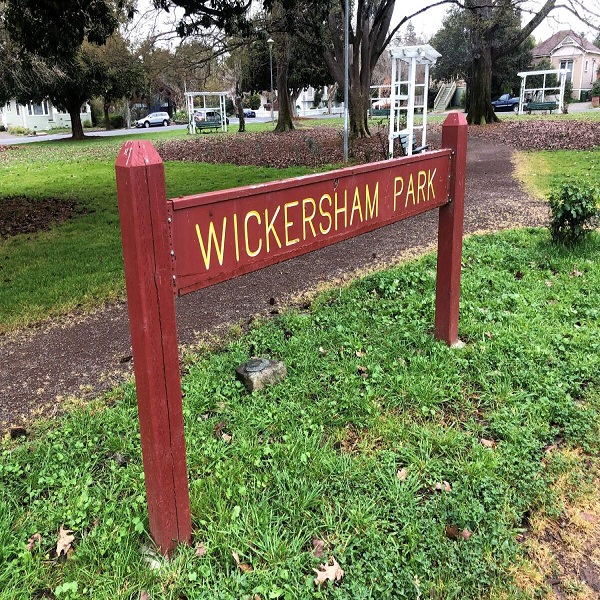
Petaluma’s beautiful Wickersham Park was later donated to the City by his daughter, Lizzie MaClay, who named it after her father.
Skip Sommer’s “Petaluma Past” runs once a month in the Argus-Courier. Sommer is an honorary lifetime member of the Petaluma Historical Museum and Heritage Homes, and the 1987 Petaluma Good Egg. You can reach him at skipsommer31@gmail.com.
 PREVIOUS ARTICLE
