


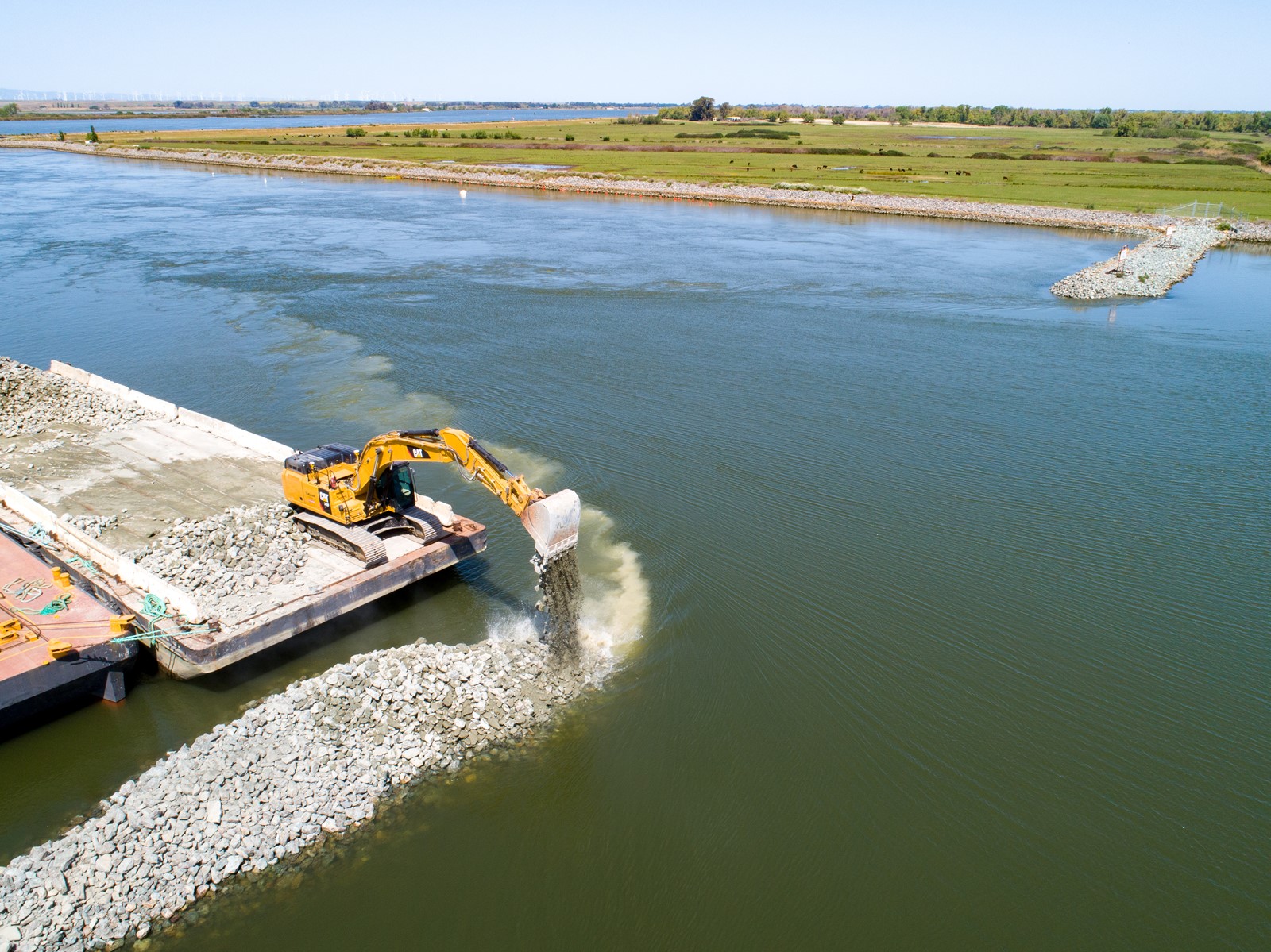


California water officials are poised to release the first environmental review of a controversial project to replumb the Delta — a plan in the works for decades that has alternately been called a water grab or a critical update to shore up state supplies.
Known as the Delta Conveyance Project, a tunnel supported by Gov. Gavin Newsom would take water from the Sacramento River and bypass the vast Sacramento-San Joaquin Delta, funneling the flows directly to pumps in the south Delta or straight to Bethany Reservoir at the northern end of the California Aqueduct.
The tunnel proposal, still in the early stages of environmental review, is the latest, scaled-down iteration of the contentious twin tunnels project, which Newsom scrapped in 2019 in favor of a single tunnel.
The goal, according to state officials, is to make the State Water Project, which provides water to 27 million Californians and 750,000 acres of farmland, less vulnerable to rising seas, earthquakes and the extreme droughts and precipitation shifts of climate change. The massive system transports water through the Sacramento-San Joaquin River Delta to agencies and irrigation districts in the San Joaquin Valley, Southern California, the Central Coast and the Bay Area.
What would a Delta tunnel mean for California? “Ask me that after the EIR (environmental impact review) comes out,” said Greg Gartrell, former water manager with Contra Costa Water District and a consulting engineer. “It all depends on what the rules are for how it gets operated.”
The tunnel, stretching for about 44 miles, would allow the state Department of Water Resources to pipe additional water south to reservoirs, farms and cities. State officials say it would be especially beneficial during storms, when endangered species protections and other restrictions might limit pumping from the existing facility farther south.
Had the tunnel existed during the storms of late 2021, the state agency calculates that the tunnel would have sent 236,000 more acre-feet of water to storage — enough to supply 2.5 million people for a year.
Efforts to funnel water around the Delta have been in the works for decades under various names, dating back to the peripheral canal first proposed in the 1960s and rejected by California voters in the 1980s.
The costly proposals have been controversial ever since, with critics concerned that bypassing the Delta could worsen salinity and stagnation, and that years of construction could drive residents and tourists from the region.
The prolonged efforts to build tunnels could be called “the epicenter of the California water wars for almost 60 years,” Gartrell said.
The tunnel would be no quick fix: It would have to clear a gantlet of permits, hearings and environmental review, including from federal agencies.
The first step is a draft environmental impact review expected later this summer, which would consider all of the alternatives, addressing the amounts of water the three routes would divert from the Delta and how they would affect water quality, the ecosystem and fish.
Next steps include public comment, finalizing the preferred route and deciding whether to move forward. In all, obtaining various permits and designing the project could take six to eight years, and construction could add another another 12 years, state officials said.
The state would issue bonds, but public water providers that ultimately sign on to receive the tunnel’s water will be on the hook for paying back the costs, estimated at just under $16 billion in 2020 dollars. That number is likely to climb, given inflation and rising construction costs.
“It’s not like we’re going to turn dirt tomorrow, and we’re going to set this thing up, and we’re going to start moving water next year. It’s a long way off,” said Tony Meyers, executive director of the state’s Delta Conveyance Office.”So there’s a lot of time to amend and adjust.”
State officials hope that by piping water from the north and pumping from the existing facilities in the south, the state can capture more water during wet spells to tide water agencies over during droughts.
It’s “not a heart transplant, but a heart bypass,” Meyers said. “We’ve got a system that’s completely clogged up and very difficult to pump water through the Delta with all the restrictions that are on it. And the tunnel gives you a direct line straight to the pump station with the capacity that you’re looking for.”
Crossing Alameda, Contra Costa, Sacramento, San Joaquin, Solano and Yolo counties, the Delta is formed where the Sacramento and San Joaquin rivers come together and flow into the San Francisco Bay.
With 57,000 navigable waterways that draw 12 million visitors a year to its marinas, wineries and small towns, the Delta is California’s first National Heritage Area. It’s home to more than 627,000 people, threatened and endangered fish species, a vibrant boating and fishing culture and 1,800 agricultural water users, including vineyards and pear orchards.
California’s water regulators say the Delta is experiencing an “ecological crisis” with a “prolonged and precipitous decline in numerous native species,” including endangered winter-run Chinook salmon and the tiny Delta smelt. The reasons include “reduced and modified flows, loss of habitat, invasive species, and water pollution.”
Rudy Mussi, who farms on Roberts Island and Union Island, worries a tunnel could upset the Delta’s delicate balance that keeps ocean tides from overwhelming irrigation water. In years like this one, when winter rains fail to wash the salt away, seeds fail to germinate, and transplants don’t thrive. “It’s not good for any of our crops,” he said.
Already, less water is making it into the Delta during dry and critically dry years, the Public Policy Institute of California reports — the apparent result of increasing upstream water use.
Scientists agree that a tunnel’s impact on the Delta will depend on how it’s used.
“Just the water diversion itself is not going to make a huge difference, because there’s so many things going on in the Delta right now — especially invasive species,” said Peter Moyle, a fish biologist and professor emeritus with the University of California Davis Center for Watershed Sciences. Still, he added, “The ‘devil is in the details’ of operation.”
Tom Birmingham, general manager of the powerful Westlands Water District, which serves San Joaquin Valley growers, extolled the “eminently good sense” of a tunnel or canal that bypasses the Delta.
But he said the district did not join the previous twin tunnels project because it was concerned that suppliers who get water from the federal Central Valley Project were not guaranteed to actually get the tunnel water. Plus, he said, the federal strategy for divvying up the cost meant it “exceeded what Westlands thought it could afford to pay.”
 PREVIOUS ARTICLE

