


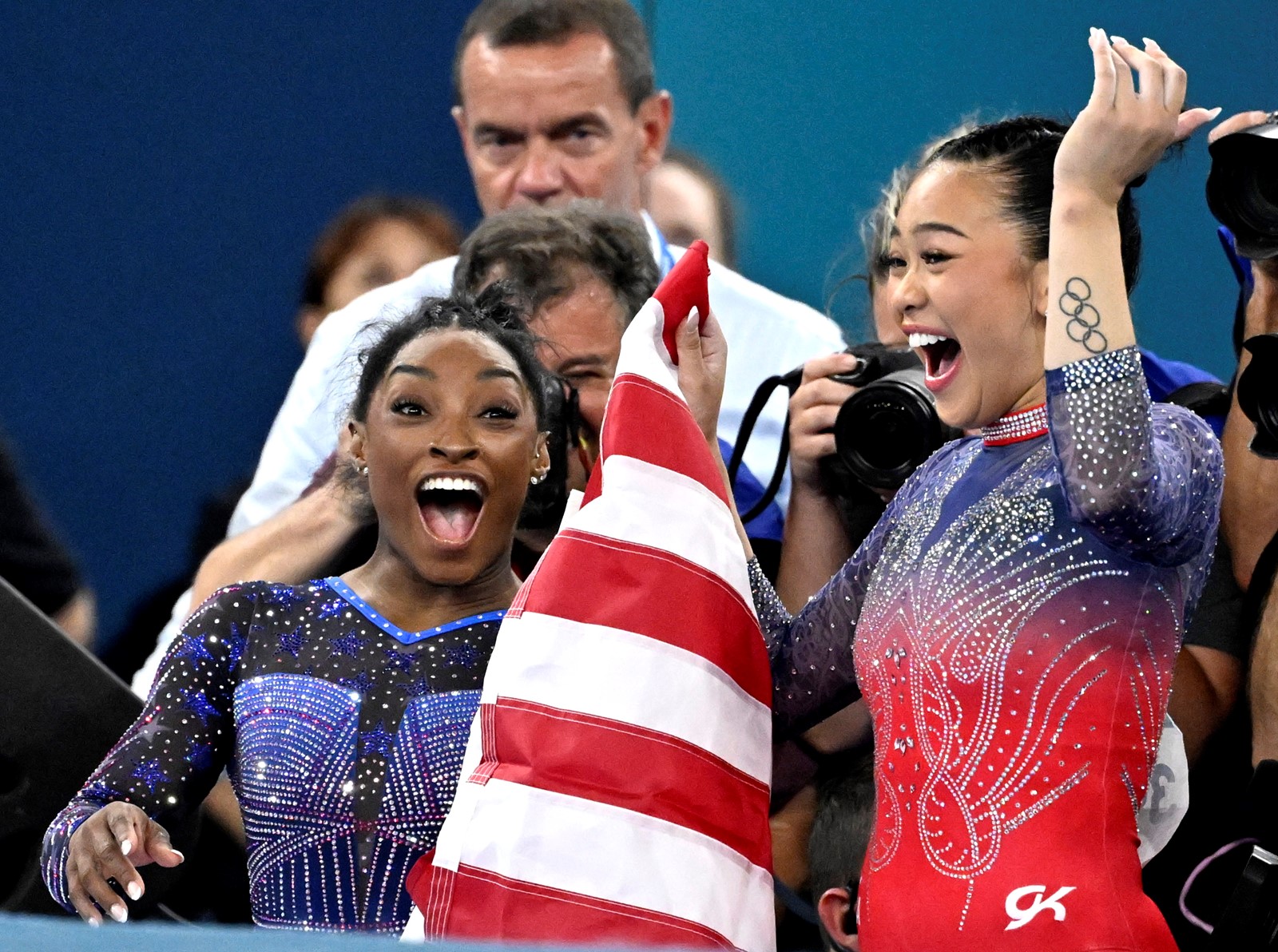
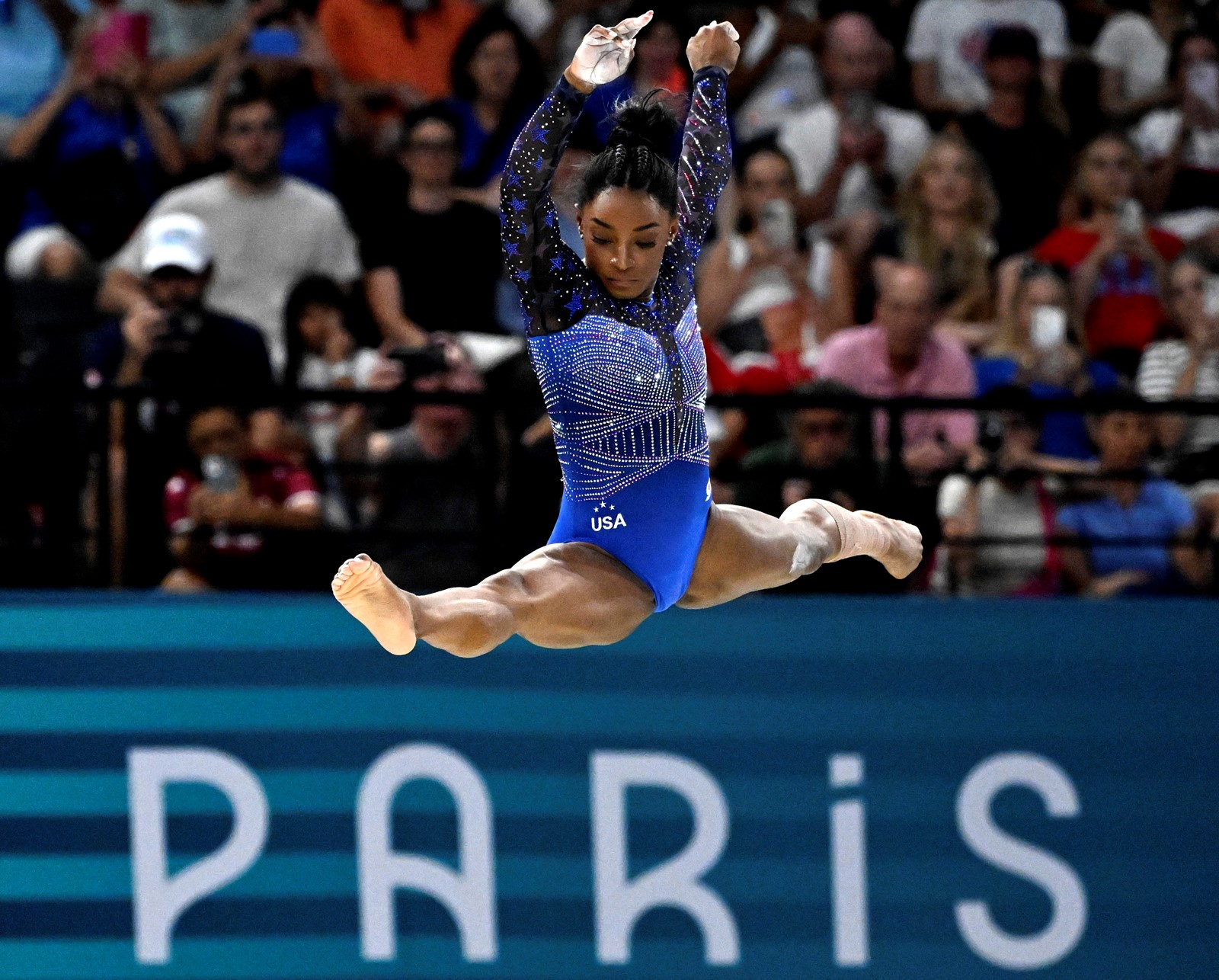


PARIS >> Even before a record sixth Olympic gold medal was placed around her neck Thursday night, Simone Biles donned another piece of jewelry that reflected her place in history.
It was a necklace attached to a gold figure of a goat.
That’s GOAT, as in “greatest of all time.”
Biles confirmed her place as the greatest gymnast ever to wear a leotard and in any conversation about the most gifted athletes — male or female — on the planet or the greatest all-time Olympians by winning the Olympic Games all-around gold medal, along with track and field’s 100-meter dash, the most storied individual prize in women’s sports.
Biles became only the third woman to win two Olympic all-around crowns, the first since 1968 and the first to win them in non-consecutive Games, by rolling up an overall score of 59.131 at Bercy Arena, posting the highest score in three of the four events.
Her second Olympic all-around title came eight years after she won gold in the team, all-around, vault and floor exercise competitions as a 19-year-old at the Rio de Janeiro Games.
“The team competition is always my favorite because we all get to go out there and compete together and it’s just such a fun time,” Biles said. “But tonight, it means the world to me and it’s just so crazy.
“The fight that I’ve had for the last three years mentally and physically just to get back. Competing on the world stage, the Olympic Games is an amazing experience.”
Winning her sixth Olympic gold medal, her ninth medal overall, both records for American gymnasts, did not come easy for Biles. She was in third after two rotations and the performance of Brazil’s Rebeca Andrade left Biles little room for error, especially after a slip-up on the uneven bars.
Biles transcended the sport largely because of gravity and imagination defying athleticism that left her millions of fans and even Olympic icons asking themselves, “How did she do that?” But Thursday’s victory was a reminder of her determination, resiliency and courage, three qualities that carried her through three trying years after she was forced to withdraw from the team, individual all-around competitions and two event finals at the Tokyo Games in 2021.
“Three years ago, I never thought I’d set foot on a gymnastics floor again just because of everything that had happened,” Biles said. “I got back in the gym and worked really hard mentally and physically.”
Team USA’s failure to win a third consecutive in Tokyo was largely the result of Biles taking herself out of the final three rotations of the team final after suffering from a form of gymnastics vertigo known as “the twisties” in midair during her vault routine on the U.S. opening rotation.
“Everything” was more than just “the twisties.” She admitted she struggled with her mental health, which was further impacted by her critics, who blamed her for the team loss in Tokyo, blamed her for speaking out on Black Lives Matter, called her soft for speaking out on mental health issues.
Conservative commentator Charlie Kirk described Biles after Tokyo as a “sociopath.”
“We are raising a generation of weak people like Simone Biles,” Kirk said on his podcast. “If she’s got all these mental health problems, don’t show up.”
Biles, the most famous and one of the most outspoken survivors of former U.S. Olympic and national team physician Larry Nassar’s sexual abuse, also struggled to come to terms with representing USA Gymnastics, the national governing body, which was accused of enabling Nassar and prominent coaches’ predatory behavior for decades and then covering it up.
Eventually, she returned to the World Champion Centre, the Spring, Texas, gym owned by her mother, Nellie, coaxed back by her French coaches Cecile and Laurent Landi and the notion that she had unfinished business.
Biles, less than a year into her comeback, picked up gold medals in the team competition, the individual all-around, the vault and balance beam at last year’s World Championships.
She started her day Thursday with a 7 a.m. Zoom call with her therapist.
“So she is so amazing for allowing me to do that these couple of days here in Paris,” Biles said. “So just making sure I’m mentally well. I think you see that out on the competition floor.”
Biles appeared to have all-around wrapped up after just one rotation, landing a double Yurchenko double pike also known as the Biles II, the vault’s hardest skill, a trick so difficult that no other woman has even attempted it let alone landed it in competition. Her score of 15.766 would stand as the night’s highest score on any event.
Biles and her coaches debated whether to attempt such a high-risk, dangerous trick in the all-around final, but scoring value of the routine would prove crucial after she stumbled on the uneven bars, slipping to third.
“I was like, ‘Oh, goodness,’ ” Biles recalled. “I was like, ‘Oh, thank God we did the double pike today,’ because I wasn’t planning on doing it. But I just knew how phenomenal of an athlete (Andrade) is. And on each event were very similar scores. So I was like, ‘Okay, I think I have to bring out the big guns this time.’”
She also called for backup.
At one point between the bars and the balance beam, her third rotation, Biles could be seen off by herself deep in thought.
Or prayer.
“I was probably praying to every single god out there trying to refocus and re-center myself because that’s not the bars that I’ve been training,” Biles said. “Out of all the events bars was the one that I haven’t messed up once while training here or back in Houston.
“So just refocusing myself and making sure that as soon as we go to beam since I’m first up, I can just re-center myself and finish the rest of the competition. Because it’s not over till it’s over.”
She was also in contact with her husband, Jonathan Owens, a Chicago Bears defensive back.
“What place am I in?” Biles recalled asking Owens, “and he’s like you’re fine. You’re in third.’
“Because I’ve never been so stressed before.”
Even after her 14.566 score on the beam propelled her back into first place, Biles and her U.S. teammate Suni Lee calculated the scores in their heads.
Or at least tried to.
“We were both freaking out, so it just felt nice to know that I wasn’t out there freaking out by myself,” Lee said.
At one point, Lee turned to Biles and said, “I don’t even know how to do math in my head.”
“Me, neither,” Biles replied.
As Biles stood on the edge of the floor exercise square, she needed a score of 13.866 to reclaim the gold medal. She seemed to know she finally had clinched it when she broke with a wide smile after successfully completing her first tumbling pass on the floor exercise.
She was right. Biles was awarded a 15.066 mark.
Andrade, runner-up to Lee three years ago in Tokyo, again had to settle for the silver medal with a score of 57.933.
“I don’t want to compete with Rebeca anymore,” Biles said laughing. “She’s way too close.
“I’ve never had an athlete that close, so it definitely put me on my toes. It brought out the best athlete in myself, so I’m excited and proud to compete with her.”
Lee, the Olympic all-around champion in Tokyo in Biles’ absence, held on for the bronze with a 56.465 score and a performance that reflected the resiliency she showed in just making it back to the Olympics.
In February 2023, Lee, then competing at Auburn, began experiencing what doctors would later diagnose as two rare kidney diseases. Lee has declined to talk about the specifics of the condition. Because her kidneys weren’t processing water and waste retained excess fluid to the point where at times she was 40 pounds over her normal weight.
“I couldn’t even look at myself in the mirror,” Lee said. “I didn’t even recognize myself.”
She stopped training in March 2023. A month later she moved back home to her native Minnesota.
“I was just rotting in my bed,” Lee said. “I couldn’t talk to anybody. I didn’t leave the house.”
Eventually she was cleared for limited physical activity and slowly worked her way toward returning to training. Some days she could only bounce on a trampoline because her eyes were almost swollen shut.
By August 2023, she was back at the U.S. Championships, taking third on the balance beam. She chose not to attend a selection camp for the World Championships, citing her kidney condition.
But Lee continued to struggle with self-doubt.
“It has taken so much,” Lee said. “I mean I was telling everyone today, like, I really didn’t think that I would even get on the podium. So it’s just like crazy that I was here and I did everything that I could. I went out there and just told myself not to put any pressure on myself because I didn’t want to think about the past Olympics or even anything to prove to anybody because I wanted to prove to myself that I could do it because I didn’t think that I could. But it has taken a lot.”
Now the conversation turns to where Biles goes after Paris and her place in the history of the sport.
While she joked about not wanting to face Andrade anymore and has repeatedly told the Landis she “is so ready to be done,” she has also hinted at sticking around to compete as an individual event specialist in Los Angeles in 2028.
If Biles can win one of her three individual events in Paris, she can tie Vera Cáslavská of Czechoslovakia, the 1964 and 1968 all-around champion, for second on the all-time gold medal list at seven. If she wins the vault, floor exercise and beam, she can tie the Soviet Union’s Larisa Latynina, the 1956 and 1960 all-around winner, for the most gold medals by a female gymnast.
Caslavska won 11 Olympic medals, Latynina 18. But they competed in a different era and a different sport, light years from the athleticism Biles has displayed.
In reality no one compares to Biles in gymnastics’ glorious and tortured history. Instead, her greatness is best measured against the GOATs of other sports. If Mount Olympus had a Rushmore side, Biles would be on it next to Bolt, Owens, Lewis and Phelps, and quite possibly Sydney McLaughlin-Levrone by the end of next week.
Biles dodged the question Thursday night, although her neckwear was her way of making a fashion statement.
“Is just kind of an ode because the people love it and then some people hate it,” she said of the necklace. “So it’s like the best of both worlds. And I was like OK, if it goes well, we’ll wear the goat necklace and people will go crazy over it. But at the end of the day, it is crazy that I am in the conversation of greatest of all athletes because I still just think I’m Simone Biles from Spring, Texas, that loves to flip.”

