


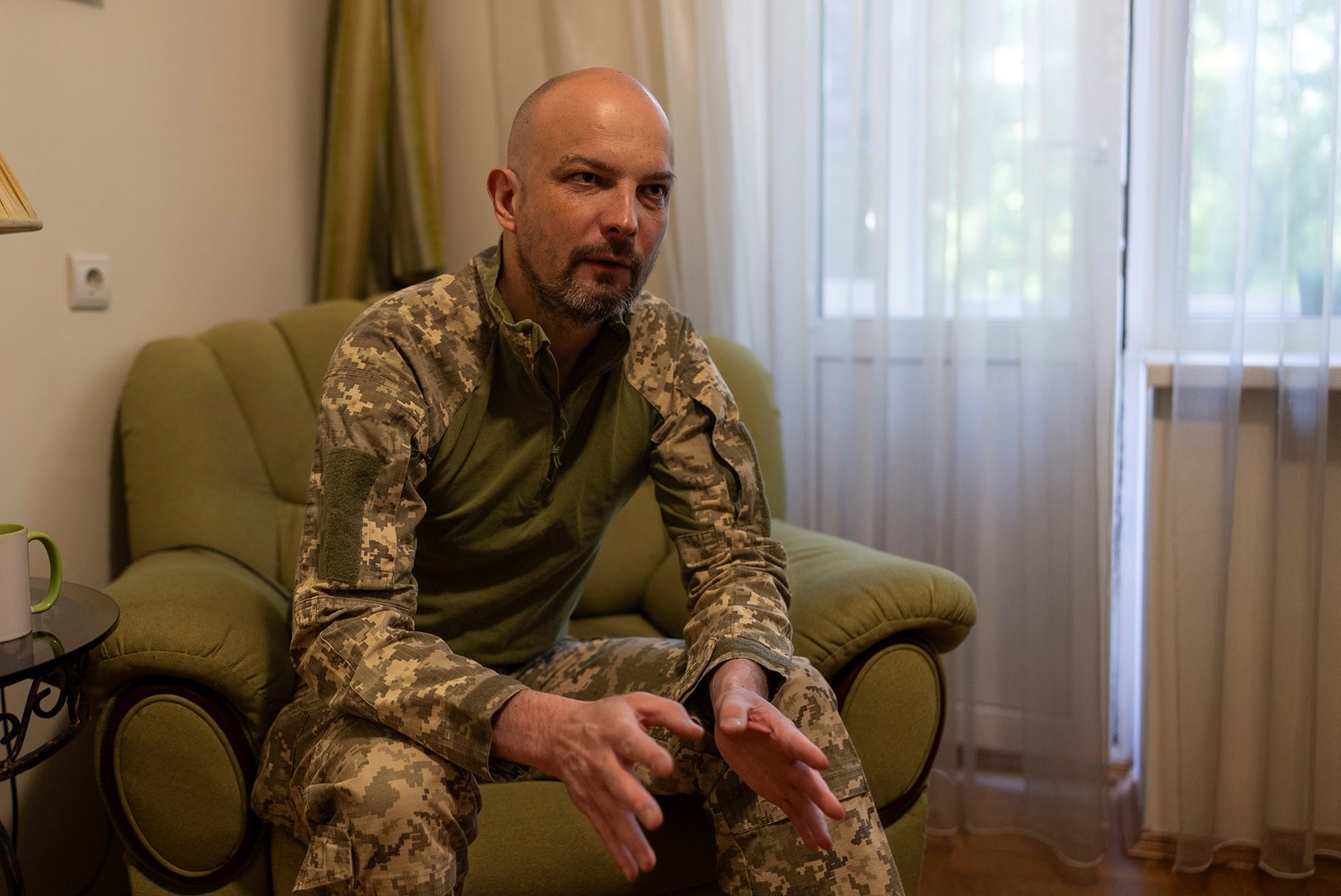


KYIV, Ukraine>> As an investigative journalist, then an activist, and later a lawmaker, Yehor Soboliev sought to expose corruption in business and government as a way to defend Ukraine’s budding democracy.
Now, as a soldier battling Russia, he’s had to put those aims on hold as he fights alongside some of the people he once tried to bring down.
“Till the victory, we are on the same side,” said Soboliev, a lieutenant in a front-line drone unit. “But maybe — definitely — after the victory, we should separate ourselves from each other. And we should continue that fight in making our country more honest, more responsible, more serving to its citizens.”
Ukraine has spent years trying to build a Western-style democracy, although not without some bumps along the way as it shed habits from its Soviet past. Russia’s full-scale invasion two years ago raised the stakes of these democracy-building efforts, which are fundamental to Ukraine’s goal of joining the European Union and NATO.
Soboliev’s feelings capture a paradox within Ukraine: To beat back Russia and remain a democracy it has felt compelled to suspend or restrict some democratic ideals temporarily.
Elections have been postponed, a once-robust media has been restrained, corruption-fighting has slipped down the agenda, and freedom of movement and assembly have been curbed by martial law.
And as Russia pounds Ukraine’s cities and makes battlefield gains, the unity sparked by the invasion — and the sense of common purpose crucial to defending democracy — have come under growing strain.
This story, supported by the Pulitzer Center for Crisis Reporting, is part of an ongoing Associated Press series covering threats to democracy in Europe.
Corruption “metastasized” in the midst of war
When comedian-turned-politician Volodymyr Zelenskyy was elected Ukraine’s president in 2019, he promised to crack down on corruption that had flourished for decades after the collapse of the Soviet Union.
War hasn’t made that any easier. Corruption exists at a “frightening scale” in Ukraine, the pro-democracy organization Freedom House said in a February report, noting that it “metastasized within the army in 2023,” especially around defense contracts and men seeking exemptions from the draft.
The European Union says Ukraine must reduce corruption before it can join the 27-nation bloc and in November said the country had made “some progress” but needed to do more, especially on “high-level cases.” Ukraine’s defense minister, agriculture minister, top prosecutor, intelligence chief and other senior officials have been pushed out over the past two years, and last year the leader of the Supreme Court was arrested, accused of taking bribes.
But Ukraine’s judiciary has been an obstacle. After Zelenskyy took office, Ukraine’s top court said officials no longer needed to declare their assets in an electronic register. That decision was overturned, in part because of public pressure — but it was just one of many that have undercut anti-corruption efforts.
Still, Olha Aivazovska, who leads the pro-democracy charity OPORA, believes pressure to eliminate corruption will be maintained by Ukraine’s desire for EU membership. “Ukrainian politicians will not win any elections after the end of the war if they will not be successful on the EU integration track,” she said.
“A democracy even without elections”
Zelenskyy indefinitely postponed the 2024 presidential election because of the war. With almost one-fifth of Ukraine occupied by Russia and millions of citizens displaced from their homes, Ukraine’s opposition leaders supported the decision, and opinion polls suggest most Ukrainians agree.
Criticism of Zelenskyy grew last year after Ukraine’s failed counter-offensive, and political rivals are testing the ground.
Kyiv Mayor Vitalii Klitschko has accused Zelenskyy of becoming increasingly autocratic, citing the replacement of some elected mayors with military officials. Zelenskyy’s immediate predecessor as president, the candy magnate Petro Poroshenko, says he is planning a postwar comeback. And in a possible sign of his desire to sideline rivals, Zelenskyy in February dismissed the country’s popular military chief, Gen. Valerii Zaluzhnyi.
Russian President Vladimir Putin has used the canceled elections to question Zelenskyy’s legitimacy. The idea of Zelenskyy as anti-democratic has been echoed in the U.S. by some Republicans in Congress who oppose military support for Ukraine.
Aivazovska rejects that argument. “During wartime, Ukraine can be a democracy even without elections,” she said — as long as it strengthens its media, local government and civil society organizations.
Journalists under pressure
Soon after the invasion, a handful of Ukrainian TV networks combined resources to create one 24-7 channel, the “United News Telemarathon,” as a way to ensure continuity. Public trust in the channel is low, and so are ratings, according to Reporters Without Borders, a journalism advocacy group that has called for the arrangement to be broken up.
Ukraine has a vigorous online media that includes widely read investigative outlets, although some independent journalists say they have faced dirty tricks from the authorities.
The draft divides society
Martial law, imposed on the day Russia launched its full-scale invasion, gave Ukraine’s government power to expropriate property, impose curfews, limit people’s movement, ban gatherings and more.
Men between 18 and 60 are barred from leaving the country without permission and must register with the military. Nonetheless, there has been an illicit exodus of fighting-age men.
With Ukraine’s outnumbered troops facing repeated attempts to push them back by Russia’s much larger army, the government in April lowered the conscription age and announced that it was suspending passport renewals and consular services for men of conscription age who are outside the country.
Some human rights groups criticized the move aimed at pressuring expatriates to register for the draft. But it met with broad support inside Ukraine, where the divide between those who stayed and those who left could become a fault line that threatens social unity in the future..
Keeping the faith in democracy
Despite everything, research suggests war has not destroyed Ukrainians’ belief in democracy, and may have strengthened it.
Some 59% of Ukrainians surveyed by the Kyiv International Institute of Sociology said they felt democracy was more important than having a strong leader — up from 31% before the war.
Twice in the past two decades, Ukrainians have taken to the streets to defend democratic decisions. In 2004, mass protests against attempted election fraud ushered pro-Western President Viktor Yushchenko into office in what became known as the Orange Revolution.
In late 2013, Moscow-friendly President Viktor Yanukovych scrapped an agreement to bring Ukraine closer to the EU. Protesters flooded Kyiv’s Independence Square and were met by a brutal police crackdown. Yanukovych ultimately was ousted.
Putin annexed Crimea soon afterward, and Moscow-backed separatists began an uprising in eastern Ukraine’s Donbas region that grew into a conflict that left thousands dead.
More than two years after Putin escalated with a full-scale invasion, many Ukrainians are tired and traumatized by a war in which victory feels remote. But, by and large, they do not feel powerless to influence events, something experts say is key to the country’s resilience.
Soboliev was an organizer of the 2013 protests against Yanukovych and sees the current war as an extension of that struggle for democracy. “I wrote about democracy. I tried to build to improve democracy, and now I am fighting for it,” he said.
 PREVIOUS ARTICLE
