


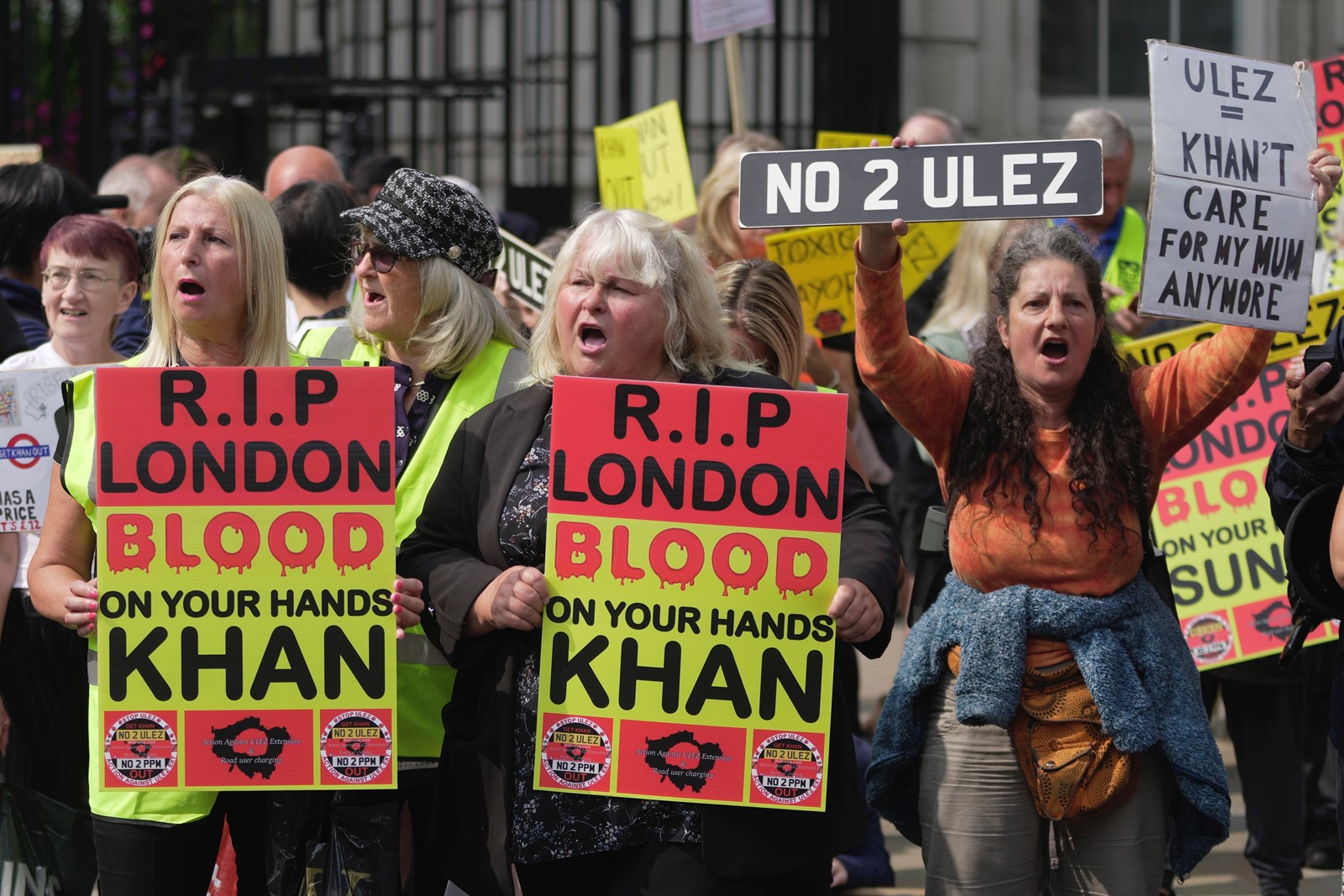


LONDON — London’s traffic cameras are under attack. Police say hundreds of license plate-reading cameras have been damaged, disconnected or stolen by opponents of an anti-pollution charge on older vehicles that came into force across the metropolis Tuesday.
The vandalism shows that emotions are running high over the city’s Ultra Low Emission Zone.
London’s mayor says the measure will cut air pollution that is linked to about 4,000 deaths a year in the British capital.
But critics say it’s a cash grab that will penalize suburban residents who depend on their cars for work and essential travel.
“The cameras are going to keep coming down,” said Nick Arlett, who has organized protests against the clean-air charge and says he neither condones nor condemns the vandalism. “People are angry.”
Moves in the U.K. to cut air pollution and reduce car use have become a political flashpoint.
Supporters say cynical politicians and conspiracy theorists are exploiting opposition to the plans. The Conservative government has attacked London’s vehicle levy, leading to allegations it is backing down on green pledges.
London’s plan, known as the ULEZ, levies a 12.50 pound (about $16) daily charge on most gas cars and vans built before 2006 and on pre-2015 diesel vehicles. Introduced in central London in 2019, it was expanded in 2021 to the city’s inner suburbs.
From Tuesday, it covers all of Greater London, including the sprawling outer suburbs where more than half the city’s 9 million people live.
Mayor Sadiq Khan says the expansion “was a difficult decision, but it’s a vital one and a right one.”
But some suburbanites say it will be an unbearable new expense, amid a cost-of-living squeeze that saw inflation top 11% late last year. Outer London has higher levels of car ownership and less public transit than the city center.
“It’s going to make poor people poorer,” said Anna Austen, who says she relies on her 15-year-old diesel car to get to work and take her children to school. “I have no money to pay the fines, I have no money to replace my car.”
The issue shot up the national political agenda in July when the governing Conservatives unexpectedly won a special election in the outer London district of Uxbridge by campaigning against the levy introduced by Khan, a member of the opposition Labour Party.
Since then, Prime Minister Rishi Sunak has asked for a review of Low Traffic Neighborhoods — often locally controversial zones where cars are banned from some residential streets — and slammed Labour as hostile to motorists.
Sunak said the new car charge “is going to hit working families. I don’t think that’s the right priority.”
The ULEZ was announced in 2015 by then-Mayor Boris Johnson, a Conservative.
Khan has expanded a program that offers London residents up to $2,500 to replace old vehicles. Opponents say the money is nowhere near enough.
 PREVIOUS ARTICLE

