


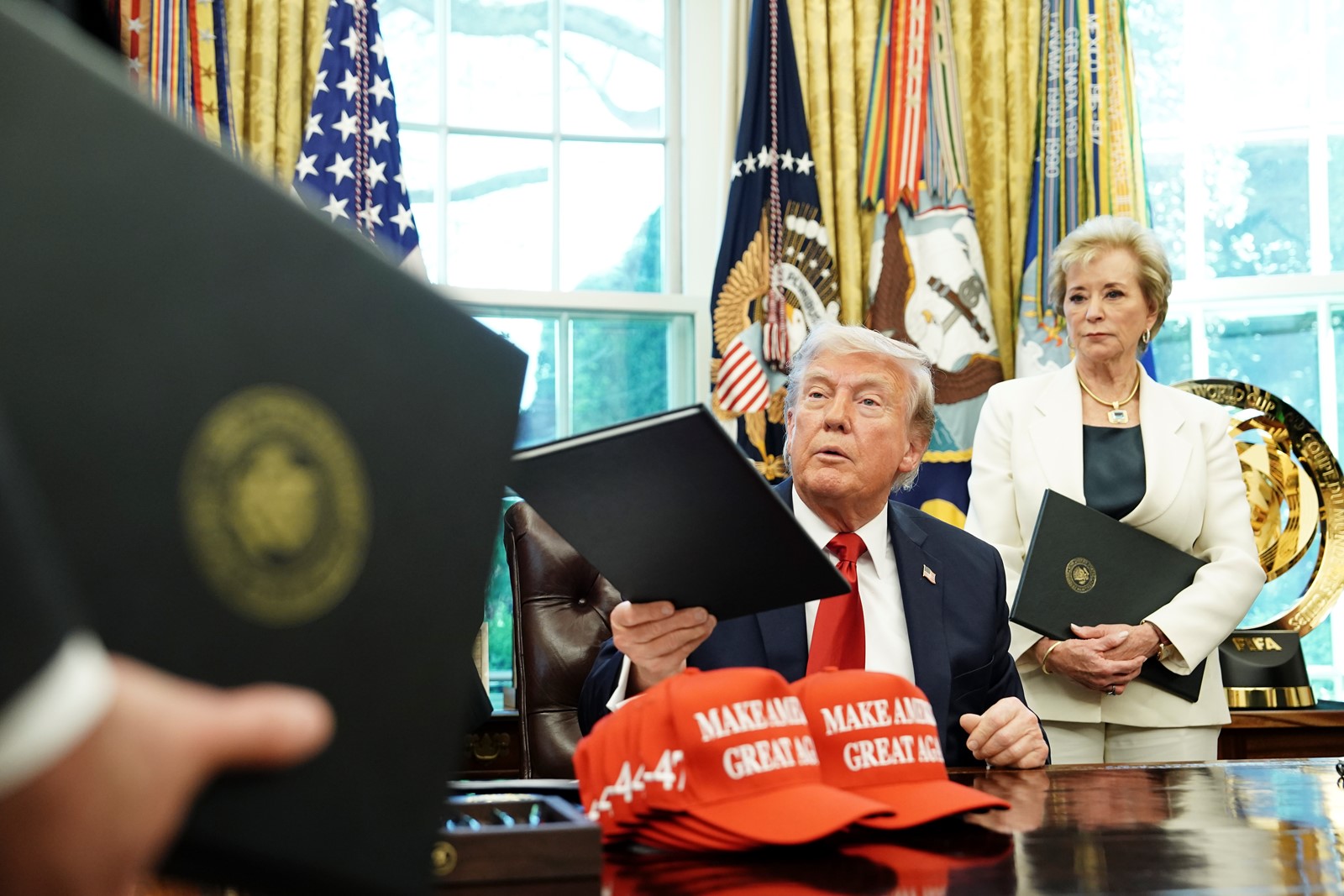


WASHINGTON — President Donald Trump has ordered federal agencies to abandon the use of a long-standing legal tool used to root out discrimination against minorities, a move that could defang the nation’s bedrock civil rights law.
In an expansive executive order, Trump directed the federal government to curtail the use of “disparate-impact liability,” a core tenet used for decades to enforce the Civil Rights Act of 1964 by determining whether policies disproportionately disadvantage certain groups.
The little-noticed order, issued last month with a spate of others targeting equity policies, was the latest effort in Trump’s aggressive push to purge the consideration of diversity, equity and inclusion, or DEI, from the federal government and every facet of American life.
The directive underscores how Trump’s crusade to stamp out DEI — a catchall term increasingly used to describe policies that benefit anyone who is not White and male — is now focused not just on targeting programs and policies that may assist historically marginalized groups, but also on the very law created to protect them.
“This order aims to destroy the foundation of civil rights protections in this country, and it will have a devastating effect on equity for Black people and other communities of color,” said Dariely Rodriguez, the acting co-chief counsel at the Lawyers’ Committee for Civil Rights Under Law, an advocacy group.
The disparate-impact test has been crucial to enforcing key portions of the landmark Civil Rights Act, which prohibits recipients of federal funding from discriminating based on race, color or national origin. For decades, it has been relied upon by the government and attorneys to root out discrimination in areas of employment, housing, policing, education and more.
Civil rights prosecutors say the disparate-impact test is one of their most important tools for uncovering discrimination because it shows how a seemingly neutral policy or law has different outcomes for different demographic groups, revealing inequities.
Lawyers say the test has been crucial in showing how criminal background and credit checks affect employment of Black people, how physical capacity tests inhibit employment opportunities for women, how zoning regulations could violate fair housing laws, and how schools have meted out overly harsh discipline to minority students and children with disabilities.
Over the past decade, major businesses and organizations have settled cases in which the disparate-impact test was applied, resulting in significant policy changes.
One of the largest settlements involved Walmart, which in 2020 agreed to a $20 million settlement in a case brought by the Equal Employment Opportunity Commission that claimed the company’s practice of giving physical ability tests to applicants for certain grocery warehouse jobs made it more difficult for women to get the positions.
rule a target of Conservatives
The use of the disparate-impact rule, however, has also long been a target of conservatives who say that employers and other entities should not be scrutinized and penalized for the mere implication of discrimination, based largely on statistics. Instead, they argue that such scrutiny should be directed at the explicit and intentional discrimination prohibited by the Civil Rights Act.
Opponents say that the disparate-impact rule has been used to unfairly discriminate against white people. In 2009, the Supreme Court ruled in favor of White firefighters in New Haven, Connecticut, who claimed reverse discrimination when the city threw out a promotional examination on which they had scored better than Black firefighters.
Trump’s order resurrects a last-ditch effort made in the final days of his first term to repeal disparate-impact regulations through a formal rule-making process, which was nixed by the Joe Biden administration when he left office.
The new order, titled “Restoring Equality of Opportunity and Meritocracy,” echoes arguments Trump has adopted from far-right conservatives, who say the country has become too focused on its racist history, and that protections from the Civil Rights era have led to reverse racism against nonminority groups. Disparate-impact liability is part of “a pernicious movement” that seeks to “transform America’s promise of equal opportunity into a divisive pursuit of results preordained by irrelevant immutable characteristics, regardless of individual strengths, effort or achievement,” the order stated.
The president ordered federal agencies to “eliminate the use of disparate-impact liability in all contexts to the maximum degree possible,” under the law and Constitution, and required that agencies “deprioritize enforcement of all statutes and regulations to the extent they include disparate-impact liability.”
That means no new cases are likely to rely on the theory in civil rights enforcement — and existing ones will not be enforced.
His order also instructs agencies to evaluate existing consent judgments and permanent injunctions that rely on the legal theory, which means that cases and agreements in which discrimination has been proved could be abandoned.
The order takes aim directly at the use of the test in enforcing the Civil Rights Act, requiring Attorney General Pam Bondi to begin repealing and amending any regulations that apply disparate-impact liability to implement the 1964 law.
One of the most glaring examples in history of how seemingly race-neutral policies could disenfranchise certain groups are Jim Crow-era literacy tests, which some states set as a condition to vote after Black people secured rights during Reconstruction.
The literacy tests did not ask about race, but were highly subjective in how they were written and administered by white proctors. They disproportionately prevented Black people from casting ballots, including many who had received an inferior education in segregated schools, and were eventually outlawed with the passage of the Voting Rights Act of 1965. In 1971, the Supreme Court established the disparate-impact test in a case that centered on a North Carolina power plant that required job applicants to have a high school diploma and pass an intelligence test to be hired or transferred to a higher-paying department. The court ruled unanimously the company’s requirements violated the Civil Rights Act because they limited the promotion of minorities and did not measure job capabilities.
legal challenges expected
Trump’s executive order, which is likely to face legal challenges, falsely claimed that the disparate-impact test was “unlawful” and violated the Constitution. In fact, the measure was codified by Congress in 1991, upheld by the Supreme Court as recently as 2015 as a vital tool in the work of protecting civil rights, and cited in a December 2024 dissent by Justice Samuel Alito.
Harrison Fields, a White House spokesperson, said the disparate impact theory “wrongly equates unequal outcomes with discrimination and actually requires discrimination to rebalance outcomes.”
“The Trump administration is dedicated to advancing equality, combating discrimination and promoting merit-based decisions, upholding the rule of law as outlined in the U.S. Constitution,” Fields said.
Now the Justice Department’s embattled civil rights division has halted the use of disparate-impact investigations altogether, officials said.
 PREVIOUS ARTICLE
