


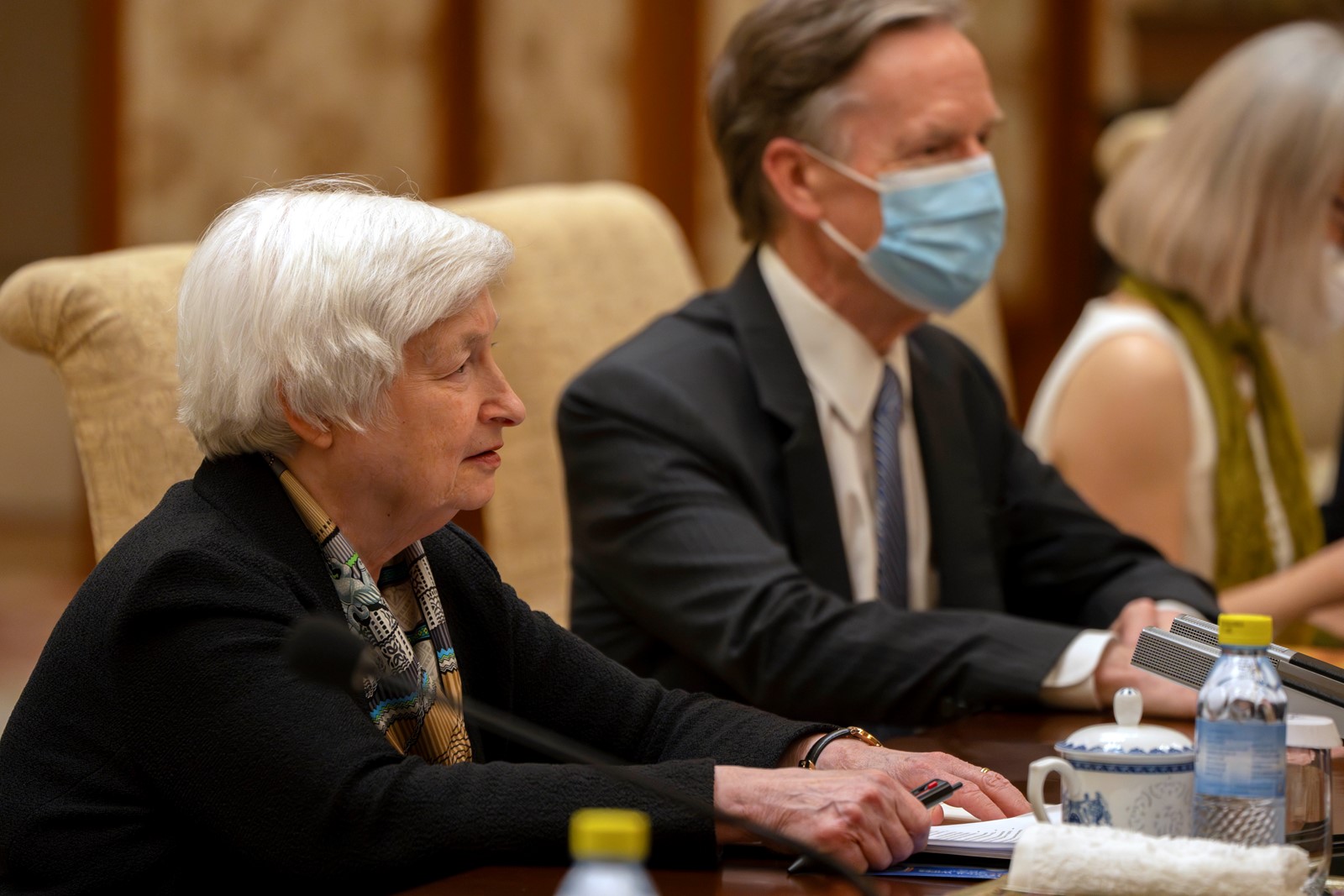


BEIJING >> President Joe Biden’s administration called on China on Saturday to do more to help developing countries combat climate change, urging the world’s largest emitter of greenhouse gases to back international climate finance funds that it has so far declined to support.
Treasury Secretary Janet Yellen delivered the message during her second day of meetings in Beijing, where she is seeking to cultivate areas of cooperation between the U.S. and China. Though China has expressed support for programs to help poor countries cope with the effects of climate change, it has been selective in choosing which funds to support, arguing that it is also a developing nation.
Yellen said that China and the U.S. share a common interest on climate change and could make a more significant impact if the nations worked together.
“I believe that if China were to support existing multilateral climate institutions like the Green Climate Fund and the Climate Investment Funds alongside us and other donor governments, we could have a greater impact than we do today,” Yellen said at a meeting with a group of Chinese and international sustainable finance experts Saturday morning.
Yellen also raised climate finance and the debt difficulties of developing countries during a meeting with Vice Premier He Lifeng, her counterpart who oversees China’s economy.
In remarks at the beginning of that meeting, Yellen noted that the U.S. and China “face important global challenges, such as debt distress in emerging markets and developing countries and climate change, where we have a duty to both our own countries and to other countries to cooperate.”
Yellen and He met in a conference room and then had dinner together for nearly seven hours. It was a marathon session nearly rivaling the 71/2 hours that Secretary of State Antony Blinken and Foreign Minister Qin Gang of China spent in a meeting followed by dinner three weeks ago in Beijing, as the Biden administration tries to forge a deeper level of communication with the Chinese government.
He seldom has met with foreign officials or business executives in recent years, and many of his personal views on policy are a mystery, prompting a strong desire by U.S. officials to establish more communication with him.
The Treasury Department described the conversation as “candid, constructive and comprehensive.” Though Yellen raised “issues of concern,” she also “discussed the administration’s approach to seeking a healthy economic competition with China, with a level playing field for American workers and businesses.”
“Secretary Yellen also conveyed that even when the United States and China have disagreements, it is vital that the two countries find ways to work together on issues of shared — and global — concern, including debt distress in low-income and emerging economies and climate finance,” the statement said.
The United States and China both are facing pressure from developing countries to mobilize more money for developing countries that are struggling to shut down coal plants, develop renewable energy or cope with the consequences of climate change by building sea walls, improving drainage or developing early warning systems for floods and cyclones.
Under President Barack Obama, the U.S. pledged $3 billion over four years to the Green Climate Fund, a United Nations-led program aimed at helping poor countries. So far, it has delivered $2 billion of that pledge. Republicans have sought several times to block taxpayer spending for the fund and other climate finance, but Biden has used discretionary spending within the State Department to fulfill part of the U.S. pledge.
China pledged $3.1 billion, and it has delivered about 10% of that, according to studies.
It long has resisted pressure to contribute to the same climate funds as wealthy nations.
Ma Jun, the director of the Institute of Public and Environmental Affairs, a research group in Beijing, said that China was willing to help developing countries cope with climate change and manage the transition to a warmer world. But harm to developing countries already is being caused by accumulated emissions released largely by industrialized countries, and it is those countries that should bear most of the responsibility, he said.
 PREVIOUS ARTICLE

