


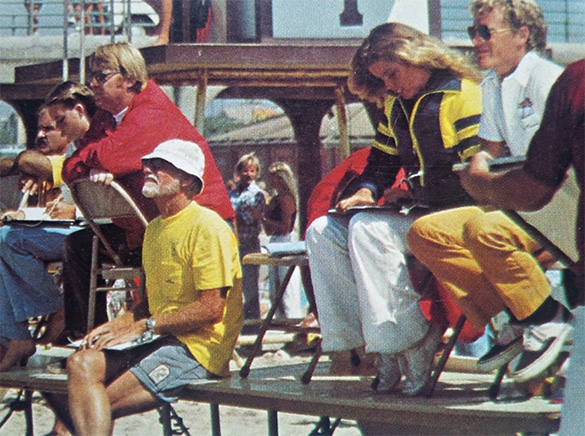


The story goes that on June 25, 1916, the day Lewis Earl Swarts was born in Tulsa, Oklahoma, his father, an oil industry worker, was reading a Hopalong Cassidy novel.
The “Hoppy” nickname he gave his newborn son stuck, even after the family left Oklahoma to move to California, settling in Redondo Beach. Hoppy became enamored with the beach, the waves and the ocean in general — and he would spend his life in thrall to surfing.
He rode his first waves as a 14-year-old in 1930 in the surf in front of the Hermosa Biltmore in Hermosa Beach on a giant redwood paddle board that weighed more than 100 pounds.
He met his lifelong friend, pioneering surfer and photographer LeRoy Grannis, while both were students at Redondo Union High School in the early 1930s. Together, they surfed Malaga Cove and other Peninsula surfing spots.They became early members of the Palos Verdes Surfing Club shortly after John “Doc” Ball and Adolph Bayer founded it in 1935. Based at Bluff Cove, it was just the second surf club formed outside of Hawaii. Surfing Club members wore the club’s distinctive green jackets during meetings, where smoking was not allowed.
Members swore to the group’s code, which called for them to “at all times strive to conduct myself as a club member and a gentleman.” As the sport’s popularity grew, the club began organizing surfing competitions and paddleboard race events with newer clubs that had begun springing up along the Southern California coast. Swarts competed in many such events during the 1930s.
He didn’t fit the modern-day slacker surfer stereotype in the slightest, though. He enrolled at Occidental College in Eagle Rock, where he majored in math and minored in education. He graduated in 1941 and earned his teaching credential a year later.
During World War II, he took a job as a researcher at the Massachusetts Institute of Technology’s radiation laboratory in Cambridge. After the war, he worked for the Navy doing research in microwave communications. He would go on to earn a master’s degree in electrical engineering at UC Berkeley.
For the next few years, he would work for local aerospace firms such as Hughes and TRW, where he helped design space radar systems. He left the industry in 1971 in order to teach math in Barstow-area high schools.
Despite his educational and research accomplishments, though, Swarts always declared that they were mere sidelights to surfing, which he considered his life’s work.
Surfing contests during the 1950s were somewhat haphazard affairs, and surfers began to develop a reputation as being itinerant layabouts on the fringes of society. Surfing’s meteoric rise in popular culture, thanks first to the 1959 film, “Gidget,” followed by the surf music explosion of the early 1960s, brought more attention to the phenomenon.
Swarts became concerned. He and his fellow veteran surf compadres thought that organizing competitions with a unified set of rules and a set schedule would help unify the sport and bring it more respectability as well.
With this in mind, Swarts became the first president of the United States Surfing Association, the sport’s first public umbrella organization. In addition to promoting the sport and working to improve its image, the group also created a series of tournaments. When the USSA split into regional associations in 1967, Hoppy became the first president of the new Western Surfing Association,
Swarts gets credit for developing surfing’s sophisticated tournament scoring system, which used mathematical principles that he originated. It helped to quantify surfing performances, which then could be used to create a system ranking professional surfers.
He also worked tirelessly to bring surfing into high school and college athletic programs. The concept seemed outlandish to many at the time, but by 1970, a South Bay high school surfing league had been established with 10 teams. Many schools have since added the sport to their athletic curricula.
Another one of Swarts’ unusual ideas ended less successfully. In late 1970, the WSA announced that it would build the world’s first artificial surf reef from sandbags submerged in the ocean 200 feet offshore from the southern end of Hermosa Beach, near its border with Redondo Beach.
The philosophy behind the idea was to open up more areas for surfing and reduce the risk of injuries and territorial disputes from too many surfers trying to catch too few waves in too small areas in prime surfing spots.
With a surprising assist from L.A. Rams defensive great Merlin Olsen, who owned a construction company that built embankments, work began on the project in April 1971. Sadly, a year later, the reef was determined to have been a failure. But ensuing projects based on similar principles later would be built, with particular success in Australia and New Zealand.
Hoppy Swarts was standing in line to buy a plane ticket at Los Angeles International Airport on June 9, 1988, when he collapsed and died from a massive stroke. At the time, he was heading to a surfing contest in Santa Cruz that he was going to run. He was 71.
More than 200 friends and admirers turned out 10 days later at a celebration and memorial service held for him near the Avenue C lifeguard station in Redondo Beach, during which his ashes were scattered in the ocean.
Despite his nickname, Swarts, who competed in his last senior competition in 1983, always was smooth as silk on the waves. His longtime friend, Grannis, told the Los Angeles Times at the ceremony, “He looked good in the water. Some people looked all stooped over, but he just looked like he was flowing.”
Sources: “Chairman of the Board,” by Doug Beacham, Occidental Magazine, Summer 2017. Daily Breeze archives. Find A Grave website. “The History of Artificial Surf Reefs,” SurferToday website. “Hoppy’s Reef: The First Attempted Artificial Surf Reef,” Raised Water Search website. Los Angeles Times archives.
 PREVIOUS ARTICLE
