


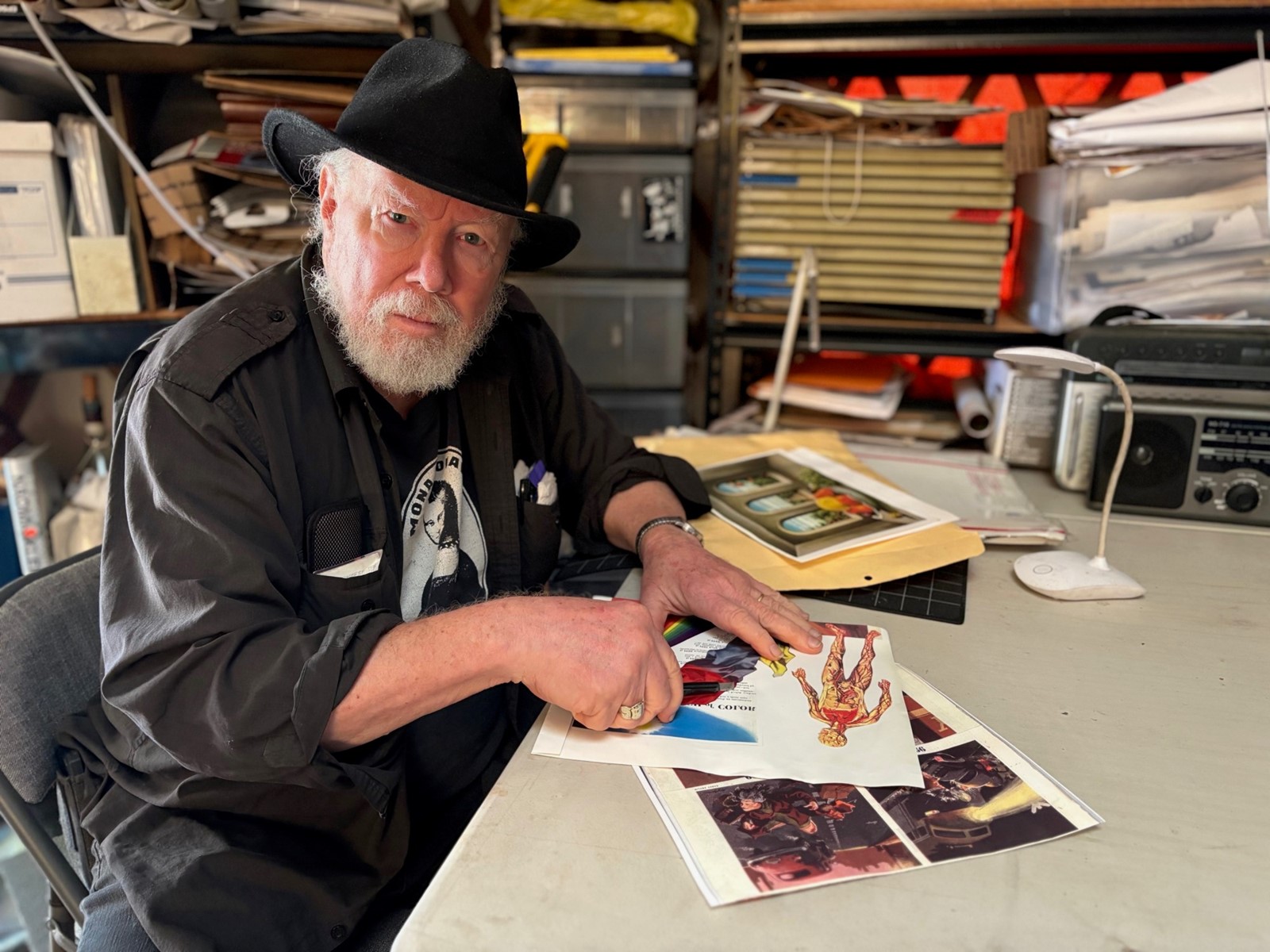


“It’s Always Something, Ain’t It?” is the title of the show featuring the work of artist, illustrator and album cover designer Winston Smith.
A longtime resident of Mendocino County and San Francisco, Smith works primarily in the medium of montage. He is best known for the artwork produced for the American punk band the Dead Kennedys and the Alternative Tentacles record label, whose “bat” logo, as well as the logo Smith created for the Dead Kennedys, have become iconic symbols of the punk rock ethos. He has produced over 50 record covers and art for artists as well-known as George Carlin, Ben Harper and MoonAlice, and as obscure as Fish Karma.
One of Smith’s most identifiable compositions is the cover of Green Day’s 1995 album “Insomniac.” A version of an illustration used on the back cover of a Jello Biafra/D.O.A. album, “Last Scream of the Missing Neighbors” was featured on the cover of the April/May 2000 issue of The New Yorker magazine.
Smith’s work has appeared in Spin, Playboy, Wired, Utne Reader, Vice, Ad Busters, Juxtapoz, Mother Jones, Metro Silicon Valley, Ugly Planet, National Lampoon and numerous punk fanzines, including MaximumRock’nRoll.
You might be thinking, “Hmm, Winston Smith. I’ve heard that name before.” You have. The person you’re thinking of is the fictional protagonist from George Orwell’s now-prophetic novel, “1984.” The taking on of the Winston Smith name is completely in line with Smith’s personal and artistic journey.
Raised in Oklahoma, Winston’s mother was a sculptress who attended the Art Institute in Chicago. “Then WWII broke out, and my grandfather, who was an executive for the Santa Fe Railroad, got moved to Tulsa — the exact middle of nowhere,” he smiles. “She wasn’t Rosie the Riveter, but she worked in a factory where they were building the B-17 Flying Fortresses. They fit the girls with roller skates so they could deliver memos all over this huge factory.”
Winston’s mother made sculptures out of clay and wood, “which I couldn’t do at all,” he notes. “My mother did observe I had a little talent, and she encouraged me to be an artist.”
Winston’s father was a fireman for the railroad. “He didn’t put out fires, he started them. He was still shoveling coal into engines at that time.” His mother loved Norman Rockwell. “I was drawn to that type of art. The books and magazines we had were vintage Life Magazines and National Geographics. I thought they were brand new, but we couldn’t afford many new magazines, and we had a giant wall space full of art books.”
Winston used to watch television at friends’ houses. “I remember as a child thinking about TV shows Beat the Clock, or Wagon Train, and thinking to myself, ‘That never happened. It doesn’t really exist. Those shows are plays. They’re not real.’ His early indoctrination into the world of DADA and Surrealism had already begun. “I realized early on that people were being indoctrinated by the media and other means. Growing up in Oklahoma was double-squaresville. It’s still that way. They have the lowest education statistics in the country.” Which is why by the time he was a teen, Winston was ready to get out of Dodge. And Tulsa.
It was the early ’60s, and the look and feel of commercial advertising was changing. “It had gone from lush illustrations to photographs. There were no more illustrations for Pennzoil featuring a genie coming out of an oil can. Those things were almost surrealistic. There was an abstraction to them. Madison Avenue created Mr. Clean, with his gold earring, and Betty Crocker.” Though he didn’t inherit his mother’s facility for sculpture, he was a skilled enough artist to be accepted to the Academy of Fine Arts in Florence, Italy, where he studied for several years before moving to Rome.
“Going to art school abroad was very affordable. I think I paid $40 for my own apartment in the middle of Florence. I was surrounded by the Renaissance art that I’d only seen in books. The food was wonderful, the art was incredible, and the girls were beautiful,” he smiles. “I was a belligerent 17-year-old, so I think my parents were happy to get rid of me,” he chuckles. “The war in Vietnam was raging. I registered for the draft in Florence, even though I had mixed feelings about serving in that particular conflict. I waited for my number to come up, but I was never called.”
In 1976, Winston returned to the States, hitched across country, and landed in San Francisco, where he worked as a roadie for local and national rock bands. The country had changed in 7 years, and from Winston’s perspective, not for the better. That’s when he officially changed his name. Around that time, Winston submitted a few of his pieces to a montage show in Berkeley. A mutual friend saw the work and contacted Jello Biafra, thinking he’d be interested in Winston’s art. He was, and the two have remained working partners and friends since that time.
Enter Jayed Scotti. Jayed was interested in book illustration when he met Winston in San Francisco, and they became friends, living together several times. Winston had been exposed to punk culture through his roadie jobs and discovered a burgeoning art scene within. Jayed and Winston shared a common interest in politics and satire, and what they developed was one of the earliest renditions of what today are known as “’zines.” Using the primitive copier machine technology available at the time, they published Fallout Magazine, in which they created fake advertisements for fake bands, original artwork — some of which ended up as album art — and no shortage of what was, at the time, rather shocking commentary on life under the thrall of President Reagan — ah, those happy, halcyon days. Not dissimilar to the work of many Dada artists of the 1930s, Winston and Jayed sounded off loudly on the political corruption of the 1970s, which, in comparison to today’s shenanigans, seems no more dangerous than the ham-fisted pranks of schoolboys.
Winston’s expertise with montage was a perfect device to augment the rough edges of punk rock. “I drew pictures at home because I wouldn’t dare cut them out of my mom’s art books.” he said. “Before there were photocopy machines, I drew things and cut up the drawings, so I’d have collected a dozen different pictures. Or I’d cut up things from magazines. I’d put them together in a way they weren’t meant to be. I was always interested in the Surrealists, and cutting up random images from popular media just made sense to me.”
Winston has a knack for taking neutral images and putting them back together, making an utterly out-of-context story. Jello Biafra once told Winston — and I’m paraphrasing: “You take two images that are right, and you put them together. Now they’re wrong, and that’s what makes them right.” His compositions are purely allegorical. A happy housewife triumphantly holding a dinner platter on which lays a slimy platypus may have a specific meaning for Winston — and many of his pieces do tell a specific story, but for him, it’s more about what the images evoke for the viewer. “People see what they see — maybe it’s something from their past, or an event, or maybe it’s just something absurd, or funny or disturbing.”
I recall Winston showing me one of his pieces decades ago — a nurse holding a newborn baby with a huge steam shovel about to snatch them up. In response, I said, “Yeah. Welcome to the world,” which remains the title of that piece to this day.
“In about 1979, I was attending an event in San Francisco. Some guys from the Berkeley Barb were looking at my work and invited me to visit them, which ended up with my work being on the front cover of their newspaper. A woman saw the paper, called me up, and told me there was going to be a 4-day Dada Festival in Ukiah. I’d never heard of Ukiah, but I knew I had to come to a Dada Festival. I stayed with PollyEsther Nation in a tent in her backyard in Talmage.”
“A year or so later, we came up to look at some property near Laytonville. It wasn’t what we were looking for, but driving back through Ukiah, we decided to stop at the Palace Hotel, which was so utterly elegant and beautiful at the time. We called Polly and let her know we were in town. Turns out she was working upstairs for a company called Up Yurts, owned by David Raitt. We found another property for sale, moved here, and David built our yurt, which we still live in to this day. Mendocino County has been my anchor for 44 years.”
Winston’s current work continues to be imbued with provocative, surrealist, and satirical imagery. He still uses vintage magazines and other imagery from Victoriana to mid-20th-century American magazine art. Despite the ease of computer-aided collage, Winston, a self-confessed Luddite, continues to hand-cut his montage elements, creating work that now inspires a new generation of artists. A not-to-be-named “fancy college” once canceled a workshop they’d scheduled with Winston when they discovered he used an Exacto knife and not Photoshop in the creation of his art.
He is widely credited for defining the iconic style still used by punk bands worldwide. His graphic style has become so ubiquitous that practically everyone has a Winston-esque refrigerator magnet lying around, featuring some ’50s style housewife holding a cake, saying something like, “Stressed is Just Desserts Spelled Backward.”
With the support of his wife and longtime best buddy Chick Lewis, Winston has been running successful montage workshops for the public in San Francisco.
“Conspire to Inspire” is Smith’s slogan of the day. “I truly believe that everyone has a creative streak. Not everyone will become an artist or musician, but everyone has the ability to create,” he concludes.
The show is on display for the month of November at the Medium Art Center, 110 S. School Street in downtown Ukiah. For more information on Winston’s art, visit winstonsmith.com artcrimes or his Instagram page. For information about the art center, visit mediumarts.org.
 PREVIOUS ARTICLE
