


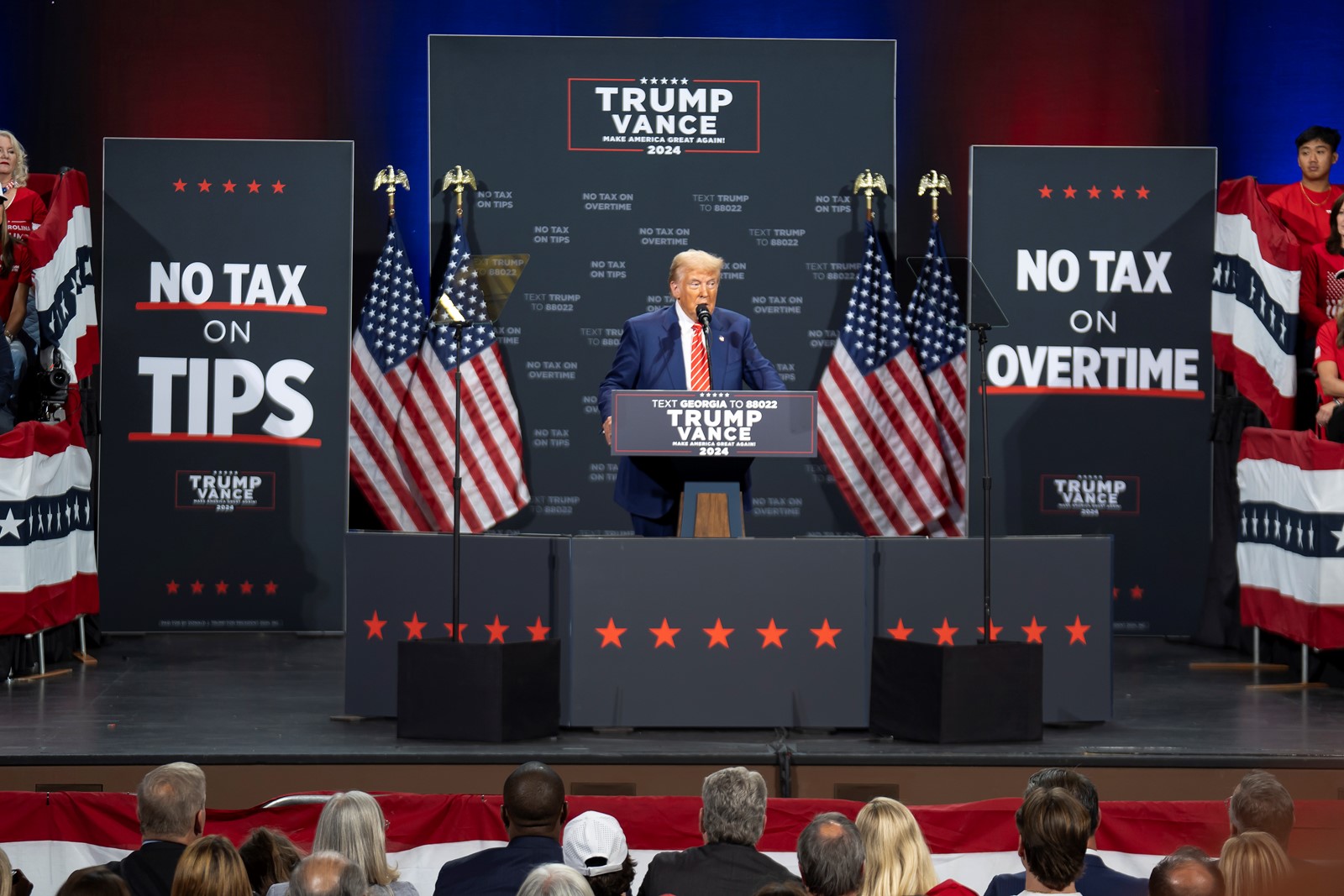


WASHINGTON — No tax on tips? Lower corporate taxes? No tax on Social Security benefits?
The slew of tax cuts President-elect Donald Trump proposed in loosely defined slogans over the course of his victorious campaign will now face a fiscal reckoning in Washington. While Republicans are poised to control both chambers of Congress, opening a path for Trump’s plans, the party is now grappling with how far they can take another round of tax cuts.
Trump’s ambitions for a second term will ultimately have to compete with the signature accomplishment from his first: the giant tax package that Republicans passed and Trump signed into law in 2017. Large swaths of that tax cut expire at the end of next year, setting up an expensive debate that could overshadow Trump’s other goals.
“Nobody wants to acknowledge at all the sheer enormity of the challenge,” said Liam Donovan, a Republican strategist. “There’s a reckoning coming.”
Unlike in 2016, when Trump’s victory surprised many in Washington, Republicans have spent months preparing for their return to power. They have been discussing using a fast-track budget process that skirts the supermajority requirement for legislation in the Senate, a tactic that would allow for a party-line passage of more tax cuts if Republicans ultimately keep control of the House.
But lawmakers and advisers to Trump are undecided about how much money they can commit to lowering the nation’s taxes again. The cost of just preserving the status quo is steep. The nonpartisan Congressional Budget Office has estimated that continuing all of the expiring provisions would cost roughly $4 trillion over a decade, and Trump’s campaign proposals could add trillions more to the debt.
In interviews before the election, some Republicans said the party would have to show some fiscal discipline.
“We can’t just have it be unlimited, whatever we want to it to be,” Sen. James Lankford, R-Okla., a member of the Finance Committee, said of the cost of a tax bill next year.
In financial markets, investors are preparing for higher deficits under a second Trump administration, selling bonds that could become less valuable if the government has to issue many more to finance a larger debt. Republicans and some advisers to Trump are already looking at ways to bring down the cost of his agenda.
For proposals like not taxing Social Security benefits, for example, Republicans could raise the income threshold for tax-free benefits rather than eliminating the tax entirely, according to John Paulson, a billionaire hedge fund manager advising Trump on economic issues.
Paulson, a potential nominee for Treasury secretary, said that several other of Trump’s proposed tax cuts — including not taxing tips or overtime, and restoring a deduction for state and local taxes — should also become narrower so they benefit fewer people and cost less money.
“You need to keep the concept of what he wants to achieve, and put guardrails around it so you achieve the goals, but lower the revenue impact,” Paulson said in an interview before the election. “And I have discussed that with members of his economic team, and they’re all cognizant of that.”
Beyond the cost, the policy goals of some of Trump’s campaign proposals, including creating a new deduction for interest on car loans, run counter to traditional conservative ambitions of simplifying the tax code.
Trump and his team have put forward a number of ideas to offset the cost of his tax cuts. Those include rescinding tax credits for clean-energy projects passed under President Joe Biden, as well as creating a commission run by billionaire Elon Musk to find deep spending cuts.
But some of those plans could face skepticism from Republicans who favor programs that Trump has targeted for cuts. For instance, several Republicans have already pressed House Speaker Mike Johnson to move cautiously on repealing clean-energy subsidies, which they say benefit their districts.
Trump’s chief idea for raising federal revenue has been to impose steep tariffs on imported goods. Some advisers to Trump have presented those ideas as only a negotiating position, and they have also debated whether Trump can unilaterally impose such broad levies or if he will need the approval of Congress. Many Republicans on Capitol Hill oppose broad tariffs, meaning such a plan may not be able to become law.
“I’m also one who’s not anxious to budget around tariff revenues, and we need to be very careful not to pursue inflationary policies,” said Rep. Adrian Smith, R-Neb.
Even if Trump does impose broad tariffs, though, it would likely not be enough to cover the cost of his other plans. The Committee for a Responsible Federal Budget has estimated that Trump’s agenda, including higher tariffs, could add roughly $7.5 trillion to the debt over the next decade.
Adding to fiscal concerns is the unusually large size of the deficit, which stood at roughly $1.8 trillion last fiscal year. While Trump said little about the deficit during his campaign, Republicans have routinely criticized the gap between what America spends and what it earns through taxes.
and other revenue since Biden took office.
 PREVIOUS ARTICLE
