


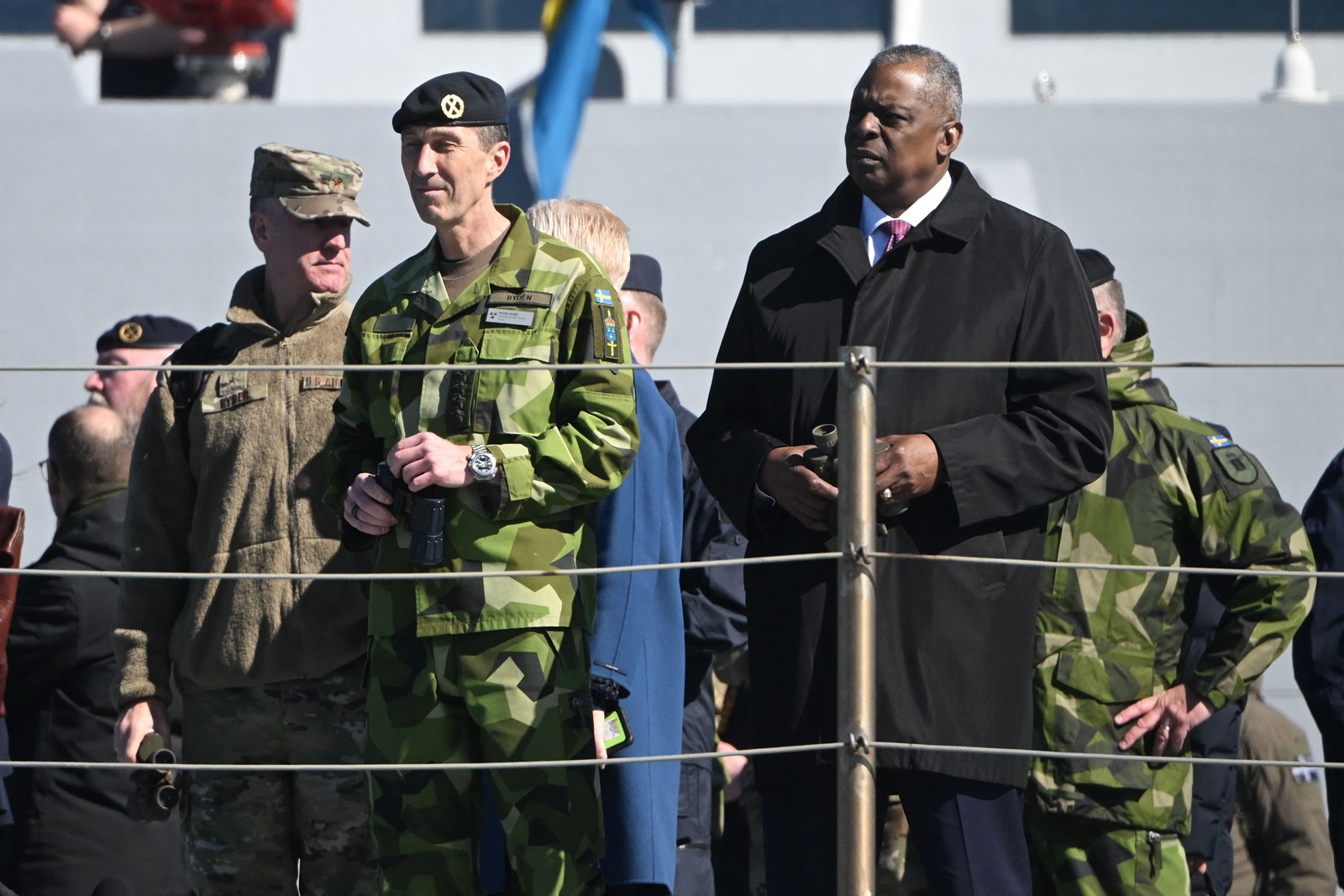


MUSKO NAVAL BASE, SWEDEN — Defense Secretary Lloyd Austin on Wednesday defended the Pentagon policy to allow young enlisted service members access to sensitive national security secrets and downplayed whether a 21-year-old Massachusetts Air National Guardsman accused of leaking top secret documents should have been allowed access to them in the first place.
Austin’s comments came as Jack Teixeira, the airman charged under the Espionage Act with unauthorized retention and transmission of classified national defense information, made a brief court appearance Wednesday, as a hearing to determine whether he should remain jailed while awaiting trial was delayed to give the defense more time to prepare. Teixeira has not yet entered a plea.
That question of why the Pentagon would allow a junior-ranking enlistee the clearance to view secret war plans for Ukraine has dogged the Defense Department since Teixeira was arrested last week.
Confronted with the question during a news conference Wednesday in Sweden, Austin said that age is not the issue. “The vast majority of our military is young,” he said. “So it’s not exceptional that young people are doing important things in the military.”
Teixeira, Austin noted, had top-secret clearance as part of his job as a computer specialist in an intelligence unit of the Massachusetts Air National Guard.
“The issue is how you responsibly execute or carry out your duties and how you protect the information,” Austin said. “All of us have a requirement to do that, and supervisors have a requirement to make sure that’s being done.”
Teixeira is accused of sharing highly classified military documents about Russia’s war in Ukraine and other top national security issues in a chatroom on Discord, a social media platform that started as a hangout for gamers. The stunning breach exposing closely held intelligence, including on such topics as the capabilities and geopolitical interests of other nations and other national security issues, has sparked international concern and raised fresh questions about America’s ability to safeguard its secrets.
In Sweden, where Austin met with Swedish Defense Minister Pal Jonson in a show of support for that country’s NATO bid, Jonson said the issue of the leaks did not come up.
“I can just say that we have good intelligence cooperation between Sweden and the United States,” Jonson said. “We feel completely sure of the U.S. commitment of handling the situation.”
The classified documents range from briefing slides mapping out Ukrainian military positions to assessments of international support for Ukraine and other sensitive topics, including under what circumstances Russian President Vladimir Putin might use nuclear weapons.
Austin’s comments were the first time a senior Pentagon leader has, in a public setting, spoken about whether the military is entrusting too much responsibility to service members at too young an age. Military leaders have long maintained that if you are old enough to die for the country, you are old enough to do any number of jobs in the military.
Whether Teixeira’s case sparks a wider reckoning on age and sensitive material remains unclear.
Air Force Secretary Frank Kendall has directed the service’s inspector general to look at the Air National Guard 102nd Intelligence Wing, where Teixeira served, and at how Teixeira was able to post hundreds of national security documents into a chatroom for gamers. From there, they eventually drifted to Twitter and the Telegram messaging platform.
In an extraordinary move, Kendall also temporarily shut down the 102nd’s operations.
That unit supports global surveillance drone and spy plane missions from its base in Cape Cod.
“The 102nd Intelligence Wing is not currently performing its assigned intelligence mission,” Ann Stefanek, an Air Force spokesperson, said in a statement. “The mission has been temporarily reassigned to other organizations within the Air Force.”
The wing is being investigated for its “overall compliance with policy, procedures and standards, including the unit environment and compliance” related to “the release of national security information,” she said.
The Air Force’s own reviews are on top of a militarywide review directed Monday by Austin, who has ordered that all military facilities that handle classified information report to him within 45 days on how they access, share, store and destroy the nation’s secrets following the leaks.
New policies may be forthcoming that restrict or delete email distribution lists on classified computer networks, Austin’s directive said, and that limit access to certain intelligence and the ability to print paper copies of reports posted on the Joint Worldwide Intelligence Communications System, or JWICS, a government computer network for top-secret information.
Authorities have not revealed an alleged motive. But members of the Discord group described Teixeira as someone looking to show off, rather than being motivated by a desire to inform the public about U.S. military operations or to influence American policy.
The Biden administration has scrambled to contain the potential diplomatic and military fallout from the leaks since they were first reported, moving to reassure allies and assess the scope of damage. There has been no clear answer on how many documents were leaked.
Associated Press contributed.
 PREVIOUS ARTICLE
