




FOR THE PRESS DEMOCRAT
Amid a concerted federal push to rewrite certain parts of history, a tiny library just outside of Cotati is fighting like hell to protect it.
That library, dubbed the Sitting Room, is a Mecca of matriarchy, a community-based resource dedicated specifically to literature and art by and about women. The facility was co-founded in 1983 by former public librarian Karen Petersen and former Sonoma State University professor J.J. Wilson. It is housed in a private residence surrounded by redwoods and next to a church.
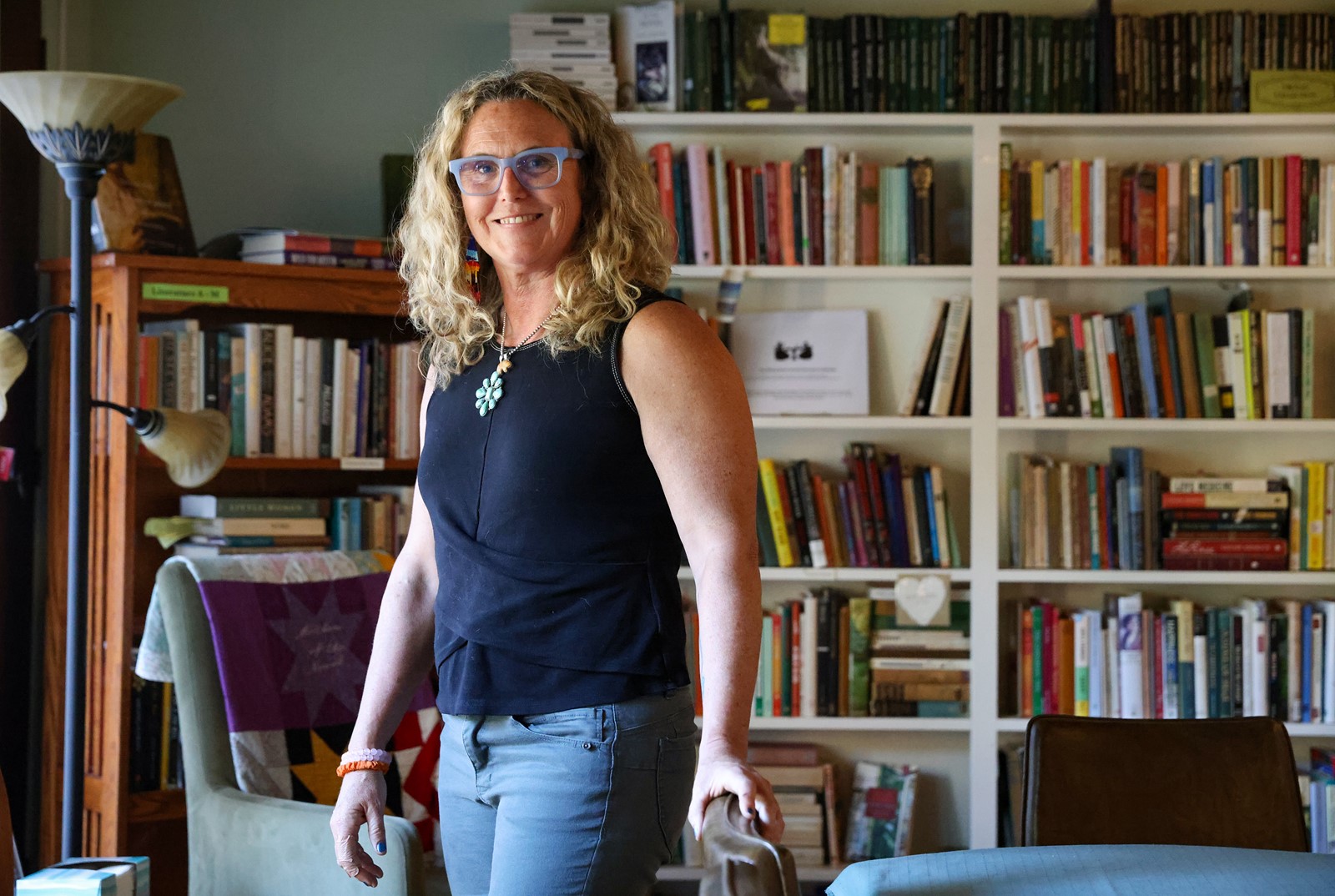
Today the library is as much a treasure as it is a resource. Iris Jamahl Dunkle, a local poet, author, and scholar who works at the Sitting Room, described it as a haven.
“One of the tenets of the Sitting Room is to be a place to remember,” said Dunkle, who teaches writing at Sonoma State and UC Davis. “To remember where we are and remember the greater history we’re a part of.”
The Sitting Room is more than 40 years old.
Wilson and Petersen, both active participants in the local women’s movement, realized they and fellow activists needed a place to rest, recover, research, strategize, and converse. They began to daydream of a place where readers and writers alike could gather and celebrate the literary and artistic contributions of women, a safe place for women and women’s points of view. They signed a lease on a spot in Cotati and set out to build one.
In the first few weeks, Wilson and Petersen put out a call for donations and collected an initial library of 52 books by or about women.
As word spread, the library became a refuge for students who graduated from Sonoma State and missed conversations about books and art. Writers began coming and hanging out in the writing room. Suddenly the place began to take on a life of its own.
The collection grew, and the Sitting Room began to differentiate itself. Unlike public libraries, the Sitting Room does not allow visitors to take out books. Instead, the idea was for visitors to make the library the destination, creating an environment where books and art were readily available to everyone, so long as they stayed put.
“We had a collectors’ avidity—we wanted all the books the public library didn’t have,” said Wilson, who is 89. “There are only a handful of women’s libraries like this in the world.”
Eventually, the library outgrew that small space in Cotati and moved to its current home on Curtis Drive in Penngrove in 2004. Dunkle, a former poet laureate of Sonoma County, joined the staff recently and is there most days.
Anatomy of a library
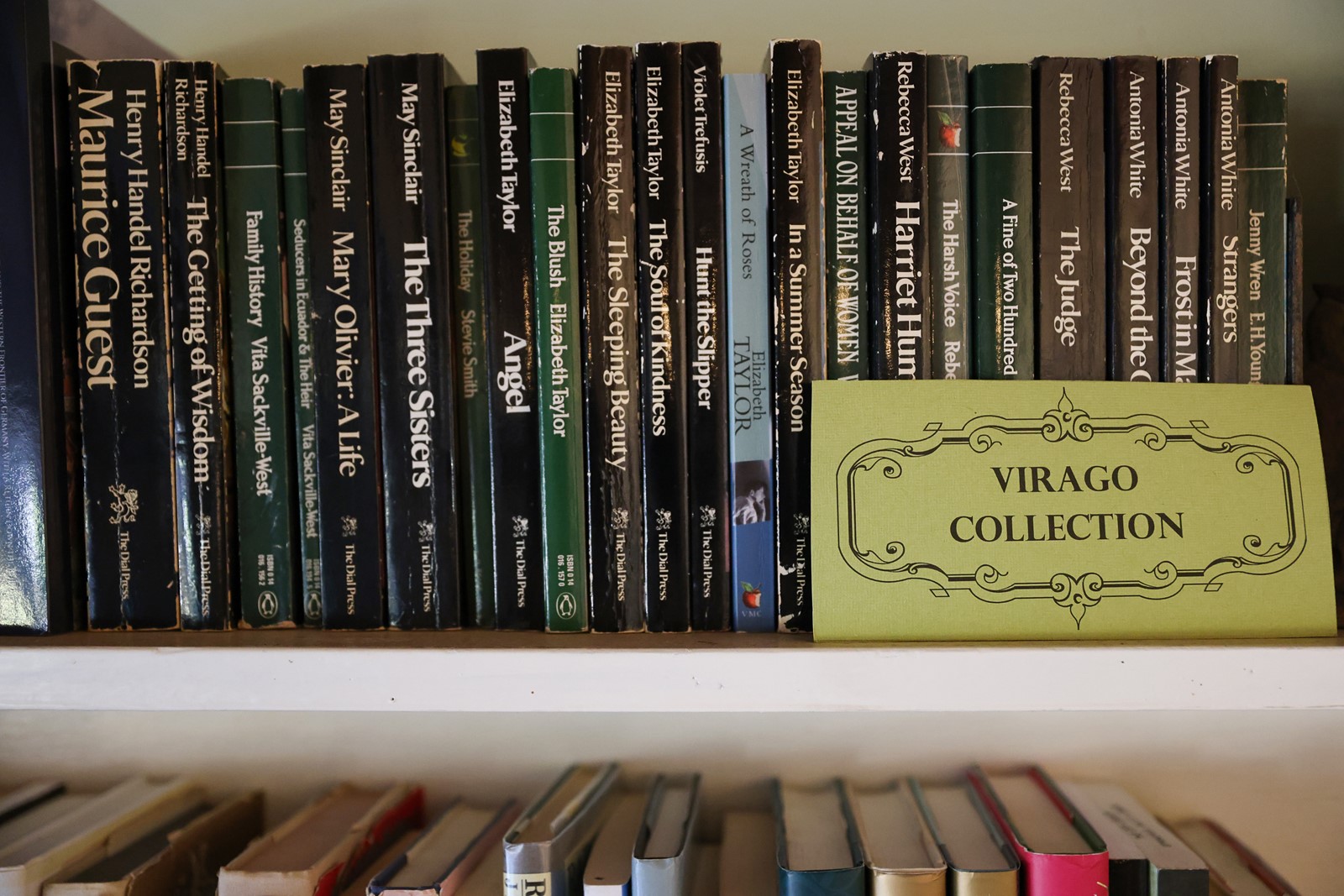
Today, the Sitting Room has a collection comprising more than 7,000 books—books by and about women, literature, art books, poetry, essays, world literature, and more. The library features an archive with files on more than 270 women writers from just about every era, and an oddly fascinating collection of obituaries of important women in history.
It has small exhibits, ample sitting space (both indoor and outdoor), and a ring of beautiful redwood trees out back.
There’s also an online catalog that lists every book on the shelves.
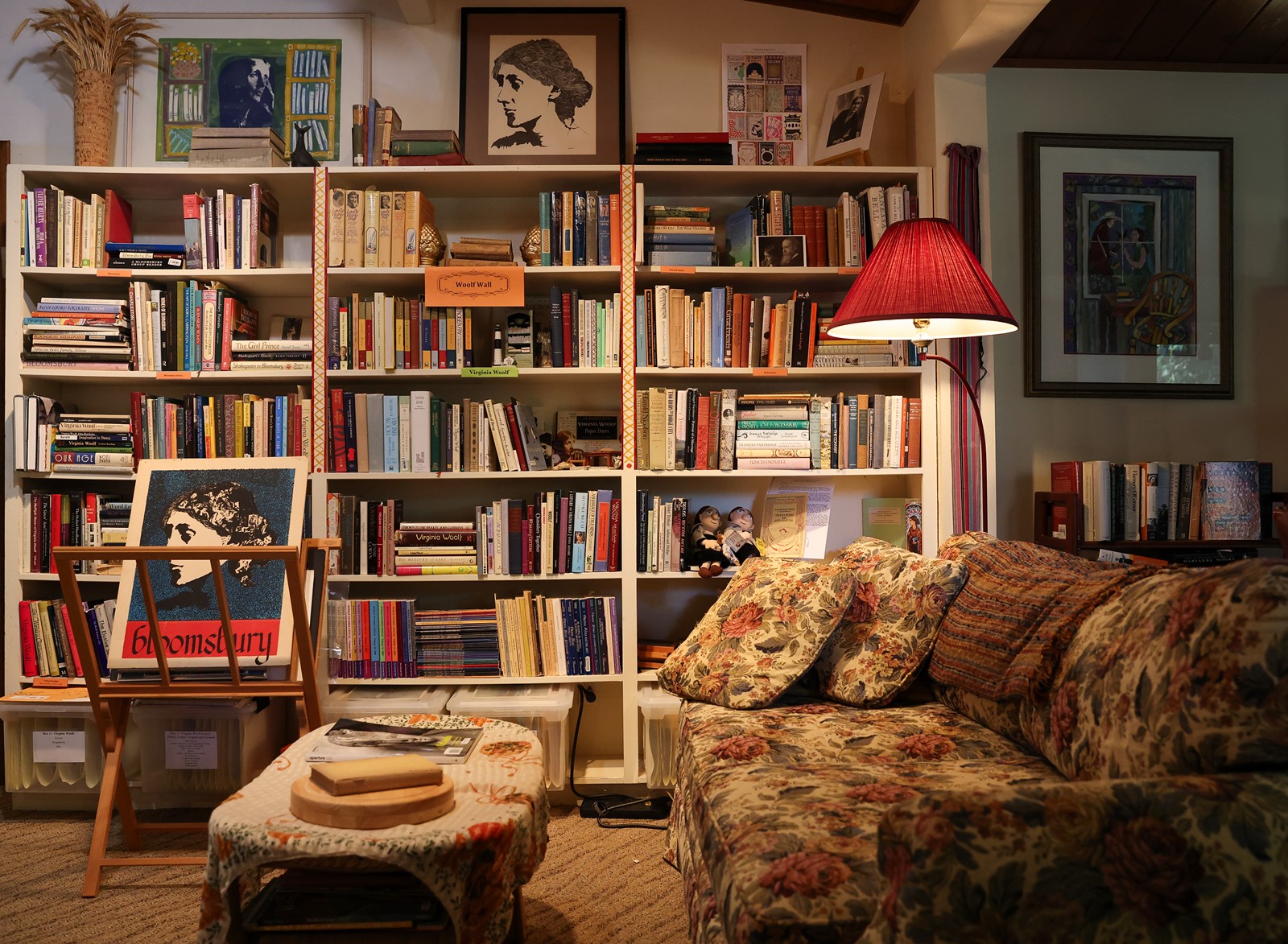
Perhaps the biggest claims to fame are the Jane Flood Poetry Room, which contains around 2,000 volumes of poetry and a unique collection of “Spineless Wonders” (unbound small press publications and zines); and the “Woolf Wall,” a section of shelves that boasts an extensive collection of texts, artwork, and archival material by and about author Virginia Woolf. The wall was the brainchild of Wilson, a renowned Woolf scholar.
“Her rise reflects what we see for women writers generally,” Wilson said. “She’s a banner and a flagpole.”
Of course, individual books in the collection stand out as well. Dunkle writes about women who have been forgotten or misremembered. Her latest biography, “Riding Like the Wind: The Life of Sanora Babb” (University of California Press, 2024), was a USA Today bestseller, and is a popular title. Other works celebrate icons of Sonoma County history: photographer Hansel Meith and Bauhaus-trained master potter Marguerite Wildenhain, to name a few.
Visitors are encouraged to linger over coffee, tea, water, and other refreshments—all of which are provided by the library.
Different touch points
Different people utilize the Sitting Room for different reasons.
Some come to escape the vicissitudes of the modern world. Others come to tap the zeitgeist of female writers and artists across time. Still others—college and university students, mostly—might swing through to review works of a particular author.
Then there’s local author Ianthe Brautigan-Swensen, who said she first started writing at the Sitting Room when she had a toddler and “quiet was in short supply.”
Whatever the motivator, the library welcomes men, women, and nonbinary individuals from all walks of life. It is open most days by appointment only, and starting Sunday, April 19, the Sitting Room will be open for walk-ins on Wednesdays and Fridays from 11 a.m. to 4 p.m.
“The idea is that women’s history is everybody’s history; celebrating women’s history is helping us see a more inclusive past,” said Dunkle, whose
forthcoming book is titled “Endnotes on the West” (Texas Review Press, 2028). “Places like the Sitting Room empower people to read on and keep looking to find a larger and more inclusive story.”
There are other ways for locals to experience the Sitting Room.
Beyond its role as a reading room, the Sitting Room offers a spate of free programming, including book groups, writing workshops (including an annual self-obituary writing workshop), and round tables.
The library supports local writers through an annual residency program featuring readings and performances.
Every year the Sitting Room also publishes an anthology of original works that address a unique prompt. This year, the prompt was (essentially) “overlooked heroines,” and participants were encouraged to submit poetry, prose, or visual arts that introduced the library community of readers to inspiring and relatively obscure women figures from across history. The finished product, titled Who Is She? Remarkable Women You Want to Know, will be available at the library’s birthday party gathering June 6.
What’s next
These programs and this place have had a profound impact on the local writing community.
Local author Jane Lott comes to the Sitting Room to write twice a week, and she said the companionship and conversation she finds there has changed her life.
“In this world today, libraries are the sanctuaries that churches used to be and more—they seem to be the last refuge of reason, and not just for their books,” Lott wrote in a recent email. “One of the more important facets of The Sitting Room Library is the people: the founders, librarians, volunteers, and participants. They hold lifetimes of knowledge that form a vast resource for readers, writers, and researchers.”
Wilson agreed, adding that at a time of human history when misogyny and patriarchy seem to be gaining influence worldwide, the importance of a library like the Sitting Room only grows stronger.
Because the library is a living archive, it can always use donations of books and money (and love) from the community to survive. Especially over the next few years.
In the meantime, the Sitting Room will continue its free programs. The next round table discussion was scheduled for Saturday (April 11) and was expected to spotlight Emily Van Duyne, author of Loving Sylvia Plath: A Reclamation. Later in the month, on Sunday, April 26, Dunkle and local poet Claire Drucker will teach a workshop on poetry erasure and collage.
For more information about these programs or the June 6 birthday celebration, visit the library’s website, sittingroomlibrary.org.
 PREVIOUS ARTICLE
