


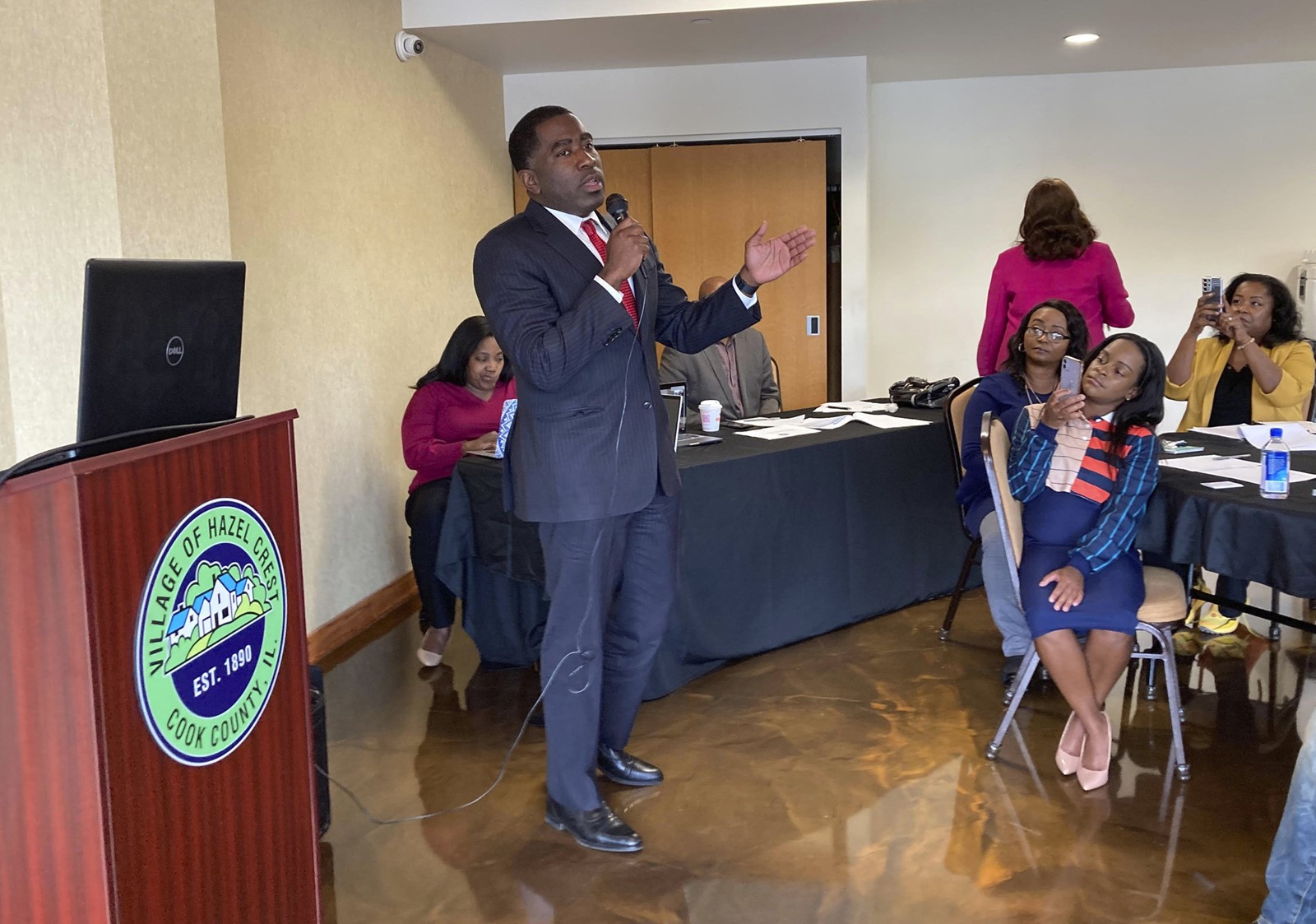


South suburban state Rep. Marcus Evans sounded frustrated by how law enforcement, municipal officials, Republican politicians and others are spreading disinformation about the Illinois Safety, Accountability, Fairness and Equity-Today, or SAFE-T Act.
“People don’t understand this, and all the lies are being pushed out,” Evans said. “There are so many lies.”
Evans fielded questions from south suburban mayors this week during an Illinois Legislative Black Caucus listening tour event in Hazel Crest. He addressed misinformation about the law that is set to take effect Jan. 1, such as false claims that the law will force sheriffs to empty jails of suspects accused of serious crimes.
“Prime example, they’re listing all the crimes that a person can be released for by posting bail,” Evans said. “Well that’s the reality today. The vast majority of charges you can post bail and be released.”
Wealthier suspects with access to money tend to post bail and go free while they await trial, while poorer suspects often remain detained.
Another misrepresentation is that lawmakers passed the bill in the dead of night with little time to review hundreds of pages before voting on it. In fact, legislators held hearings, sought input from police chiefs and spent years working on the bill before it was brought up for a vote.
“This bill was discussed for three or four years,” Evans said.
Evans wasn’t the only lawmaker this week pushing back against a well-funded operation trying to use fearmongering about crime for political advantage in the upcoming midterm election.
House Speaker Emanuel “Chris” Welch defended the SAFE-T Act Wednesday during a City Club of Chicago luncheon.
“It’s the latest effort by Democrats to try to get control of the narrative around the law that eliminates cash bail starting Jan. 1,” Politico reported. “Republicans have whipped up distrust around the bill, claiming it will allow criminals to roam free.”
Will County State’s Attorney Jim Glasgow, a Democrat, has been among the harshest critics of the law. Some criticism could be attributed to “back the blue” sentiment that values support for police officers, no matter what.
Mayors Keith Pekau of Orland Park, Michael Glotz of Tinley Park and Terry Vorderer of Oak Lawn have denounced the legislation. The three communities have the largest populations of more than 60 municipalities in the south and southwest suburbs.
Some critics have described the law in near-apocalyptic terms, as if to terrify residents into opposing the legislation.
What’s going on? Racial inequity is part of the dynamic, as the law seeks to address how disproportionate numbers of Black and brown people are detained in jails because they cannot afford to post bail.
“There are very few crimes now you’re not getting bail for,” Evans told a room full of Black mayors and lawmakers. “There’s a system for criminal justice. We’ve got to talk about our people. Some of our kids make mistakes. They’re down in college, they’re doing stupid stuff and you’ve got police that are over charging.”
The law’s intent was to address racial disparities that are often aggravated by poverty.
“We have people sitting in jail over $300 bails,” Evans said. “They’re losing their jobs. They get out, and they go right back into the system.”
Lawmakers expect to amend the legislation during the fall veto session in November due to widespread criticism based in part on false information. Some, like Vorderer and the Oak Lawn Village Board, have called for a complete repeal of the law.
Others, like state Sen. Patrick Joyce, D-Essex, support tweaking language to clarify what the law actually does. Joyce sponsored Senate Bill 4228, which he said would address many concerns raised by local law enforcement officials.
Joyce’s bill seeks to clarify that pretrial release reforms would only apply to individuals arrested on or after Jan. 1, 2023. The legislation would also permit a judge to deny pretrial release for any alleged crime if the person arrested posed a safety threat.
Also, the amendment clarifies officers have the authority to detain trespassers if the person is a threat to themselves, a person, or the community, or if the officer feels it necessary to discontinue the criminal behavior.
“With all the confusion surrounding the SAFE-T Act, it’s important that we make things as clear as possible,” Joyce said Tuesday in a statement.
Some of the confusion is deliberate. Republicans trailing in polls are trying to make crime and public safety a top campaign issue. Pekau is running against Democratic incumbent Rep. Sean Casten for the 6th District congressional seat.
However, a poll released this week by Emerson College for WGN showed the top issues among likely voters in November were the economy (35%), threats to democracy (17%) and access to abortion services (14%). Crime was fourth at 10%.
Some sheriffs and other law enforcement officials oppose eliminating cash bail that would reduce jail populations because their facilities make money by detaining suspects, Evans said.
“They have an issue because they want to see guys sitting there in jail,” Evans said. “They like the bail system.”
Ted Slowik is a columnist with the Daily Southtown.
tslowik@tribpub.com
 PREVIOUS ARTICLE
