


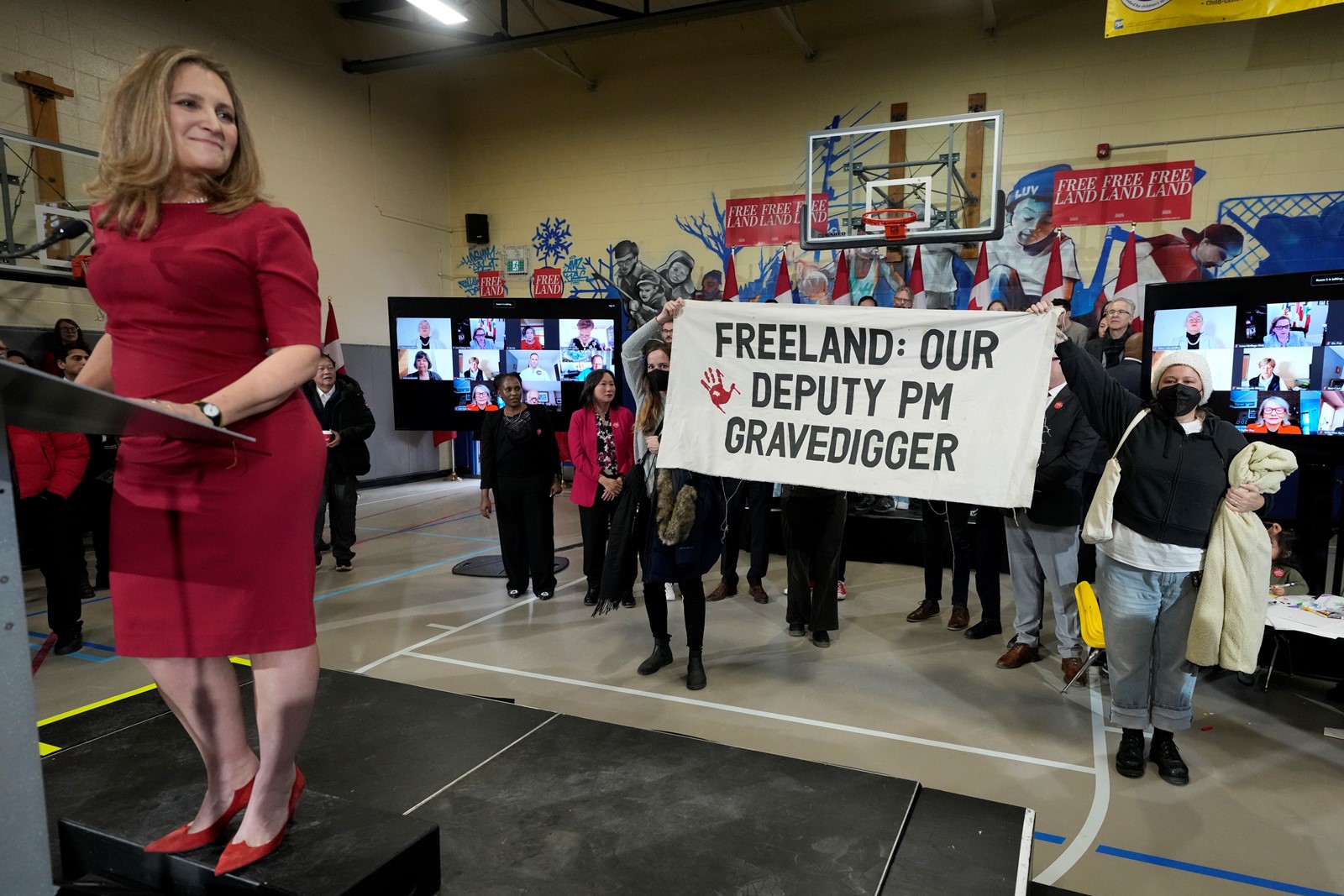


TORONTO — Pro-Palestinian protesters and a significant endorsement of her rival for the Liberal Party leadership marred former Finance Minister Chrystia Freeland’s campaign launch Sunday for the job of Canada’s next prime minister.
It was Freeland’s abrupt resignation as finance minister last month that forced Justin Trudeau’s exit as prime minister and party leader. Freeland is now running for both the next leader of the Liberal Party and prime minister of Canada.
But as Freeland (photo) started her speech at a children’s club in Toronto on Sunday, about a dozen protesters who were in the audience would start yelling, at different times: “Free Palestine!”
After security guards kicked each protester out, another would repeat the process. Those outside banged on the doors and kept shouting. The disruptions stretched Freeland’s speech to about two hours.
It wasn’t immediately clear why the protesters chose to target Freeland’s campaign launch.
“I am not afraid and I’m not going to back down,” Freeland said. “Canadians are just not going to put up with it. You can have a different point of view, but you cannot stop others from speaking and you cannot stop our democracy.”
Just before Freeland took the stage, Foreign Minister Melanie Joly released a statement on X, saying she was endorsing former central banker Mark Carney to be the next Liberal leader and prime minister.
Trudeau is to remain prime minister until a new Liberal Party leader is chosen March 9.
Joly said she believes Carney is best positioned to defeat opposition Conservative leader Pierre Poilievre in the coming general election, and is the best candidate to deal with Donald Trump’s threat to impose sweeping tariffs on Canada.
Carney helped Canada dodge the worst of the 2008 financial crisis while heading the country’s central bank. He also helped the U.K. manage the after-effects of Brexit during his seven-year tenure as governor of the Bank of England.
“Mark brings unparalleled economic experience,” Joly said. “During times of crisis, governments of all stripes turn to Mark, including the 2008 financial crisis and Brexit.”
Carney and Freeland are the front-runners for the Liberal Party leadership. Ex-Government House leader Karina Gould also declared her candidacy. The Liberal Party membership will elect the new leader.
Joly herself was considered a leadership candidate but decided not to run so she help the government deal with Trump’s tariff threat. Her support for Carney gives him a boost in Quebec, where Joly is from.
Freeland announced her resignation from Trudeau’s cabinet on Dec. 16, criticizing some of Trudeau’s economic priorities in the face of Trump’s tariff threats. The move stunned the country and raised questions about how much longer the increasingly unpopular Trudeau could stay in office.
The next Liberal leader could be the shortest-tenured prime minister in the country’s history. All three opposition parties have vowed to bring down the Liberals’ minority government in a no-confidence vote after Parliament resumes on March 24. An election is expected this spring.
Trudeau announced his resignation on Jan. 6 after losing support both within his party and in the country.
The political upheaval comes at a difficult moment for Canada. Trump keeps calling Canada the 51st state and has threatened to impose 25% tariffs on all Canadian goods.
“If you hit us, we will hit back,” Freeland said in a message to Trump. “I promise, if I’m prime minister, that our response to illegal and unjustified tariffs will be dollar-for-dollar retaliation,” she added. “If you force our hand, we will inflict the biggest trade blow that the United States has ever endured.”
After she resigned as finance minister, Trump called Freeland “totally toxic” and “not at all conducive to making deals.” Freeland was Canada’s pointperson when the U.S., Canada and Mexico redid its free trade deal during the first Trump administration.
Freeland and Trudeau had disagreed about two recently announced policies: a temporary sales tax holiday on goods ranging from children’s clothes to beer, and plans to send every citizen a check for $250 Canadian dollars ($174.) Freeland, who was also deputy prime minister, said Canada could not afford “costly political gimmicks.”
 PREVIOUS ARTICLE
