


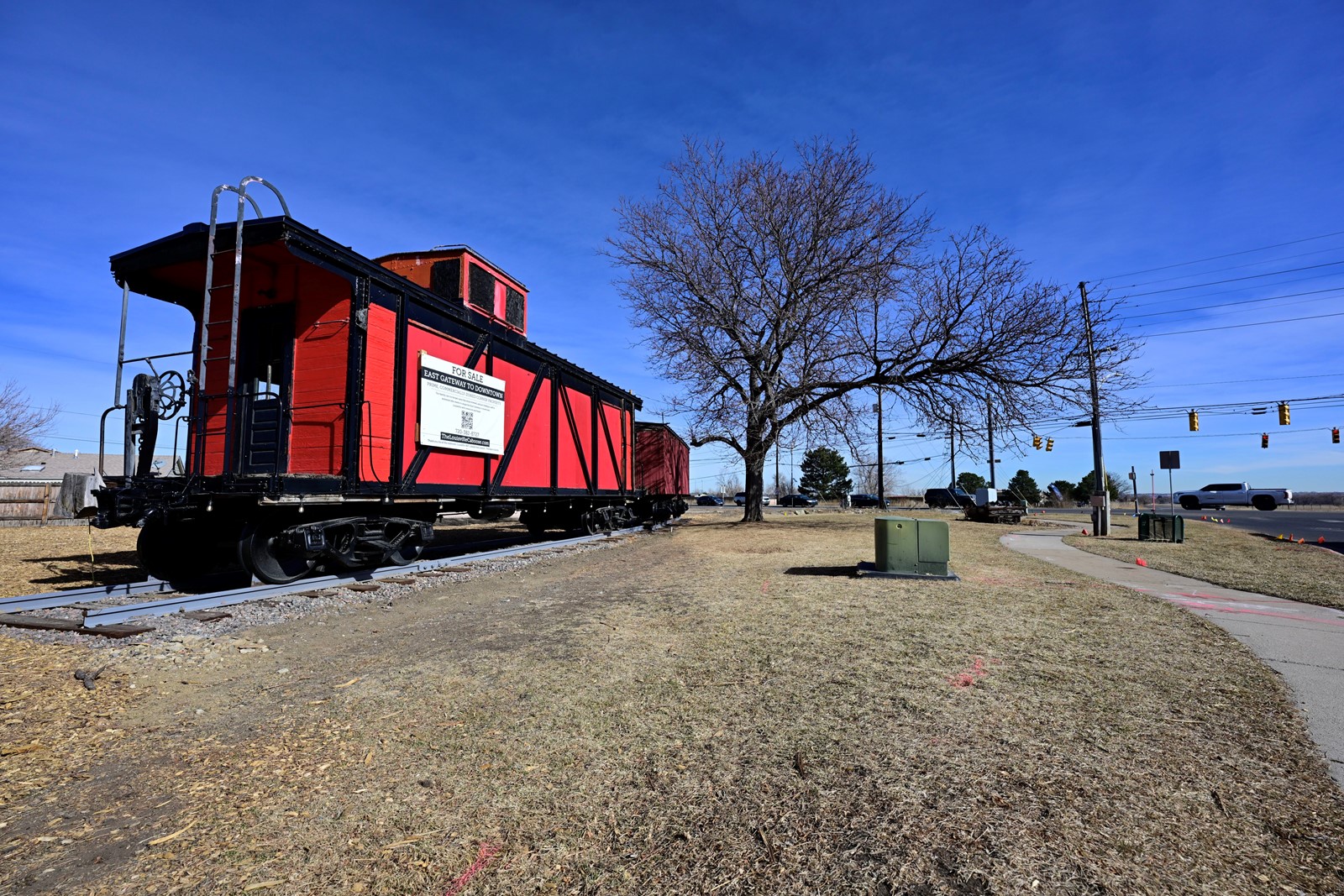


The Louisville Town Council voted 5-1 on Tuesday night to purchase a portion of land, an old train caboose and a boxcar at that corner for about $400,000, citing the site’s location and potential to serve as a “gateway” to the community.
The decision came amid divided resident opinion, with some raising concerns about the price and public engagement process, while others supported preserving the railcars as part of Louisville’s history.
Council members Caleb Dickinson, Deborah Fahey and Judi Kern voted in favor, along with Mayor Chris Leh and Mayor Pro Tem Barbara Hamlington. Council member Josh Cooperman voted against the purchase. Council member Dietrich Hoefner was absent from the vote.
The land at 1155 Pine St. sits at the intersection of Courtesy Road — also called Colorado 42 in the area — where the city’s gridded downtown begins, its Main Street just a few blocks east.
The property includes a single-family home and a train caboose and boxcar sitting on historic railroad tracks. The full parcel is about 0.23 acres. The city plans to purchase and retain 0.09 acres — the portion containing the railcars — while the current owners would retain the remaining land.
Those owners, Travis and Laura Ramos, purchased the property in 2023 with plans to re-create a two-car section of the historic Colorado and Southern Railway, which ran through Louisville about a century ago near the same location.
City workers were notified in October that the property owners could no longer proceed with their proposed project and that the property was available for purchase. With direction from the council, city workers negotiated to purchase the portion of the property, with the railcars and tracks, for $396,000. Because that money will come from the city’s general fund, a budget amendment will be required to fund the purchase.
“Preserving the caboose and boxcar at the easterly entrance to Louisville’s historic downtown provides a visual landmark that reinforces the city’s heritage, creates a distinctive gateway feature, and represents a unique story for Louisville,” the memo states.
Because a subdivision plat is required, city workers recommended executing a contract for lease and purchase of real estate so the city can lease the property while the plat is prepared. Once the subdivision plat is complete, the property would transfer to the city.
Under the agreement, the city will deposit $150,000 and pay $10,000 per month in rent. The deposit and rent will be credited toward the purchase price at closing, which must occur on or before July 31.
The effective date for the ordinance is estimated to be March 7, according to city spokesperson Derek Cosson. Future use of the land, which will inform operational and maintenance costs, is yet to be determined.
One of the railcars, known as the Steinbaugh boxcar, was built in 1898 and is “not known to have any history of being located or used within Louisville,” a memo from City Manager Diana Langley said. But, the memo said, an inscription inside the boxcar reading, “J.J. Steinbaugh, Louisville, Colo.,” may provide a “potential link” to the city.
The memo indicates there are records to show the boxcar was decommissioned in Denver in 1939 and later sold to the Autrey family, who used it on their farm outside Louisville for about 80 years, before it was relocated to 1155 Pine St in 2023.
The other railcar, a caboose built in 1913, was previously part of a railroad-themed restaurant near Main Street and South Boulder Road, according to the memo.
In 2020, the caboose and other structures were slated for demolition, but before the caboose could be demolished, the Ramoses moved it to a site outside Louisville. After they purchased the Pine Street property in 2023, the caboose was relocated there, the memo states.
Some residents questioned the true historical relevance of the railcars after, in September, the Louisville Historic Preservation Commission denied an application to landmark the caboose, determining that its relocation to 1155 Pine St. had removed it from its historical context.
A letter from Louisville resident Tawnya Somauroo says, “The city’s formal historic preservation process ensures that preservation investments meet established standards for historical significance, integrity, and public benefit, ensuring fairness and consistency in fund use. In this case, those standards were not met.”
 PREVIOUS ARTICLE

