


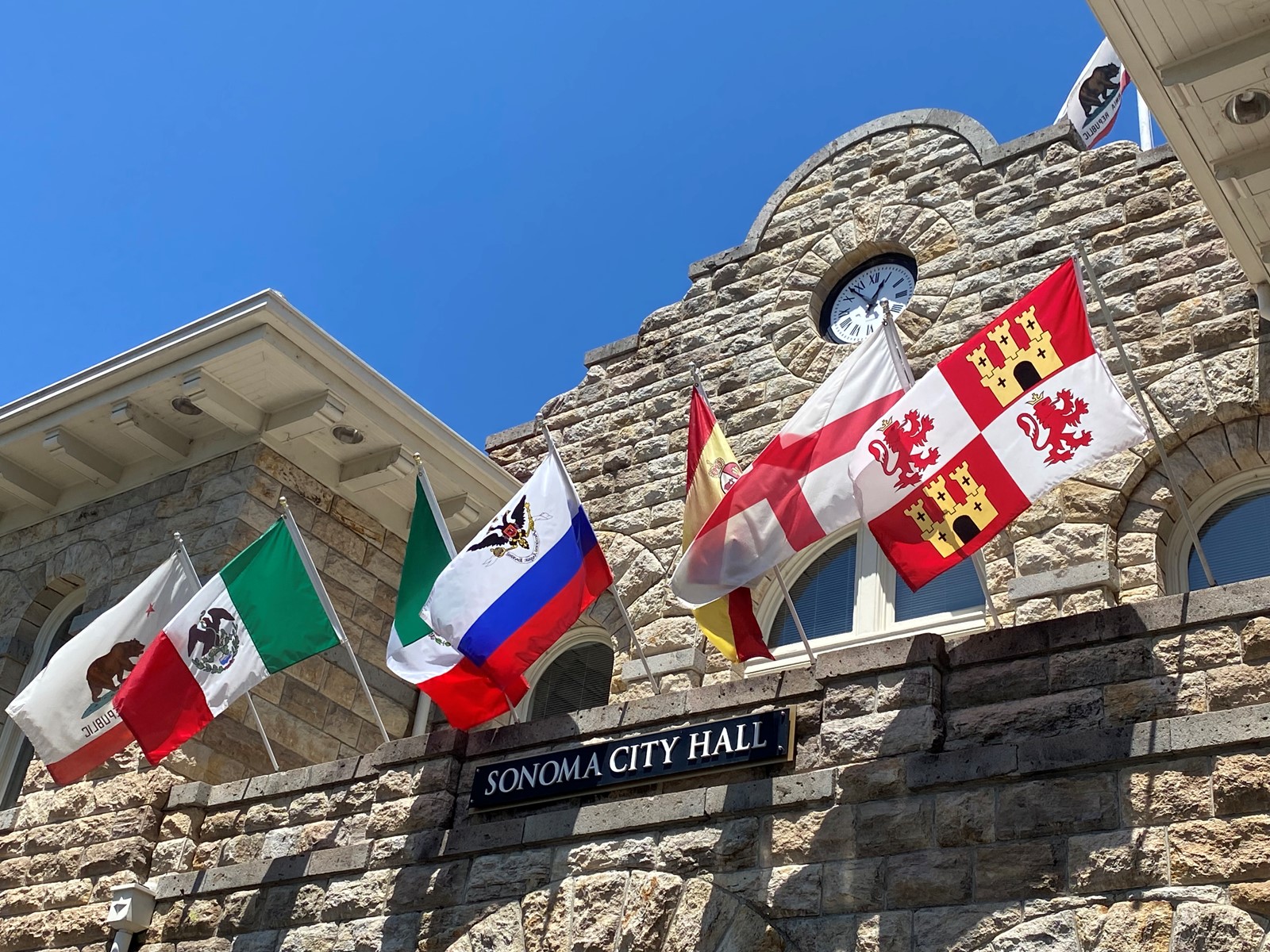


Featuring tales of romance, triumph and disaster, “Seven Flags Over Sonoma — The Musical,” will be offered at Burlingame Hall in Sonoma twice in July.
The original production, created and performed by local historians and actors George Webber and CW Bayer, will take place from 3 to 4 p.m. on Saturday, July 11, and Saturday, July 18.
Webber wrote the script, Bayer (a professional musician) composed the music and they shared writing the lyrics.
“I have been fascinated by the collision between European and Indigenous people in the Americas my entire life,” Webber said. “In my walking tours and performances, I keep returning to this topic — and a musical about the seven nations that claimed California is the perfect framework to expand on this fascinating subject.”
The seven flags displayed outside Sonoma City Hall, which represent various chapters in the area’s history, are the Spanish flag of the Cabrillo Expedition (1542), English flag of Sir Francis Drake (1579), Spanish National Ensign (1785-1821), Russian-American Company flag (1812-1842), First Mexican Empire flag (1821-1823), First Mexican Federal Republic flag (1824-1835) and California Republic “Bear” flag (1846).
Some other U.S. cities also have flown several flags, representing different periods in their history.
“What makes Sonoma unusual is that one of the flags was first created here, and the Bear flag became the state flag of California,” Webber said.
In the musical, Webber and Bayer explain the technical features of each flag, including the meaning behind each color, pattern and insignia. They also place each flag in a timeline as Spain, Britain, Mexico, Russia and the United States competed for California.
“Each flag allows us to tell incredible, true stories of adventure and political intrigue in the far-away province of California,” Webber said. “Each one features the outsized personalities of those willing to dare everything for glory and riches.”
Webber said the stories were all carefully researched and are factually accurate.
“We often quote directly from period letters and diaries,” he said. “The original songs are sung in the first person, and we have done our best to make each song true to its period in history.”
He said they use a radio theater format—focusing on voice, music, and sound effects — to create an immersive experience for the audience.
“We added original songs to take the drama to a higher level,” Webber said. “We also get laughs, and this is generally done by revealing true ironies of history—our duty as humans is to laugh, rather than cry.”
Bayer said historical facts can be humorous.
“Funny things happen and history is full of moments that lend themselves to song,” he said.
He said the music helps distinguish the emotions prevalent in the different historical periods featured in the show.
“We focus on very different people at very different times,” Bayer said.
Webber and Bayer described four of the songs in the musical.
“Why Did I Need to Conquer More” is a sad, mournful song capturing the feelings of Spanish explorer Juan Rodriguez Cabrillo on Catalina Island in 1543.
“His expedition had been a failure as he had not discovered the Northwest Passage from the Pacific to the Atlantic Ocean,” Webber said. “Plus, he had been attacked by Indigenous people, and was dying on the beach. He wished he had stayed in his Guatemala paradise.”
A rollicking sea chanty, “Take Me Back to Merry Old England,” conveys the buoyancy of Capt. Sir Francis Drake on the Marin coast in 1579.
“He was feeling rather good, having a ship full to the brim with gold, silver and jewels, and was looking forward to a triumphant return to England,” Webber said. “This is an audience participation number.”
Bayer added, “We can all be sailors and sing along to the shanty.”
“I Will Hear the Bell” is a heartfelt song sung by Cathy Webber, who performs as Dona Maria de la Conception Arguello, also known as Conchita, and accompanies herself on ukulele in the production.
“Her song brings to life the true story of the failed romance between her and Russian Count Nikolai Petrovitch Rezanov, set at the Mexican Presidio in Yerba Buena (a settlement that grew into the city of San Francisco),” George Webber said. “It is a song of enduring love that appeared in the most unlikely of places.”
Bayer noted, “Conchita is a unique character. She is both innocent and tragic.”
The song, “My Heart Remains Red, White and Blue,” expresses the thoughts of Gen. Mariano Guadalupe Vallejo as he rides toward Maj. Gen. John C. Fremont’s camp on the American River the day after the Bear Flag Revolt in Sonoma in 1846.
“He reminds himself of his belief in the ideals of American self-government but wonders how he will stop the hooligans that have seized his town,” Webber said.
Webber and Bayer have created and performed in several other productions about Sonoma that combine history, music and comedy, but they feel “Seven Flags Over Sonoma — The Musical” is their best show yet.
“With a fun show like this, each show will be different, every audience will be different and we will be different,” Bayer said. “Both shows will be a pleasant surprise and a great way to revisit the many facets of the past of California and Sonoma.”
Tickets for the show are not being sold in advance and no registration is necessary. Attendees may purchase tickets, $20 per adult, at the door on the day of the event. Children, ages 16 and under, will be admitted free.
 PREVIOUS ARTICLE
