




LONDON >> In the middle of AMC+’s new dramatization of the poisoning of intelligence agent Alexander Litvinenko, a police officer asks a pathologist about the state of the man’s organs when he died. The doctor thinks for a moment, as if considering how graphic to be, and then replies, “sludge.”
It’s a visceral moment in “Litvinenko,” a limited series written by “Lupin” creator George Kay that depicts Litvinenko’s 2006 poisoning in London via a cup of tea laced with the radioactive element polonium 210, and its aftermath.
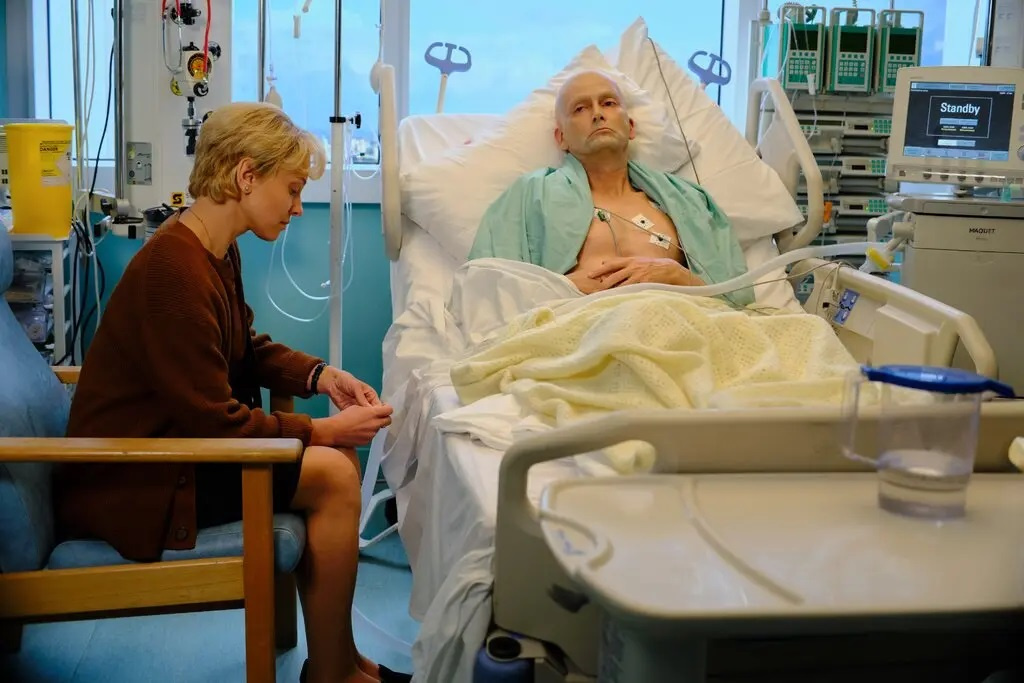
While many will remember the photo of Litvinenko on his deathbed, gaunt and newly bald, that appeared on front pages around the world, fewer will know the details of his final days, and how — convinced he was poisoned by President Vladimir Putin of Russia — he aided the investigation into the attack, even as his internal organs were failing.
The story of a former KGB agent assassinated in broad daylight in the dining room of a British hotel could have made for a sensationalized show about international intrigue. But “Litvinenko,” which is streaming on AMC+ and Sundance Now, instead focuses on the human cost.
Most of the running time of the series’s four episodes is spent with police investigating the murder and the Litvinenkos themselves — Alexander (played by David Tennant), but also his widow, Marina (Margarita Levieva), who for years agitated for the British government to hold an inquiry into her husband’s death.
Kay’s research for the program involved close collaboration with Marina Litvinenko, as well as the investigating officers, including Brent Hyatt, the London police officer who took 18 hours of statements from Alexander Litvinenko in the hospital.
That was one way the murder investigation started before anyone had “actually died,” as one of the show’s police officers notes. Litvinenko used the hours it took for the poison to wreck his body “to tell the police what he knew, so he was not just a witness to his own murder, he was a detective in it,” Kay said in a video interview.
The first episode covers this time immediately following the poisoning, when every minute was precious. The second shows the weeks following Litvinenko’s death, when police scrambled to put the pieces together and contain the threat of radiation poisoning to the British public.
The subsequent episodes cover the months, and eventually years, that Marina Litvinenko spent fighting for an inquest, and then a public inquiry, into her husband’s death.
“We wanted to give a sense of the perseverance of Marina Litvinenko,” Kay said. “She’s the one person who didn’t retire or give up or look the other way, or try and get in the way of the justice.”
In many ways, Marina Litvinenko is the show’s lead character. The widow said she saw cooperating with the show’s creators as her duty.
Putin’s actions since 2006, including the war in Ukraine, have cost “millions” of people their loved ones, she added.
A 2019 play about Alexander Litvinenko’s murder, “A Very Expensive Poison,” was written by Lucy Prebble with input from Marina Litvinenko, and there was also a 2021 opera. But this television show arrives after Putin’s invasion of Ukraine, and so in a changed political landscape.
Tennant said that the brutal war had been “the moment that the world woke up to Putin, and what he was.” He added: “I think either people didn’t really understand that until now, or they understood it, but it was inconvenient to acknowledge.”
In 2006, Britain saw Russia as a supposedly friendly power. At the time, the British government condemned Russia’s refusal to extradite Andrei Lugovoi to face trial for the murder in Britain, but in 2013, Home Secretary Theresa May admitted that successive British governments had blocked a public inquiry into the poisoning out of concern for “international relations.”
May eventually agreed to Marina Litvinenko’s long-fought-for public inquiry, which in 2016 found that the poisoning was “probably approved” by Putin.
While “Litvinenko” is a show with big political concerns, the persistence of ordinary people is what ultimately motivates it. Tennant said the time he spent with Marina Litvinenko preparing for the role drove that home for him.
“The experience of being with her changes it from a story about politics to a story about a family,” he said.
 PREVIOUS ARTICLE
