




It would be easy to write off artist Regan Rosburg’s latest exhibition at RedLine Contemporary Art Center as anti-Trump propaganda. The show offers a satirical look at how powerful people have used gold — as plating, trim, medallions and in other decorative ways — as demonstrations of wealth and power, and how that is not always in the best of taste.
Because, really, we all know who is doing a lot of that at the moment in the Oval Office.
And the exhibit, titled “The New Gilded Age,” does include at least one personal dig at the president, and it’s among the exhibit’s main attractions.
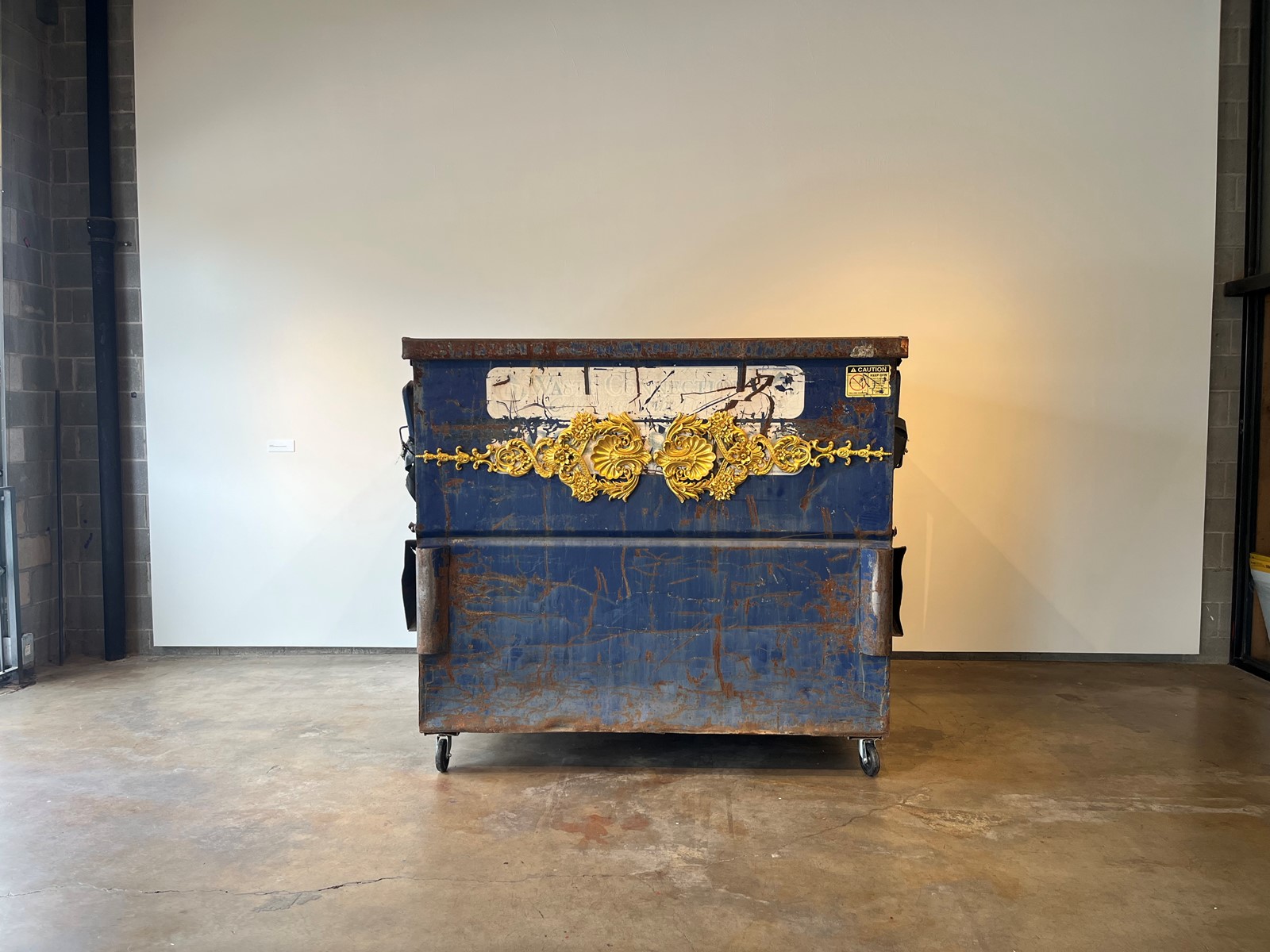
The piece, called So Rich, made in 2025, features a large, real-life trash dumpster—a blue metal container bearing the scratches and rust marks of heavy use—decorated with two flowery gold appliqués. The contrast between the polished gold embellishments and the battered dumpster plays like a punchline of a joke directed toward 1600 Pennsylvania Ave.
But Rosburg is a better artist than that, and RedLine is a more sophisticated art gallery. The artist takes her shots but moves the idea into bigger intellectual terrain, using wall text to connect her concept to Mark Twain and Charles Dudley Warner’s 1873 novel “The Gilded Age: A Tale of Today.”
That book also took a satirical view of the ostentatious use of decoration, and the ways it is employed to cover up or distract from hard truths. Those authors’ point, and Rosburg’s, is that this practice has existed for a long time, or at least as long as there have been widespread equity gaps in human society.
It goes far back in time to Rome and Paris and beyond, though it also lives in our current era — another point Rosburg makes by associating her work with philosopher Guy Debord, whose late 20th-century writings talked about the use of spectacle as a form of social control.
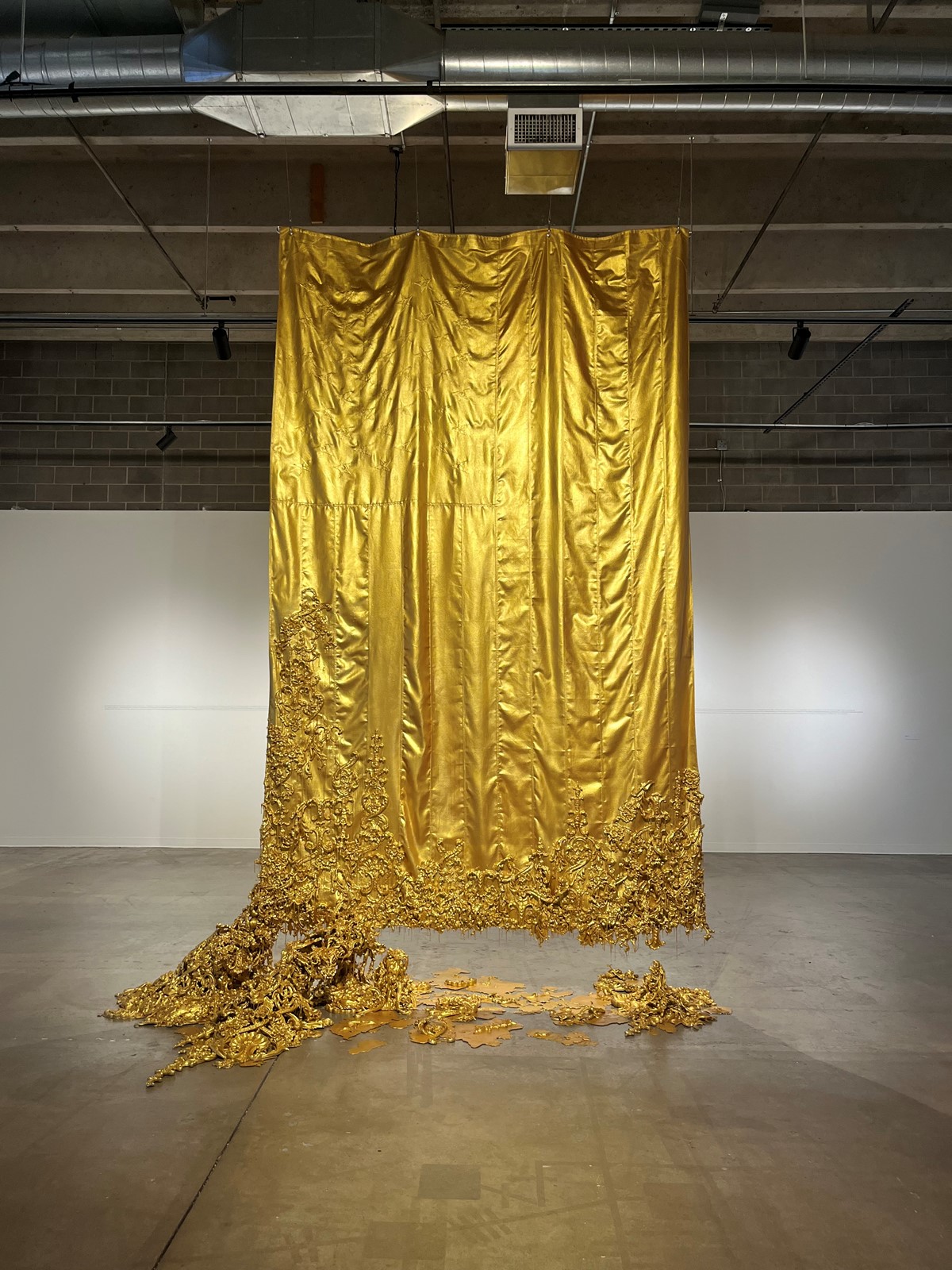
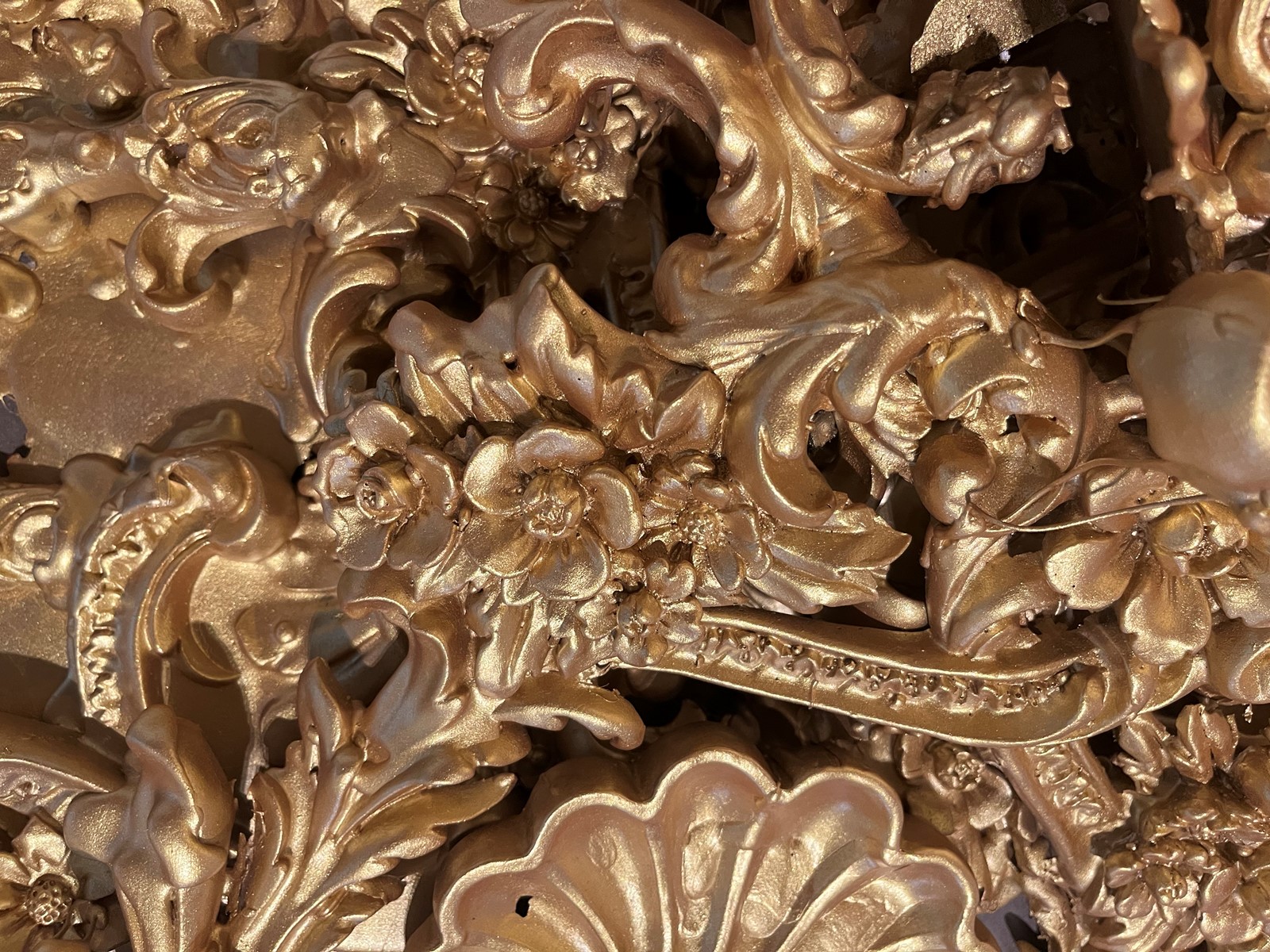
There are one-liners in Rosburg’s show but also hints at a greater danger hiding behind all that ornamentation. It’s a global issue, no doubt, although Rosburg does suggest it is a particularly American problem.The largest piece in the show, at 15 feet tall and 12 feet wide, is a giant curtain that hangs from the ceiling and greets viewers at the entrance of the exhibit. It is actually a giant U.S. flag, according to Rosburg, hung sideways and covered completely in gold paint. She has added a number of ornamental gold appliqués toward the bottom that cascade out across the floor. The piece appears to be dripping in gold.
Rosburg titled it The Trophy, suggesting the winner of the country’s political contest gets to control the power and the message of government. As presented in this artwork, that power is extreme, boldly executed and lasting.
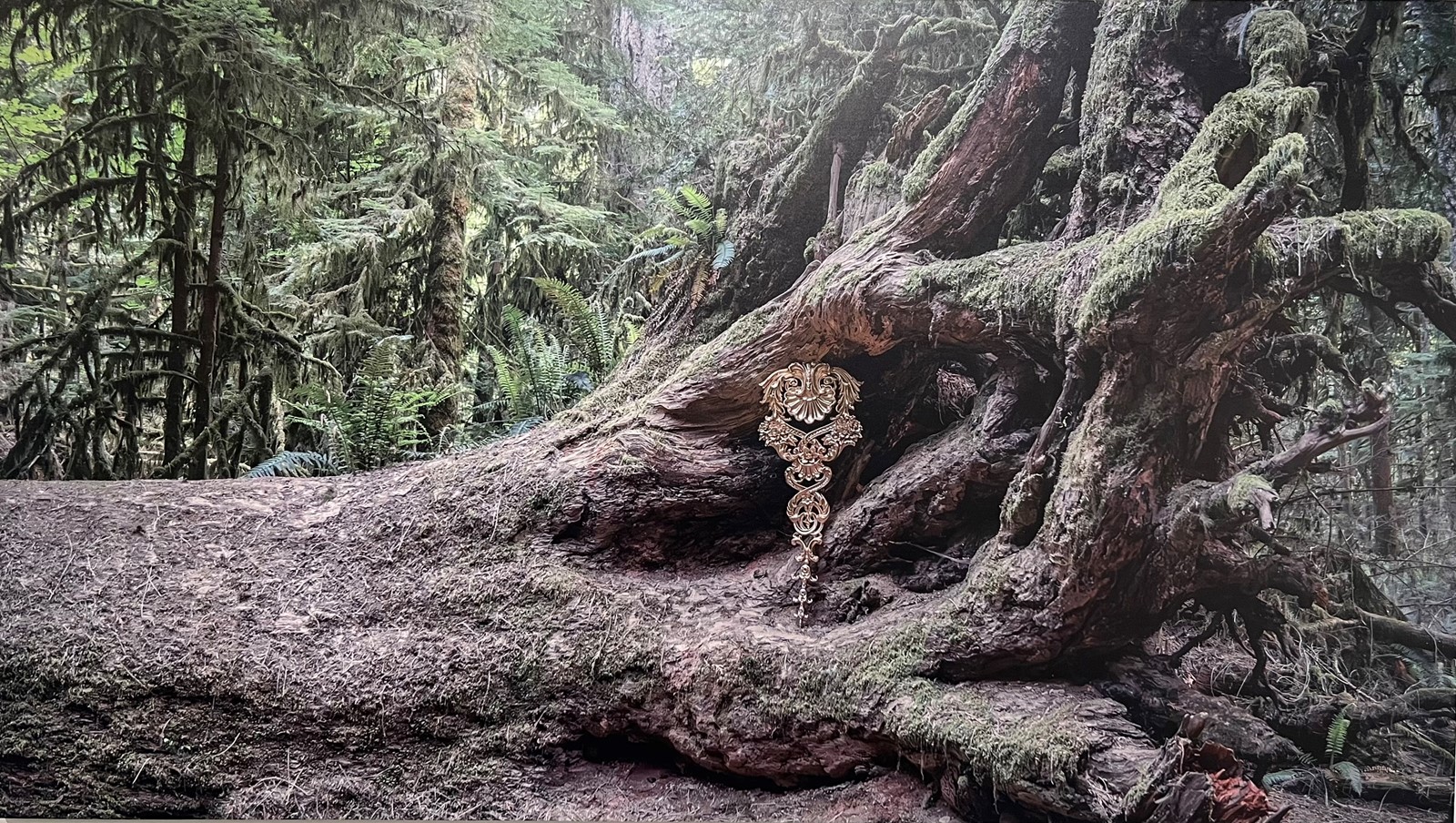
Rosburg develops this concept of spectacle and subordination throughout the exhibit. In some cases, she presents photos of the above-ground root systems of trees, part of a series called “Land Grab.” They are mighty trees, many hundreds of years old, that grow in the Northwest of the United States. Viewers cannot see any higher than the trunk.
Upon the gnarled roots she has placed similar flowery, gold appliqués — as if they too are part of the trophy that can be claimed with power, and as if the lands they have occupied for centuries — and, by extension, all of nature — are part of the prize of electoral victory. Those lands can be preserved or given away, and with the gold medallions so prominently placed at their base, these trees appear marked for potential destruction.
Again, there is commentary on current events, and it is not subtle. During the present administration, there have been many efforts to sell off public lands for development or energy exploration.
But the age of these trees gives us a wider view. Americans, in their thirst for expansion, growth and economic advancement, have routinely put nature second. Those old trees may be feeling the pressure of the moment, but they have never been safe in a greedy America.
That wide view of history gives “The New Gilded Age” a bit of heft. It’s a sensationalist effort that screams and shouts, pokes and insults. But its snark is tempered by a recognition that it is not just President Donald Trump who may be indulging in ostentation as a method of government. The finger-pointing reaches beyond the moment and extends to anyone in power, ever, who thinks that showing off equals good leadership. Think of the pyramids, think of the Palace of Versailles.
Of course, the glare falls most closely on Trump because he is decorator-in-chief at the moment, and frankly, I waited to write this review until after the recent November elections to avoid any appearance of political partisanship on behalf of myself or the people who publish me, just to be cautious.
So it is not anti-Trump, exactly. But it is not anti-anti-Trump either.
 PREVIOUS ARTICLE

