


Former Oak Lawn man spent Korean War underwater
Brother Rice grad served with Navy on submarine
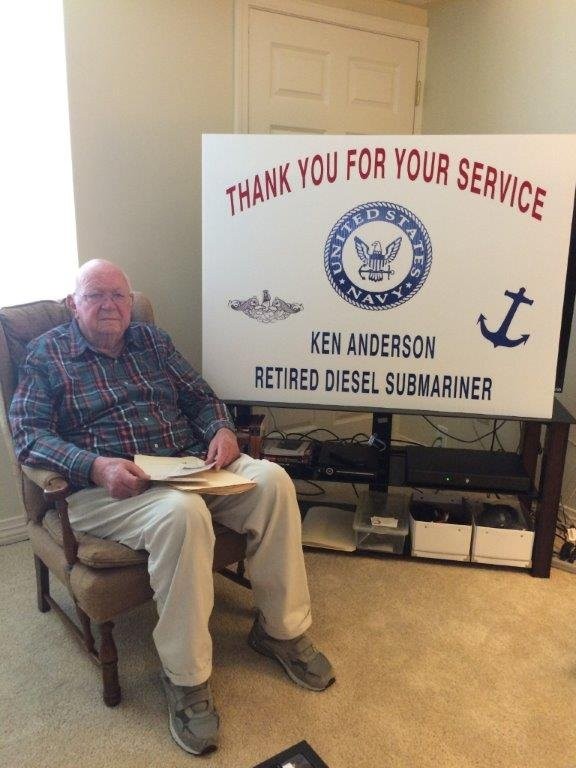


Ken Anderson, 86, has little more than a Thanksgiving dinner menu and his Navy pin to commemorate his service on the submarine USS Greenfish SS-351, but more importantly, the Korean War-era veteran has a treasure trove of memories from that time, and he's willing to share.
Anderson, a resident of Smith Village in Chicago's Morgan Park neighborhood, said it all began not long after his graduation in 1948 from Brother Rice High School.
He and his friends applied to the University of Illinois, he said, and then promptly enlisted in the service rather than take a chance on where they might land when the inevitable military draft notice arrived.
Anderson chose the U.S. Navy — for no particular reason — but he took to it like a duck to water, even though he had no idea what a submarine even looked like when he volunteered to train for submarine duty, he said.
After 11 weeks of basic training, he found himself at a naval base in New London, Connecticut, where he learned that submarines “looked like big cigars.”
A personal tour through a submarine left him “absolutely overtaken and amazed,” he said, and he was ready to begin his on-the-job training.
“To qualify takes a lot of study and it takes about a year if you work hard,” Anderson said. “(I was) looking forward to understanding all the complicated procedures.”
Recruits were required to learn everything about each of the submarine's nine compartments, their contents and how everything worked, Anderson said.
“If they ask you a question about a certain valve or piece of gear and you don't have the proper answer, then you don't pass,” he said.
Anderson passed the test, but he said there was one more trial — an initiation that still causes him to chuckle.
“What they do with you when you qualify is they throw you overboard,” Anderson said. “Literally, even if you can't swim.”
Then there was the serious stuff: The Korean War was raging on the other side of the world, and Cold War tensions with the U.S.S.R. and China were erupting.
The Greenfish was stationed out of Pearl Harbor, an exotic and unfamiliar place to the Chicago native.
“I couldn't even spell Honolulu,” Anderson joked.
But, he didn't spend much time there.
His job during patrols “to Alaska and beyond” was “maintaining the main power — the generators and the motors,” Anderson said. He was in the “battle station” compartment, the maneuvering room — the heart of the submarine.
But Anderson didn't consider his work special.
“Every job on a submarine is important,” Anderson said. “That's why you have to qualify.”
There was never daylight for the crew on those 59-day patrols. The submarine came up only at night because of the oxygen requirements. It was then that the impact of where they were and what they were doing was clear.
“We went up beyond the Bering Strait,” Anderson said. “We were taking photos. We came up at night (and) we could see the mountains. The quartermaster said, ‘You're looking at Siberia.' ”
Anderson said several times “silent running” was necessary to avoid detection. That meant no talking, no smoking, just sweating. Anderson said the heat from the diesel engines could bring the temperature inside the submarine to about 130 degrees, but it could not be relieved until the sub surfaced.
Was he scared?
“I wasn't old enough to be scared,” he said.
It all worked out. Anderson and his shipmates came back from every patrol every time during his three years of duty. He said the sailors would emerge from the submarine to face a daylight sun that was almost too bright, scrape the paint and rust off the ship, shave their beards and eventually go into town.
And then they would do it all over again.
There was no complaint, no whining from Anderson, even though his original terms of enlistment were for one year and he was recalled a year after his discharge for another three years.
“When I saw the postcard I pinched myself,” Anderson said.
But, he went, he served, and he came home to Chicago in December 1953 and married his sweetheart, Pat, who has since died.
Anderson finished his electrician apprenticeship with the International Brotherhood of Electrical Workers 134 and worked for about 10 years for various contractors before becoming the city of Chicago's foreman of electrical machinery for the movable bridges on the Chicago and Calumet rivers, he said. He retired from that job in 1991.
Ken and Pat Anderson raised five children in Chicago's Mount Greenwood neighborhood, later moving to Oak Lawn. Anderson moved in 2014 to Smith Village.
Anderson, who has 11 grandchildren and five great grandchildren, along with another one on the way, takes no credit for setting a good example, but something may have rubbed off.
One of his grandsons is in Korea with the U.S. Army as a physical therapist; another grandson is a West Point graduate studying to be an Apache helicopter pilot, and a third is in the Marine Reserves.
As a Korean War veteran, Anderson was a recent guest of Honor Flight Chicago.
He said he was impressed and honored by his treatment and that of all the veterans onboard. Like all of his fellow veterans, who have their own unique story of service and who have sacrificed for the freedom of all Americans, he wasn't expecting any reward for his service.
“I just consider I paid my dues for everything we have here,” Anderson said. “We're living in the best country in the world. We need a few adjustments, but we're doing pretty good.”
 PREVIOUS ARTICLE
