


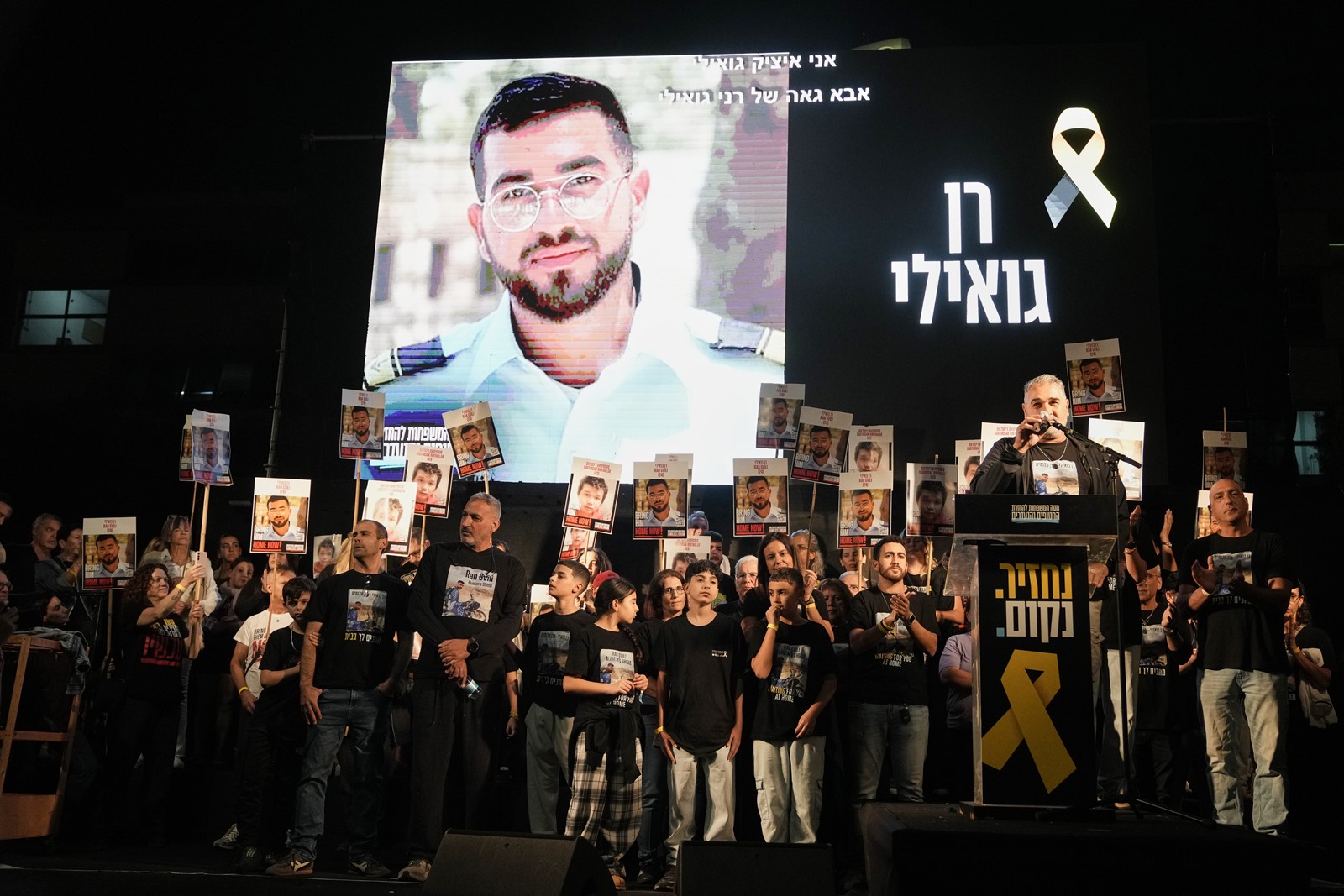


JERUSALEM — There were hundreds, then dozens, and then just a few. Now there’s one Israeli hostage left in Gaza: Ran Gvili.
Gvili, a 24-year-old police officer known affectionately as “Rani,” was killed while fighting Hamas militants during the Oct. 7, 2023, attack that triggered the war. After a series of ceasefire-mandated exchanges of hostages for Palestinians held by Israel, Gvili’s body still has not been recovered.
His remains are somewhere in Gaza. On Thursday, as Israel woke to the news that remains militants returned the previous day belonged to another hostage, the country mourned Gvili as a hero who died fighting to save a kibbutz that was not his own.
“The first to go, the last to leave,” his mother, Talik Gvili, wrote on Facebook Thursday. “We won’t stop until you come back.”
‘The Shield of Alumim’
At the entrance to Kibbutz Alumim, one of the many border villages militants attacked on Oct. 7, there is a sign emblazoned with a photo of Gvili smiling in his uniform, his name beneath it.
“He fought a heroic battle, saving the lives of the kibbutz members,” the sign says. “Since then he has been known as ‘Rani, the Shield of Alumim.’”
Unlike those from other Israeli kibbutzim targeted that day, the residents of Alumim survived. They credit that to men like Gvili, who joined a group of emergency response team members, soldiers and police officers who fended off waves of intruding militants.
Migrant workers on the kibbutz, however, met a different fate. Left exposed in agricultural areas outside the kibbutz’s defensive perimeter, 22 foreign nationals were killed, according to the Israeli newspaper Haaretz.
On the morning of Oct. 7, Gvili was at home, his younger sister Shira Gvili said in an interview with the AP. He had been on medical leave from his elite police unit for a broken shoulder.
Still, when he heard that gunmen were attacking panicked partygoers at the site of the Nova Music Festival, he headed straight for the venue grounds, along with other men from the unit. Nova later became the site of the largest civilian massacre in Israeli history, when the militants killed at least 364 people and took more than 40 hostage.
Gvili and the other officers never made it there, his sister said. Instead, they encountered the militants at Kibbutz Alumim.
Sgt. Richard Schechtman, a fellow police officer who also fought in the battle, said that Gvili appeared to immediately know what to do.
“Rani was at the head of the team — because that’s who he was,” Schechtman was quoted as telling the Israeli news site Ynet. “Rani and I were standing on the road. I saw the terrorists, but I hesitated because it was the first time in my life I’d ever seen a terrorist face-to-face, and I had a moment of, ‘Wait, what am I seeing?’ Then Rani pulled the pin and opened fire — and the whole team followed him.”
 PREVIOUS ARTICLE

