


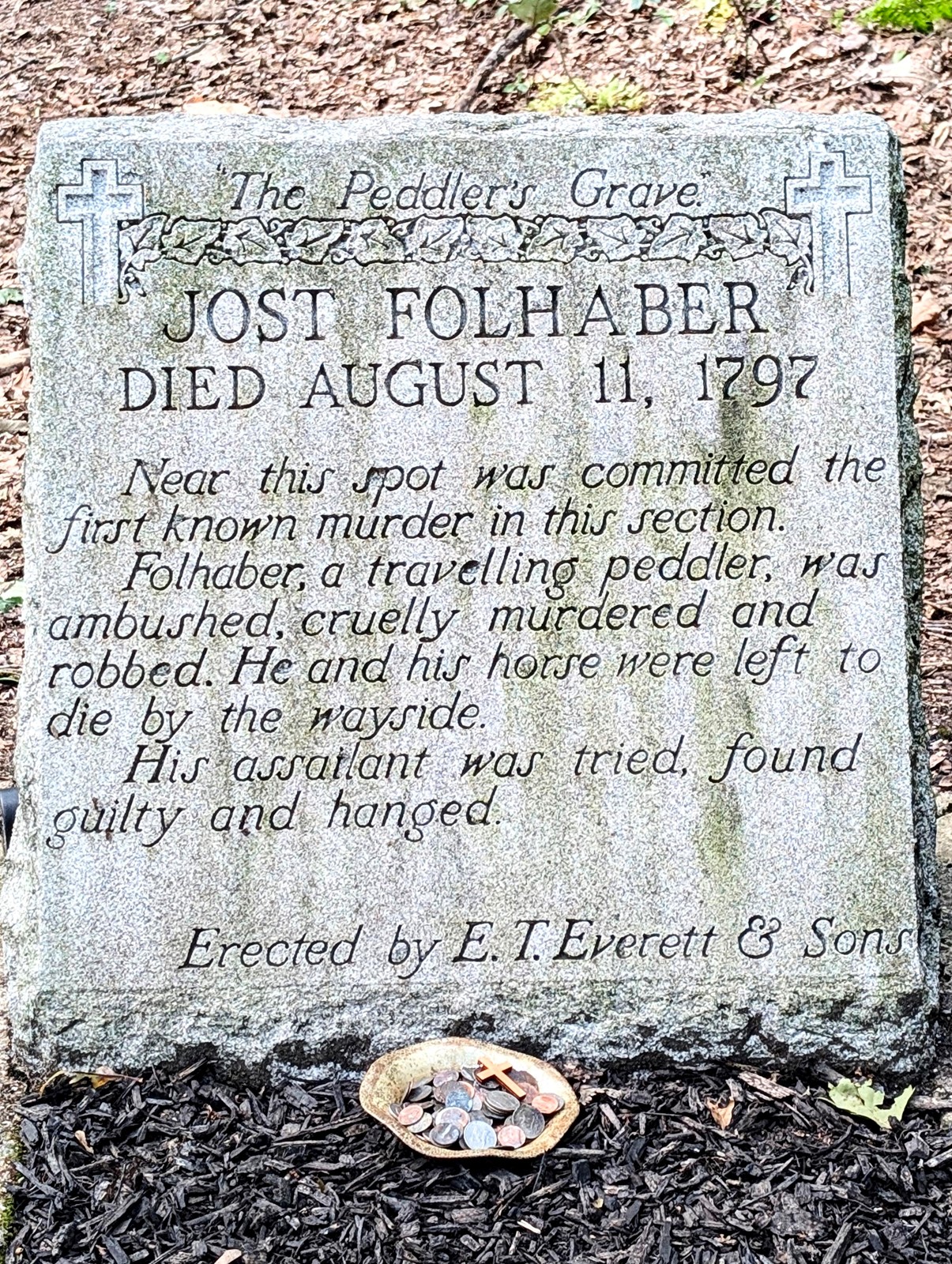


On Aug. 11, 1797, when America was in its infancy and John Adams was president, a peddler named Jost Folhaber (Folhafer) was murdered in a remote area near Mahanoy City.
The vicious slaying is widely considered the first murder in Schuylkill County.
There’s a problem with that designation, however, a reader of this column recently pointed out.
At the time of the murder, Schuylkill was still part of Berks County. Indeed, Benjamin Bailey was tried, convicted and hanged for the murder of Folhaber in Berks County.
So, if Schuylkill did not become a county until 1811, 14 years after the slaying, how could the peddler’s murder be the first in Schuylkill County, the reader wondered.
Good question.
Unfortunately, we don’t have a good answer.
Maybe we should look at it this way: If it wasn’t the first, Folhaber’s was certainly the most publicized murder around the time Schuylkill separated from Berks County.
Whoever really is the county’s first murder victim has been buried in history, while Folhaber lives in legend and lore beneath a stone marked “The Peddler’s Grave.”
Erected by E.T. Everett & Sons, it reads: “Near this spot was committed the first known murder in this section. Folhaber, a traveling peddler, was ambushed, cruelly murdered and robbed. He and his horse were left to die by the wayside. His assailant was tried, found guilty and hanged.”The gravesite, located in a wooded area near a reservoir in Mahanoy Twp., is marked with a wooden sign that reads “The Peddler’s Grave.”
A Pottsville Republican article, written by Liz Evans in 1994, suggests Folhaber achieved a status in death that he lacked in life.
“The peddler’s luck and life were short-lived, yet it seems his grave is blessed,” it reads. “It has been preserved for nearly 200 years by a protective community.”
Make that 228 years.
Judge D. G. Henning struck a similar tone in “The German Peddler’s Grave,” a lengthy article he read to the fledgling Schuylkill County Historical Society in 1905.
“No ploughshare will ever mar this turf that wraps his clay,” said Henning, who spells the peddler’s name Folhafer. “It’s silent sentinels, the old gray rocks and the majestic tall oaks and pines, the very solitude of the forest would stay the hand of sacrilege.”
In the Republican article, Evans describes a grueling 45-minute walk to reach the gravesite.
Reaching it on a hot summer day, she likens it to an oasis “as it may have felt for Folhaber.”
A peddler of pots and pans, Folhaber had stayed the night at Reich’s Tavern in Mahanoy City, where he met Bailey, a New Jersey resident on a hunting trip to the region.
In the morning, Folhaber set off for Ringtown with his wares, his horse and five pounds, about $25, in copper coins. Bailey had left prior to Folhaber.
Headed toward Brandonville, Folhaber stopped to rest at Waste House Run, the Republican reported.
Bailey shot Folhaber, threw him over his horse and took him to a remote spot off the trail. Two weeks later, Folhaber’s partially decomposed body was found. His wares and profits were gone.
Bailey was eventually caught around Easton with some of Folhaber’s possessions.
Little is known about Folhaber, except that he was from Berks or Northampton County. His age is unknown. He had a wife named Margaret Lindenmuth Folhaber, who never accompanied him on his trips, and a sister in Roaring Creek, north of Centralia.
An original headstone was erected by Frank Theil, Ed HIllbush, Joseph Troy and Frank Benedict. It was replaced by the stone from Everett & Sons, Mahanoy City monument makers.
The tale of The Peddler’s Grave has been told many times in newspaper articles, essays and blogs. Some say Folhaber’s ghost appears astride his horse, pots clanging, each year on the anniversary of his death.
In his 1905 account, Judge Henning talked of the “Whoo-Whoo” of night creatures awakening “the hermit of the mountain from his slumber.”
Berks County Judge Rush’s words to the condemned man about to enter eternity, related by Henning, are far more chilling than a spectre emerging from the mist on Mahanoy Mountain.
“Weep, I say, over the blood of Folhaber,” the judge pleaded, “for if you go out of this world with his blood on your conscience it will torment you and wring your soul with unceasing agonies and horror.”
Benjamin Bailey, 31, repentant or not, was hanged before police, militia and 6,000 spectators in Reading on Jan. 6, 1798.
 PREVIOUS ARTICLE

