


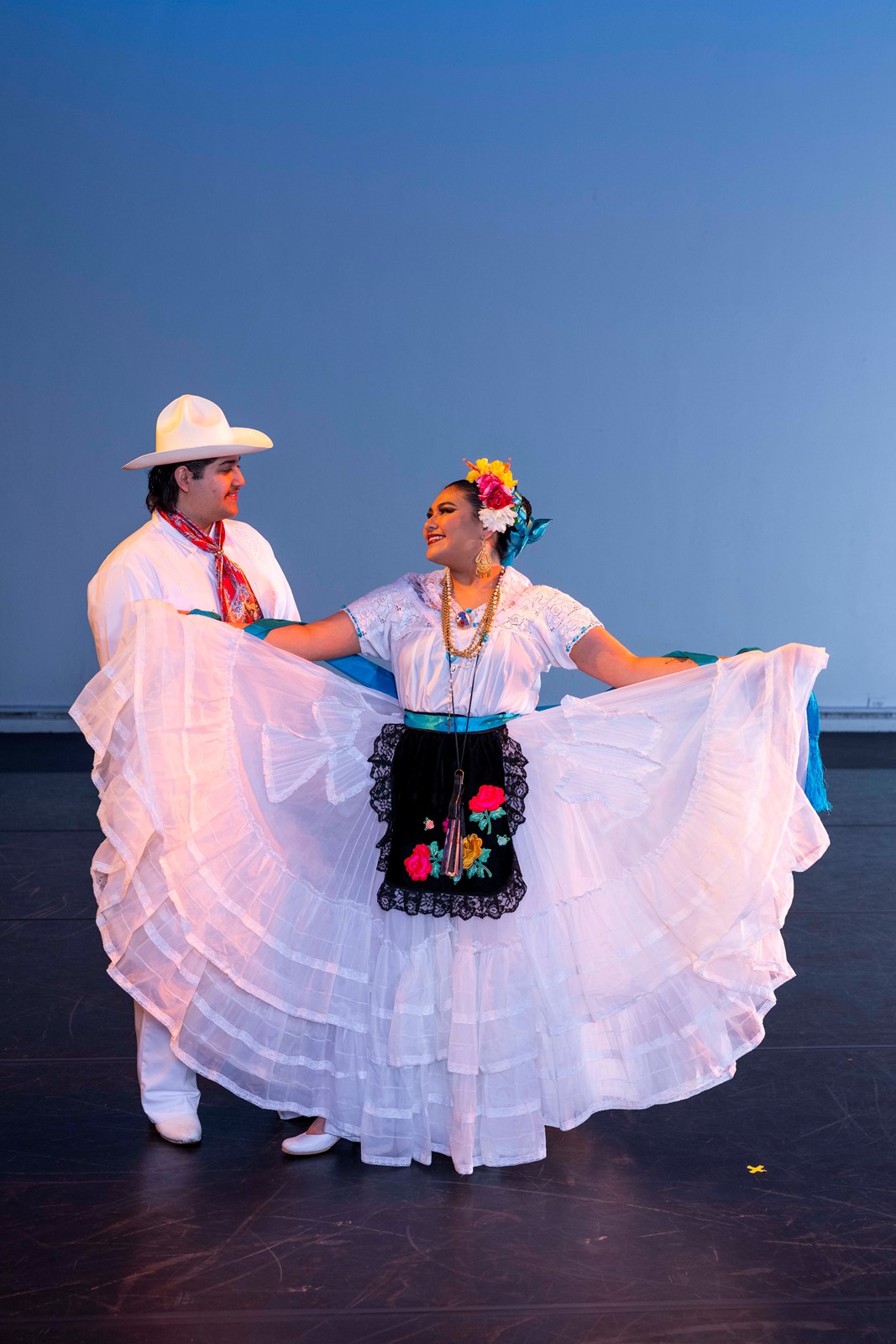


In 2023, the Cal Poly Humboldt Dance Program held its first ever “Fiesta Folklórica” on campus in the Gist Hall Theatre. It was the first time the show, now known as the “Fiesta Folklórica” brought Danza Azteca and Ballet Folklórico de Humboldt together to perform.
That first year, and in 2024, the performance was so popular that for the third annual “Fiesta Folklórica,” the performance will take place at the John Van Duzer Theatre at Cal Poly Humboldt. Directed by Linda Maxwell and Jacqueline Silva, “Fiesta Folklórica” is, according to Silva, “a celebration of Mexican culture and an opportunity to bring our community together. We have dances from eight different states of Mexico being represented on one stage, along with special guest performances from the Eureka High School LatinX Club: Folklórico Dancers and Ballet Folklórico Infantil de Arcata.”
The performances will take place Feb. 28 and March 1 at 7 p.m. and March 2 at 2 p.m. Purchase tickets online at tickets.humboldt.edu/dance-music-and-theatre. Tickets will also be available at the door. Tickets are $13 general, $8 for children and seniors and free for Cal Poly Humboldt students with ID.
The dance “Flor de Piña” is from the Mexican State of Oaxaca and represents the region of Papaloapan. There is a word in the Zapotec language, Guelaguetza, that means “offering.” The annual festivities in Oaxaca aim to show and “offer” the products of each region in the state. The dance was choreographed by Kelly Ramón and will be performed by dancers from Folklórico Infantil de Arcata and Eureka High School LatinX Club: Folklórico Dancers including Ella Ranario, 15, a student of Northern Union Humboldt Charter School and member of Folklórico Infantil de Arcata.
Ranario speaks of participating in Fiesta Folklórica: “I think it is so important to understand that cultures should be more inviting instead of being so separated. Dancing Folklórico as someone who isn’t Mexican, and coming in having no experience, I was immediately welcomed into it. It kind of just brings you another perspective of something so beautiful. These moments I’ve had provided an opportunity to learn about different traditions and customs.”
The state of Michoacán is well represented in the evening’s program. “Los Viejitos,” choreographed by Jeff O’Connor, a dance native to the Lake Patzcuaro in the Michoacán region, has been performed since before the conquest. The dancer carries a hewn wooden cane with the handle in the shape of a deer’s head resembling the staff of Tonacacihuatl — mother of the gods. The dance will be performed by Eureka High School LatinX Club: Folklórico Dancers and students from St. Bernard’s Academy.
Also directed by Jeff O’Connor and performed by the Fiesta Folklórica Ensemble, the most representative dances of the Michoacán region are the Jarabillo de Novios, Jarabillo de tres, La Costilla, and Los Arrieros. These dances give one a nostalgic taste of the life and customs of another time and express the pride and vibrance of these Indigenous peoples and their pas. The zapateados (footwork) that add accompaniment to the music are represented in all the dances.
One of the dancers, 20-year-old Yariana Esparza, a general biology major at Cal Poly Humboldt, said, “Culturally, participating in Fiesta Folklórica allows me to participate in a traditional dance that my mother and grandma couldn’t do due to finances. Being able to participate in Fiesta Folklórica shows them that I am proud of my culture.”
The state of Nuevo Leon is represented by a distinct form of music and dance that is different from the rest of Mexico. The reason is primarily geographical, as the culture that did come to Northern Mexico sifted down from the United States. The European dances that came with settlers to the United States in 1873 were the same dances that took root in northern Mexico: the contradanza, the chotis, polkas and mazurkas. The Eureka High School LatinX Club: Folklórico Dancers will perform “El Naranjo”, “El Cerro De La Silla” and “La Cápsula.” Choreography is taught by Jeff O’Connor with assistance from Xennia Arid Avendaño, Sergio Garza-Valencia and Alexis Quiros Arredondo.
Assistant choreographer Arrendondo spoke of her time working with the students: “I am grateful to have been allowed to work with Eureka High School group, seeing so much youth come together to display our culture and heritage warms my heart.”
“La Bruja”, “El Canelo” and “El Zapateado Veracruzano” are dances from the state of Veracruz. Choreographed by “Folklórica” director Jacqueline Silva, they will be performed by the Fiesta Folklórica Ensemble. The dances from Veracruz are a celebration of its life, history and diversity along with Spanish, African and Indigenous cultural influences.
Alexis Quiros Arredondo said about their favorite dance of the evening: “My favorite is Veracruz, the vestuario is so elaborate and makes me feel so beautiful. The music and dance is so magical and it always makes me feel like I’m floating when I hear the harp.”
The state of Zacatecas is a northern region of Mexico rich with dances influenced strongly by the Spanish. A relatively rich region noted for its silver and gold mining, the area’s dances showcase the strong use of zapateados. Traditional dresses include women with flowered skirts and matching colored blouses of a solid color, while the men typically wear solid pants with white shirts and scarfs around their waist. Director Linda Maxwell choreographed the dances “Mexicapan,” “Pulquette” and “Los Colorados.” The dance will be performed by the Fiesta Folklórica Ensemble.
Dancer Chancellor Arendt, 22, a marine biology major at Cal Poly Humboldt, said, “My favorite part about participating in Fiesta Folklórico is learning more about the culture, the new connections with people and coming closer as a family. Each night of rehearsal always brings smiles and laughs. It feels like we are always celebrating and coming together.”
The evening will also feature performances by the Fiesta Folklórica/Danza Azteca Ensemble. Danza Azteca is a cultural dance tradition practiced throughout the country of Mexico. Its origins date back thousands of years to ancient Mesoamerican ceremonies of Mexico and Central America. The dance “Fuego” honors the element of fire and reminds one of the responsibility to use the gift correctly. “Antigua” is the reenactment of a warrior’s preparation for battle by asking that the powers of the forces of nature be with him: fire, rain, wind and earth. “Aguila Blanca” tells a portion of one of the creation stories where eagle and jaguar battle. Danza Azteca is choreographed by Elizabeth Rivera, Naeem Tiacauh, Ayotl Alston, and Ramon Ramirez with drumming by Naeem Tiacauh, Ayotl Alston and Jude Royal.
The state of Jalisco is home of the songs and dances of Guadalajara. The lyrics and movements of the songs and dances depict country life in general, and often use imagery of the courtships of the animals as a metaphor for the relationships of people. The themes are of love, humor and tragedy. Choreographed by Jeff O’Connor and Jacqueline Silva, the dances include “Las Alazanas” performed by Ballet Folklórico Infantil de Arcata, “El Gavilancillo,” “El Gusto” and “El Son De La Negra” performed by Ballet Folklórico de Humboldt, and “Jarabe Tapatio” performed by the Fiesta Folklórica Ensemble and Eureka High School LatinX Club: Folklórico Dancers.
The dancers, directors and choreographers of the Fiesta Folklórica want everyone to know how important this performance is for the community. Alexis Quiros Arredondo says, “In a world where people who look like me and my peers are detained and deported for being brown and having specific features it is important to be in spaces that celebrate and empower each other. We have so many different backgrounds in our group and have created connections within the university but also in the community. Folklórico is an important part of my life, I have danced for about 15 years and don’t plan on stopping anytime soon.”
 PREVIOUS ARTICLE
