


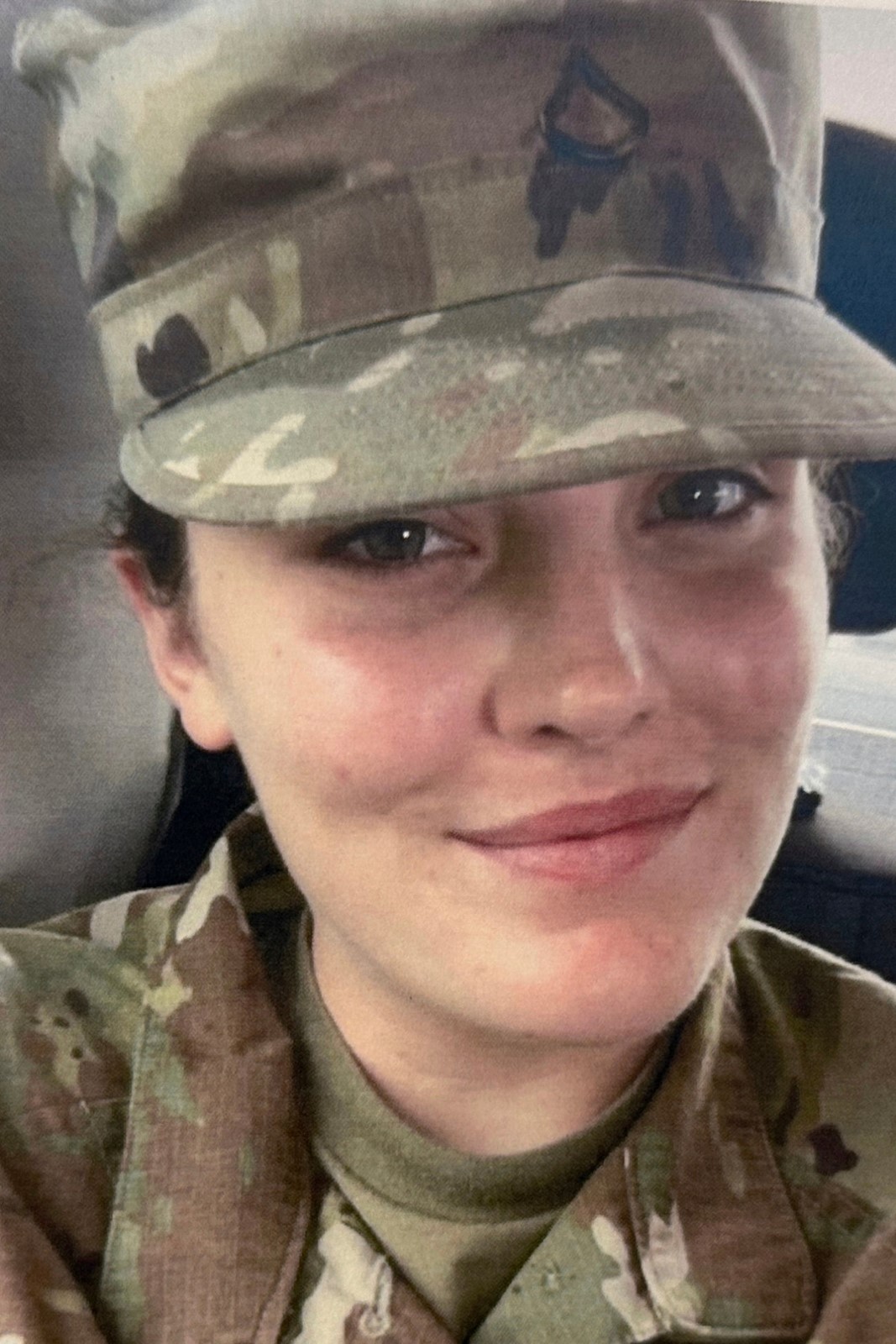


One of the two West Virginia National Guard members shot while on patrol near the White House died Thursday, as an angered President Donald Trump seized on the suspect’s background to pledge even more severe restrictions on immigration.
The guard member, Army Spc. Sarah Beckstrom, 20, of Summersville, West Virginia, underwent emergency surgery after Wednesday’s shooting but did not survive. “This is not the result we hoped for, but it is the result we all feared,” Gov. Patrick Morrisey of West Virginia wrote on the social platform X.
The other victim, Air Force Staff Sgt. Andrew Wolfe, 24, of Inwood, West Virginia, remained in critical condition. At his home, a man who answered the door said that “all we need right now are prayers for my son.”
The suspect, Rahmanullah Lakanwal, 29, is an Afghan immigrant, and during the United States’ two-decade war in Afghanistan, he had been a fighter in a CIA-backed Afghan “partner force” in the southern province of Kandahar, a stronghold of the Taliban insurgency. Like many thousands of Afghans who assisted the United States, he was allowed to immigrate to the United States after its chaotic 2021 pullout, and he settled with his wife and children in Washington state.
Jeanine Pirro, the U.S. attorney in Washington, D.C., said at a news conference Thursday that Lakanwal had driven across the country planning to commit an attack, which Trump described as an “act of terror.”
Around 2:15 p.m. Wednesday, Lakanwal walked up to the two guard members and pulled out a .357 revolver. He shot one of the guard members, who fell and was shot again by Lakanwal, Pirro said. He then turned to fire at the second guard member.
After the shooting, other guard members subdued Lakanwal, who remained in the hospital Thursday.
Before Beckstrom died, Pirro said that Lakanwal would be charged with three counts of assault with intent to kill. He will now likely be charged with first-degree murder, with potential eligibility for the death penalty. Trump, in announcing Beckstrom’s death, called Lakanwal a “monster.”
What could have driven him to fire upon the two guard members is unclear. But the war he took part in continues to haunt those who fought in it, and to echo across American politics.
After the shooting the Trump administration, which has already blocked most refugees from coming to the United States, further escalated its efforts to crack down on immigration.
It moved to suspend the processing of immigration applications for Afghans already settled in the United States. The administration said it would also review all asylum applications granted by the Biden administration.
And the director of U.S. Citizenship and Immigration Services, Joseph B. Edlow, wrote on social media that, at the direction of Trump, his agency would reexamine “every green card for every alien from every country of concern.” A green card grants an immigrant the right to live in the United States permanently.
The agency later said that those countries were the 19 that Trump had subjected to a travel ban in June, among them Afghanistan, Libya, Iran and Haiti.
Lakanwal was granted asylum by the Trump administration in April, according to three people with knowledge of the case. They spoke on the condition of anonymity because they were not authorized to speak publicly.
Many Afghans who arrived after their country fell to the Taliban remain in immigration limbo without permanent status, which could put them in jeopardy of eventual deportation.
As he has amid past spates of violence, Trump blamed his predecessor, former President Joe Biden, while also highlighting his own aggressive enforcement of immigration law.
“We must now reexamine every single alien who has entered our country from Afghanistan under Biden,” Trump said Wednesday in remarks from Florida, “and we must take all necessary measures to ensure the removal of any alien from any country who does not belong here or add benefit to our country.”
On Thursday, Tricia McLaughlin, a Homeland Security Department spokesperson, accused the previous administration of failing to vet the applicants “on a massive scale.”
 PREVIOUS ARTICLE
