


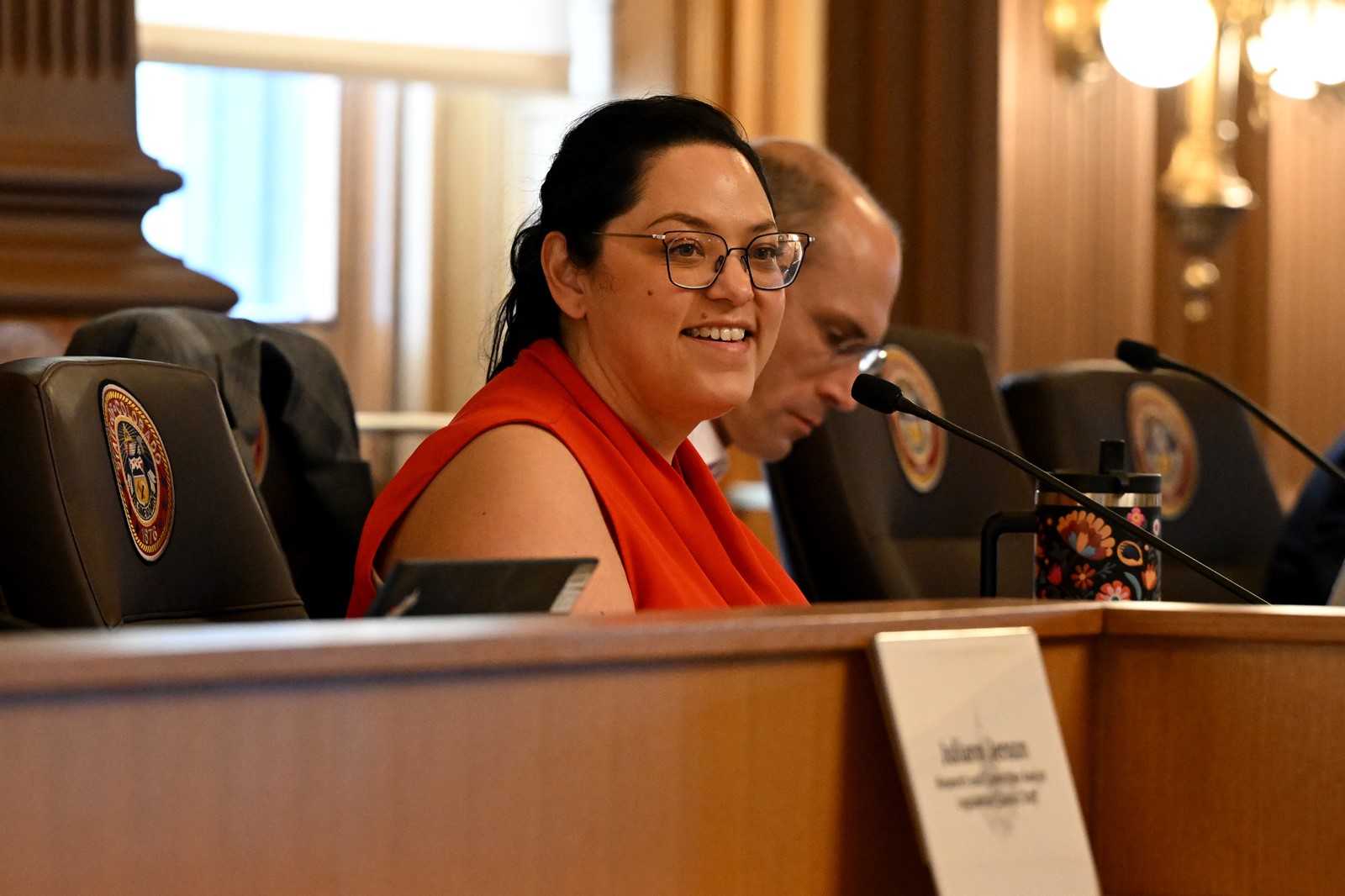


State Sen. Julie Gonzales launched a campaign Monday to unseat U.S. Sen. John Hickenlooper in next summer’s Democratic primary, joining a growing roster of challengers seeking to reorient an unsteadied party establishment.
Gonzales, who represents north, west and parts of downtown Denver, is one of the legislature’s most progressive members. The fate of her U.S. Senate candidacy will depend on how much the rising tide of Democratic discontent has reached Colorado — and whether the swell can sink one of the state’s most established politicians.
“We have seen so many communities being impacted by (President) Donald Trump’s corporate cronies treating our government like a piggy bank for their bottom lines, while millions of American families, and certainly families all across the state, are just trying to make ends meet,” Gonzales said in an interview ahead of her formal announcement. “And there has not been a response from the Democratic Party to be able to ensure that we are fighting back, using all the tools we have available to us.”
She’ll take on Hickenlooper in the Democratic primary in June as he pursues his second — and what would be his final — term in the U.S. Senate. Hickenlooper is a former two-term Denver mayor, two-term governor and one-time presidential candidate with near-universal name recognition in the state and formidable financial resources. What’s more, his supporters have been trying to fortify him against a primary challenge since the late summer.
The race will test whether that prominence is a bulwark or an albatross. Polls show Democratic voters are unhappy with the party’s direction and, in Colorado, half-hearted in their support of Hickenlooper and other politicians.
In a statement Monday morning, Hickenlooper spokesperson Jess Cohen did not directly address Gonzales’ candidacy.
“Senator Hickenlooper is focused on delivering for Colorado,” Cohen wrote. “He helped defeat the Trump and MAGA plan to auction off our public lands and is relentlessly fighting to lower costs for working families. John Hickenlooper has spent his time as mayor, as governor and as U.S. senator uniting us, and now fighting against the illegal chaos and outright corruption that has come to define MAGA and our President.”
Gonzales represents a credible threat to Hickenlooper, said Seth Masket, a political scientist at the University of Denver.
“This is a state senator, this is someone who has a following and can raise money,” he said Monday. “I still don’t get the impression that Hickenlooper is in a whole lot of trouble in the primary, but I think this is more emblematic of a lot of the Democratic base’s frustration with many centrist incumbents.”
If she beats Hickenlooper, Gonzales would be in pole position to become Colorado’s first female U.S. senator. Gonzales, 42, said her decision, which has been rumored for weeks, was solidified after last month’s elections.
In New York City, “Zohran (Mamdani) is a demonstration of what can happen when you reengage people who either have been tokenized or forgotten altogether by the Democratic Party,” she said. The left-wing state lawmaker’s laser focus on affordability helped him become mayor-elect of America’s largest city.
But Mamdami’s win wasn’t as impactful on her decision, she said, as progressive wins on Aurora’s City Council and Denver’s school board, plus the toppling of the Douglas County school board’s conservative majority.
Gonzales framed the race as a choice for a party at a crossroads: more “poll-tested incrementalism,” as she put it, or “a fighter who is clear in her values, who has a track record of taking on big fights and winning.”
Though she’s the most prominent, Gonzales is not the first Democrat to challenge Hickenlooper this year. She joins other candidates who include Karen Breslin, a political science professor and attorney; Brashad Hasley, a Navy veteran and software engineer; and A.J. Zimpfer, an accountant.
Gonzales was born to a big family on an Apache reservation in Arizona, where she spent her early childhood before moving to South Texas. She attended Yale University and, after graduating, moved to Denver to work as an organizer.
She later worked for a prominent immigration law firm before winning a state Senate seat in 2018. Her political resume includes a slew of laws intended to improve tenant protections in housing and to limit what kinds of information can be shared with federal immigration authorities.
Gonzales sponsored gun-control legislation earlier this year that put limits on sales of a swath of semiautomatic firearms, and she served as a primary sponsor of a 2022 bill that enshrined access to abortion services in state law, several weeks before the U.S. Supreme Court struck down Roe v. Wade. The state’s voters later elevated that right to the state constitution.
As she eyes a seat in a different Senate, Gonzales lists universal health care and universal child care as core policy goals, in a rejoinder to moderate Democrats’ incrementalism.
She blasted Hickenlooper for voting earlier this year to confirm Trump cabinet picks like Brooke Rollins, the Agriculture secretary whose office recently threatened to withhold funding from Democratic-led states that wouldn’t turn over immigration-related information on food assistance recipients. Hickenlooper has voted to confirm 10 Trump cabinet picks in all, tying with several other senators for the most among Democrats, according to CBS News. (U.S. Sen. Michael Bennet wasn’t far behind, with eight.)
But as Democrats faced pressure from the base not to cave to Republicans, Hickenlooper did not join the handful of Democratic colleagues who supported a stopgap spending measure in May and a November measure that ended this fall’s record-long partial government shutdown.
Gonzales faces a difficult road against the 73-year-old senator, who returned to elected office in 2020 by dislodging then-U.S. Sen. Cory Gardner, the last Republican to hold a major statewide office.
A November poll that showed Hickenlooper’s net favorability slipping — from positive 13 to 5 percentage points — also noted that only 6% of Coloradans didn’t know who he was, pointing to near-universal name recognition, a factor that’s often decisive. He’s also already amassed a significant war chest to buttress his reelection defense: more than $3.6 million in the bank, as of the end of September.
His most prominent Republican opponent thus far is Janak Joshi, who’s lost several successive races, most recently a 2024 congressional primary.
Barring a late Republican entry, Hickenlooper’s most serious threat may well come in the primary election next June, which will be decided by Democratic and unaffiliated voters. If he prevails, he won’t need to hoard cash for the November general election.
 PREVIOUS ARTICLE
