


Air quality here trending upward
Experts from EPA describe how air quality monitored
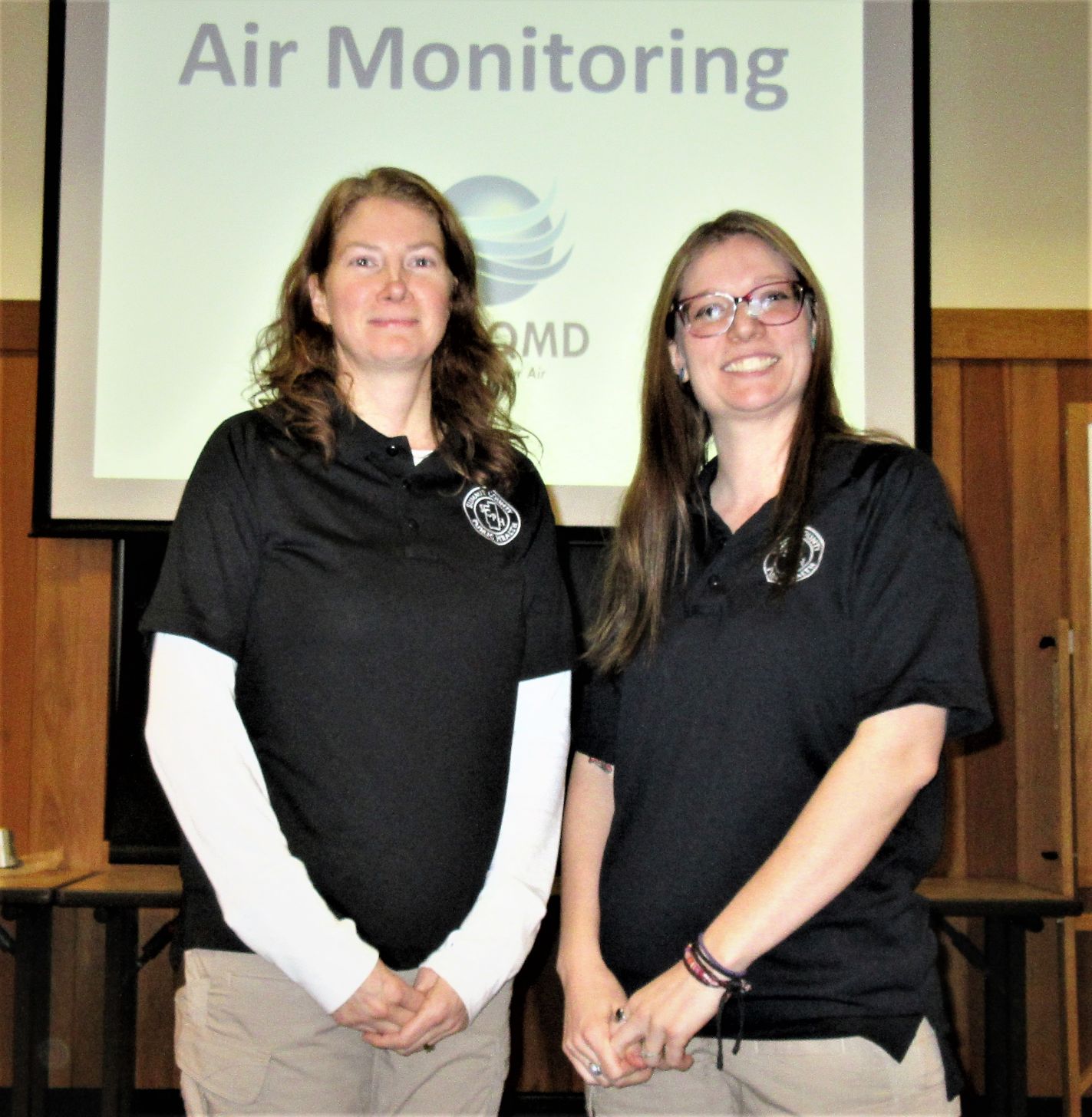
Nicole Bradley (left) and Samantha Mellott, who maintain air quality monitors for the Akron Regional Air Quality Management District, talk about air pollution during a program sponsored by the Medina County Park District. Photo by GLENN WOJCIAK


SHARON – Air quality in Medina County is “good” and has been getting better for three or four decades.
The people responsible for measuring air quality in our region work for the Akron Regional Air Quality Management District and two of them took time away from their daily jobs to describe their work to a small gathering attending their talk at Wolf Creek Environmental Center.
The event was part of a lecture series hosted regularly by the Medina County Park District.
Samantha Mellott and Nicole Bradley are scientists responsible for maintaining air quality monitors placed in Summit and Portage counties as well as one near Chippewa Lake in Medina County.
Those monitors measure the ambient air concentrations for four U.S. Environmental Protection Agency criteria pollutants: carbon monoxide, sulfur dioxide, ozone, and fine particulate matter. With these measurements, an air quality index is created twice daily at 8 a.m. and 4 p.m.
The index measure for the district was 37 March 9, the day Mellott and Bradley presented their lecture at Wolf Creek. Any measure between 0 and 50 is considered “good” on a six-step scale which ranks the agency’s level of concern about air quality.
Other steps on the scale are moderate (51-100), unhealthy for sensitive groups (101-150), unhealthy (151-200), very unhealthy (151-200), and hazardous (301-500).
Air quality is affected by weather and the AQI index here typically increases in the summer when stronger sunlight raises ozone levels near the 70 threshold, which is considered above the recommended standards for our region.
According to Mellott, high heat and other atmospheric conditions usually result in a few days each summer when ozone levels climb high enough for ARAQMD to issue warnings that air quality could pose a health risk to sensitive groups.
However, AQI levels in recent years are usually in the good to moderate range. That’s a significant improvement from the 1980s when records indicate air quality in northern Ohio often climbed into the unhealthy range.
For instance, air quality in the Akron area was considered good or moderate all but one day in 2016 when it was considered unhealthy for sensitive groups. In 1980, air quality was considered very unhealthy on two occasions, unhealthy on 57 days and unhealthy for sensitive groups on 171 days.
By comparison, Los Angeles County recorded two days that air quality climbed into the very unhealthy range last year, nine days that were unhealthy and 31 days in which it was unhealthy for sensitive groups. The AQI exceeded 450 (hazardous) in some parts of China last year and Greenpeace reports air pollution in India is worse than China.
ARAQMD was created in 1965 as a division of the Akron Health Department and later became an affiliate of the Ohio Environmental Protection Agency. Its mission is to protect the public from the adverse health impacts of air pollutants and to educate the public about air quality issues.
Bradley said air pollutants can have adverse effects on health and people under 14 years of age and over 65 are most susceptible to its affect. When pollution is bad, it can irritate your eyes, nose and throat, cause shortness of breath, aggravate asthma and other respiratory conditions, and even affect your heart and cardiovascular system.
Some now believe air pollution can also contribute to other health problems that are not associated with the respiratory system. For instance, a study published in the Lancet found people living close to major traffic arteries are more likely to be diagnosed with dementia.
The people responsible for measuring air quality in our region work for the Akron Regional Air Quality Management District and two of them took time away from their daily jobs to describe their work to a small gathering attending their talk at Wolf Creek Environmental Center.
The event was part of a lecture series hosted regularly by the Medina County Park District.
Samantha Mellott and Nicole Bradley are scientists responsible for maintaining air quality monitors placed in Summit and Portage counties as well as one near Chippewa Lake in Medina County.
Those monitors measure the ambient air concentrations for four U.S. Environmental Protection Agency criteria pollutants: carbon monoxide, sulfur dioxide, ozone, and fine particulate matter. With these measurements, an air quality index is created twice daily at 8 a.m. and 4 p.m.
The index measure for the district was 37 March 9, the day Mellott and Bradley presented their lecture at Wolf Creek. Any measure between 0 and 50 is considered “good” on a six-step scale which ranks the agency’s level of concern about air quality.
Other steps on the scale are moderate (51-100), unhealthy for sensitive groups (101-150), unhealthy (151-200), very unhealthy (151-200), and hazardous (301-500).
Air quality is affected by weather and the AQI index here typically increases in the summer when stronger sunlight raises ozone levels near the 70 threshold, which is considered above the recommended standards for our region.
According to Mellott, high heat and other atmospheric conditions usually result in a few days each summer when ozone levels climb high enough for ARAQMD to issue warnings that air quality could pose a health risk to sensitive groups.
However, AQI levels in recent years are usually in the good to moderate range. That’s a significant improvement from the 1980s when records indicate air quality in northern Ohio often climbed into the unhealthy range.
For instance, air quality in the Akron area was considered good or moderate all but one day in 2016 when it was considered unhealthy for sensitive groups. In 1980, air quality was considered very unhealthy on two occasions, unhealthy on 57 days and unhealthy for sensitive groups on 171 days.
By comparison, Los Angeles County recorded two days that air quality climbed into the very unhealthy range last year, nine days that were unhealthy and 31 days in which it was unhealthy for sensitive groups. The AQI exceeded 450 (hazardous) in some parts of China last year and Greenpeace reports air pollution in India is worse than China.
ARAQMD was created in 1965 as a division of the Akron Health Department and later became an affiliate of the Ohio Environmental Protection Agency. Its mission is to protect the public from the adverse health impacts of air pollutants and to educate the public about air quality issues.
Bradley said air pollutants can have adverse effects on health and people under 14 years of age and over 65 are most susceptible to its affect. When pollution is bad, it can irritate your eyes, nose and throat, cause shortness of breath, aggravate asthma and other respiratory conditions, and even affect your heart and cardiovascular system.
Some now believe air pollution can also contribute to other health problems that are not associated with the respiratory system. For instance, a study published in the Lancet found people living close to major traffic arteries are more likely to be diagnosed with dementia.