


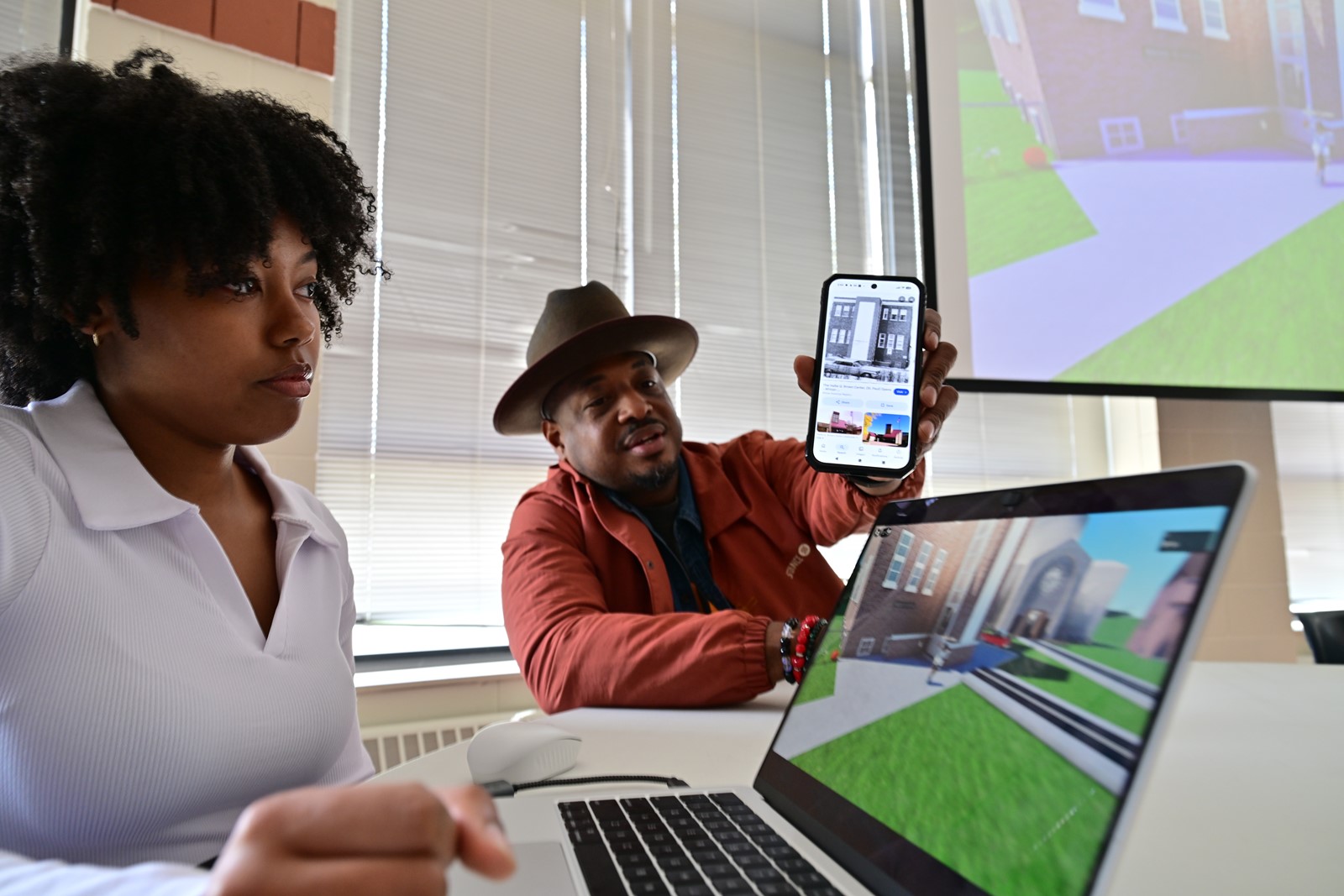


In the decades since Interstate 94 split St. Paul’s historic Rondo neighborhood, community leaders have worked to share the neighborhood’s story with younger generations.
So when Macalester College student Jolie Davis had a 10-week fellowship last summer to work on a project with Hallie Q. Brown Community Center executive director Benny Roberts, the two came up with an idea to do just that.
Davis, a sophomore biology major with a studio art minor, and Roberts decided to show Rondo before and after the development of I-94 through an immersive video game experience in Roblox. Roblox is a popular gaming platform where users can create their own games they can play.
They knew it’s a concept that kids are familiar with and wanted to build a virtual world that would be educational. They named it “Rondo-Verse,” a nod to Marvel’s series of movies about the “Spider-Verse” where characters travel across other universes.
“It’s like, let’s do the ‘Rondo-Verse,’ so it’s like the same neighborhood over dimension and time,” Roberts said. “And so they’ll learn the history, but then let’s create the same neighborhood, but the current version of it. And so we decided to use the highway as a portal. As opposed to being the tool for destruction of this community, we wanted to make it the vehicle for the future so you can see what exists today.”
Davis said it took around two days to work on each building last summer, often using photos as references and learning from YouTube tutorials.
Entering the game
When players enter the game, they’ll find themselves surrounded by several buildings, each with a different focus on the history of Rondo. Descriptions appear on the screen when players enter the buildings or approach real-life photos decorating the walls.
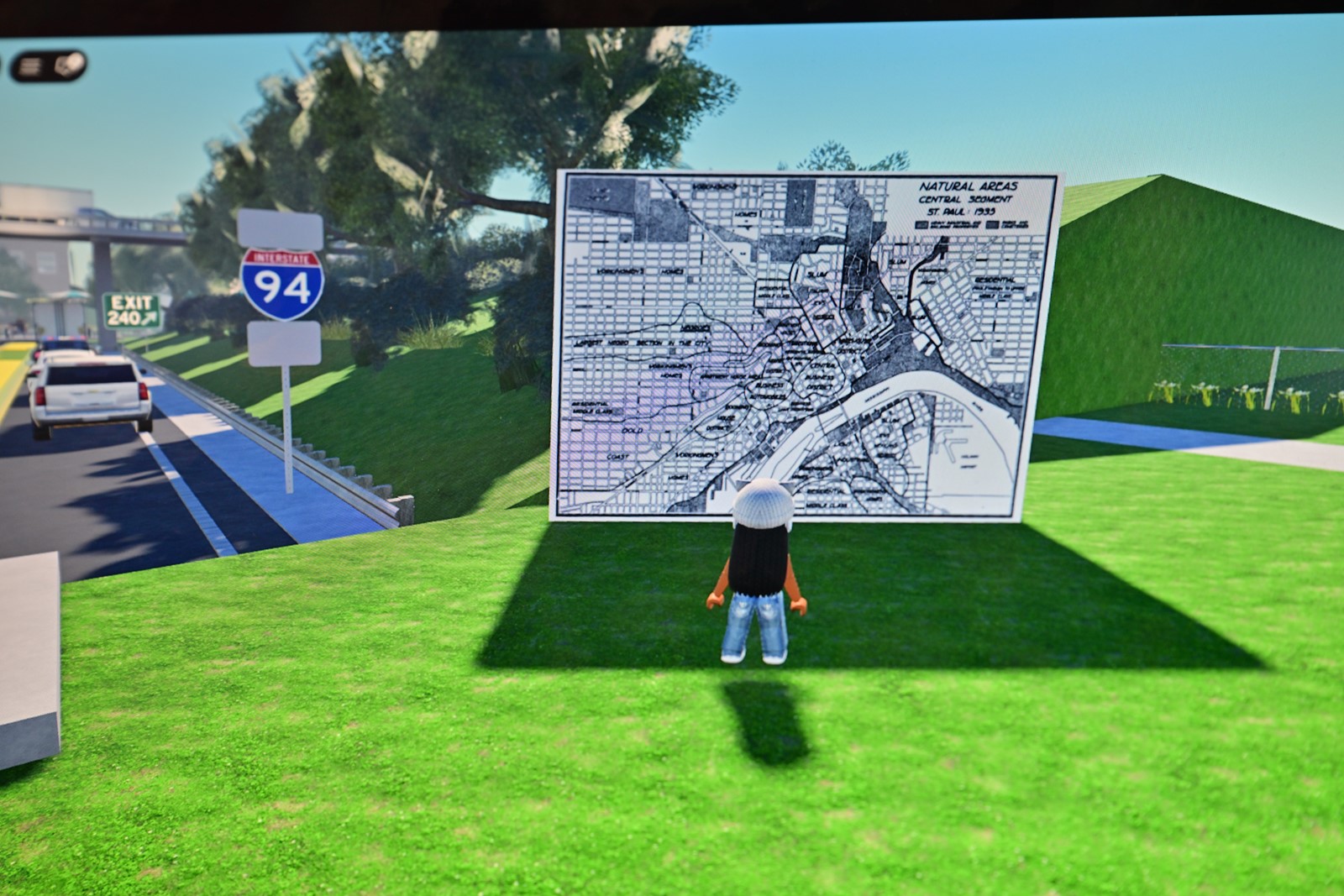
They tell the history of education, religion, business, affinity groups and Hallie Q. Brown in the historically Black neighborhood. Outside the buildings, they’ll also see a highway, leading to Rondo after 1971. Vintage cars drive toward the past version of Rondo and modern cars drive toward the modern-day version of Rondo.
“And then there’s a map right outside the highway, in which we try to give people context about urban developments and how they impacted communities across the country,” Roberts said, “And so, oftentimes when people talk about our community, they reduce it to like the highway and what happened with the highway installation. And we hope that people gain from this game not just knowing the deficit of this community but also the assets of them.”
When Interstate 94 was built in 1956, one in every eight African Americans in St. Paul lost a home, and many businesses never recovered, according to the Rondo Center of Diverse Expression.
Historic features
To understand the history of Rondo and what the game should feature, Davis and Roberts met with a focus group of around 15 community members in their 70s, 80s and 90s. They then asked them to think of the Rondo they grew up in and what the top five features of it should be in the game.
“We want people to understand the story, the value of it, but also what makes Rondo special from all the other communities is; we’re actually one of the ones that remained intact after the (freeway) installation,” Roberts said. “And that’s largely due to a lot of the folks that had input on this game because they’ve been the ones picking up this fight for us to know this story and its history, and everyone’s alive to see all the changes including the renaming of the street, the purchasing of the Sears site, the building of this game, and the sustaining of Hallie Q. Brown, all anchor things for them.”
In the education building on the side of the past, visitors enter a classroom decorated with historical photos of educational hubs of Rondo. Game avatars for photographer/author/director Gordon Parks and track coach Henry Combs stand at the front of the classroom. Another building features popular affinity groups residents took part in. The game’s religious center features historic churches in the community and highlights the significance of church institutions in Black history after the Civil War.
The Hallie Q. Brown building features an avatar for Alice Sims Onque, a previous community center director. Other avatars featured throughout the game include educator Shirley Kaiser, Central Senior High School principal Cherise Ayers, St. Paul Deputy Fire Chief Jamie Smith and others.
As part of her capstone project, Davis showed the game to the focus group, Macalester faculty members and others. Davis will take part in the fellowship again this year so she and Roberts have worked together to share it with others.
Gamifying the experience
They hope to eventually “gamify” the project to encourage players to learn more and have fun.
The two also gave tours of the game to students in the Mounds View Public Schools district and are connecting with other schools that may incorporate it into their curriculum.
Davis, who is from St. Paul’s East Side, said she didn’t know much about Rondo and learned a lot from working on the project.
“I’ve heard of Rondo before and the history, but I feel like that’s like with a lot of people outside of Rondo. All you know is the highway,” Davis said.
“And so I feel like coming here to Hallie was really beneficial for me so I’m not having those outsider lenses when I’m looking at the community. And not just like, ‘Oh, Hallie and Rondo, all it’s known for is the highway and destruction.’ (There’s a) rich community that lives here and … it’s growing. It’s still thriving.”

