


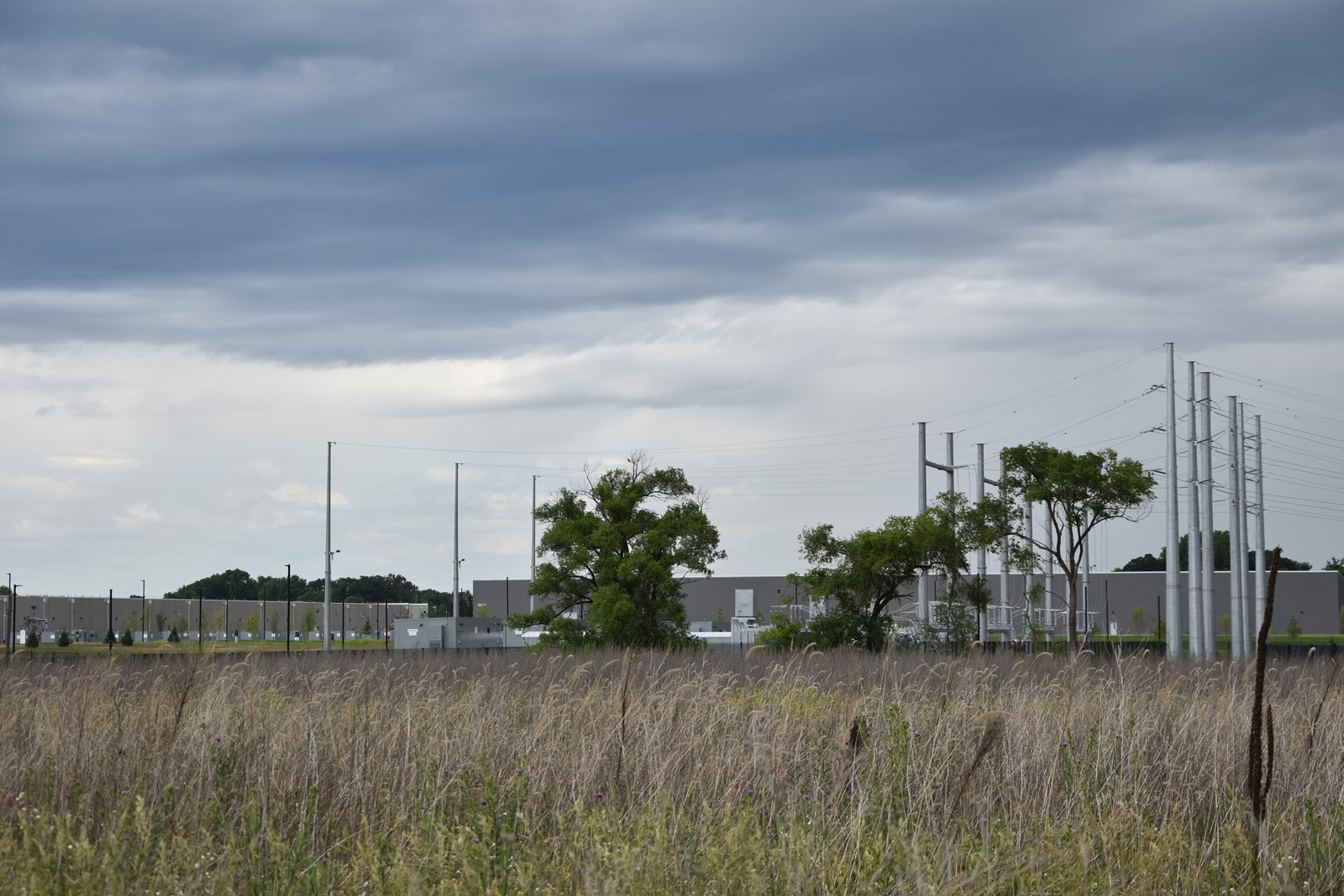



As Big Tech companies look to Minnesota to build hyperscale data centers, how to handle those projects is emerging as a campaign issue in both the governor and U.S. Senate races.
Only one hyperscale center is set to open in Minnesota this summer, as many of the other projects have stalled or been challenged with lawsuits. The prospect of the massive facilities has drawn both support and opposition from Minnesotans, and lawmakers on both sides of the aisle have carried legislation on data centers.
A clear bipartisan effort on data centers emerged in the 2026 legislative session with banning non-disclosure agreements, but that bill died. Some policy on data centers has fallen more along party lines: tax breaks or eased permitting primarily with Republicans, and full-blown data center moratoriums with Democrats. Those efforts also died at the Legislature.
With some data centers powering AI, state lawmakers have also observed the increased presence of the Big Tech lobby at the Capitol as they take up social media and data center legislation.
While most state efforts failed in 2026, lawmakers in 2025 successfully passed a standalone data center bill that included some environmental regulation, a repeal of a sales tax exemption on electricity, and a later expiration of sales exemptions on software and hardware.The federal government has yet to step in with new regulation on hyperscale data centers, but President Donald Trump has recently spoken out in support of development, saying “Let data reign.”
Here’s a look at what statewide candidates for governor and U.S. Senate say they would do about data centers if elected.
Governor candidates
“Transparency and community buy-in is essential for these projects,” Republican gubernatorial candidate Lisa Demuth said in a Sept. 9 statement.
“As speaker (of the Minnesota House), I negotiated bipartisan legislation that passed into law protecting Minnesotans’ energy bills and putting data centers on the same playing field as other businesses for their energy costs,” Demuth said. “As governor, I’ll sign legislation that would ban local governments from signing non-disclosure agreements with data centers proposed in Minnesota.”
The promise to sign an NDA ban is notable given that as recently as August Demuth wouldn’t answer whether she’d sign that bill.
In the 2026 session, the NDA bill saw unlikely partnerships between left and right lawmakers. The bill covered NDA use for local governments as a whole, but was born out of concern over Big Tech hiding under code names like “Project Bigfoot” and asking cities to sign NDAs.
The NDA bill suddenly died in the House Judiciary Committee after initial momentum. House authors of that bill said at the time they think it was a strategic kill from leadership influenced by the business lobby.
“I’m hopeful that leadership will represent the people of Minnesota instead of the special interest groups that have pushed back against this,” Rep. Drew Roach, R-Farmington, said April 14, shortly after it was voted down.
Roach didn’t say whether he meant the leadership of the Judiciary Committee or leadership of the House Republican caucus killed the bill.
But DFL author, Rep. Emma Greenman, DFL-Minneapolis, said Thursday that it was “clear that Speaker Demuth, Leader (Harry) Niska, and Chair (Peggy) Scott … had taken a position against this bill.”
“As speaker and as leader of her party, if she had supported this, she had every opportunity to bring this bipartisan bill to the floor and chose not to,” Greenman said.
Asked Thursday about the switch, Demuth said the transparency push is “what we’ve heard from communities.”
It’s not clear whether Demuth would support any kind of state environmental regulation. She said on Aug. 18 that “there’s a lot of misinformation when you hear the excess water usage or the excess power usage.”
Demuth does align on local authority with her opponent for governor, U.S. Sen. Amy Klobuchar.
“That is a local issue that needs to be fully vetted within the local areas where they are looking to go,” Demuth said on Aug. 18.
Klobuchar called out Demuth in a statement Wednesday and said her opponent “blocked” the nondisclosure agreements bill last session.
“As governor, my focus will be on making sure that Minnesotans — not Big Tech — have the final say on data centers, and that involves strong state standards and local control,” Klobuchar said. “If Minnesotans don’t want a data center in their community, I don’t want it there either.”
Klobuchar said she will make sure Minnesotans aren’t “getting hosed on their electric bills and that our state’s water is protected.” She would require any project to cover 100% of energy and grid costs.
The Minnesota Democrat also supports requiring developers to disclose things like electricity demand and water use before local approval, as well as requiring annual public reporting of those demands.
“I’ve led the effort in the Senate to take on Big Tech on anticompetitive conduct as well as holding them accountable for how their platforms affect kids and taking on the algorithms that are driving up prices for families and addicting children to their products,” Klobuchar said. “I won’t back down when it comes to protecting Minnesotans.”
Senate candidates
Lt. Gov. Peggy Flanagan, the Democratic candidate for U.S. Senate, has tended to emphasize Minnesotans not paying for the costs of Big Tech when she speaks about data centers. She’s also against major tax breaks for Big Tech.
“People across Minnesota are telling us they are freaked out about these massive, out-of-control data-center projects and Michele Tafoya’s response to folks is to just accept it and plant trees around them so they’re not an eyesore,” Flanagan said Wednesday. “I have a different take: Communities get to call the shots. Minnesotans decide, when, where and if data centers get built.”
Flanagan also thinks NDA use for data centers should be banned, that data centers should be built with union labor, and that they should meet Minnesota’s environmental standards.
In a primary debate with U.S. Rep. Angie Craig in July, Flanagan said data centers could be “an existential threat to us if it gets out of control.”
Tafoya, the Republican candidate for the U.S. Senate, said in a statement Wednesday that Minnesota should “welcome new economic growth, but these projects have to work for the communities where they’re being built.”
“Local residents, farmers and businesses deserve a real say in how a data center project will affect their power, water, roads, and property, and they certainly shouldn’t be left paying the bill,” Tafoya said.
That is an area where she and Flanagan appear to agree — not putting costs on Minnesotans. They also appear to agree on local say.
Tafoya’s campaign didn’t respond by the time of publication to questions for more specifics on whether she would support tax breaks for data centers, federally banning NDA use for data centers, or more environmental regulation.
She did say that “developers must be upfront about what they need, what incentives they’re receiving, and how they’ll cover the costs their projects create.”
“I’m all for bringing new investment to Minnesota, but it has to be done responsibly and with the people who live there at the table,” Tafoya said.
One notable omission from all four candidates: No one said they would support a statewide or federal moratorium on data center construction.
That’s not necessarily surprising, given that a moratorium bill didn’t receive a hearing last session — even in a DFL-controlled Senate.
A recent public poll from over 7,000 Minnesota State Fair attendees found that 48% of respondents said they support a moratorium, and 30% said the data centers should be banned altogether.
 PREVIOUS ARTICLE
